Ritchie, Richard Stephen (Steve)
- Service Branch: US Air Force
- Rank or Rate: Brigadier General
- Service Dates: 1964-1999
- Theater: Var/Vietnam
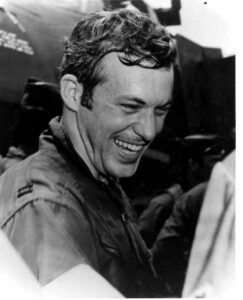
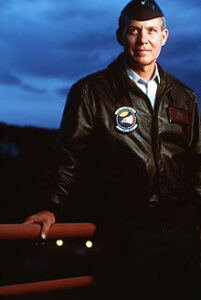
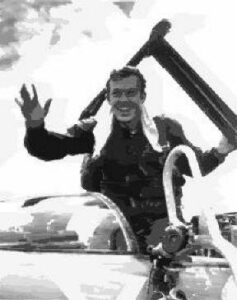 In all likelihood, there will not be another “ace” in aerial combat. General SteveRitchie is the last aviator to earn that distinction by shooting down five North Vietnamese MIG 21 aircraft in 1972.
Ritchie was born and raised in Reidsville. In high school days, he was the star quarterback on the Reidsville football team and a very good athlete. He credits Reidsville football coach George Wingfield with much of his desire and determination to succeed in life. Through a high school friend, Ritchie learned about the new Air Force Academy in Colorado and the adventures that it could offer. After graduation from high school in 1960, he received a nomination to attend the Academy and quickly accepted it, thus beginning a 39-year relationship with the United States Air Force. Ritchie retired from the Air Force reserve as a Brigadier General in 1999.
Life was rigorous at the Air Force Academy, but Ritchie believes his time there was an unmatched learning and character-building experience. Not long after arriving at the Academy in June 1960, Ritchie concluded he wanted to be a fighter pilot. He also wanted to continue to play football and “walked on” to an Air Force team that was new to collegiate ranks, the Academy having just graduated its first four-year class in 1959. The first four-year team was undefeated under legendary coach Ben Martin and ranked 10th in the nation. Ritchie had built up his strength and weight over the summer, made the team, and started as halfback his final two years on the team. In the 1963 season, Ritchie’s senior year, a very good Air Force team lost to University of North Carolina in the Gator Bowl.
After graduation, Ritchie attended flight school at Laredo TX. He graduated number one in flight school and was able to choose the aircraft in which he would receive further training. He chose the F-104 Starfighter. After training in the Starfighter, a new aircraft was coming on the scene, the F-4 Phantom, originally developed for the Navy but reengineered for Air Force duty. Ritchie went to Homestead Air Force base to learn to fly the F-4. The F-4 was a multipurpose aircraft for the Air Force. It was heavy and hard to turn in flight. However, it held the speed and climb to altitude records, could carry much armament and made a good fighter. It also left a smoke contrail that could be seen for 20 miles. On the other hand, its adversary, the Russian built MIG 21 did not leave much trail and could not be seen beyond 2 miles. At supersonic speeds, this was a distinct disadvantage to the F-4 pilot. As Ritchie comments, “Fortunately the North Vietnamese were not very accurate with their missiles.”
Ritchie volunteered for, and was assigned to, Vietnam. He flew a magnificent, brand-new F-4 to Vietnam, refueling every 45 minutes from an accompanying tanker aircraft. There were some stops along the way. The planes tanks were topped off regularly so if there were any trouble they could reach a base in the Pacific.
Ritchie arrived in Vietnam on April 1, 1968. His first night in Danang, there was an enemy rocket attack. This happened every few nights, aiming primarily for aircraft, not the service members stationed there. Ritchie lived in an old French compound built in 1954 with a high wall around it. All the service help in the compound were Vietnamese. While Ritchie was there, he noticed one day that half the Vietnamese service help was gone. He learned that the missing half were all Viet Cong – helping us during the day and fighting against us at night. A person did not go off the base at night if that person valued his life.
Captain Ritchie flew some routine missions and became qualified for night missions. On his fourth mission after being qualified as night flight leader, he was to take off at night in a raging thunderstorm. His wingman was a major flying his first night mission. At night, pilots kept in touch through radar and radio. While on the runway prior to takeoff, Ritchie and his wingman were held up, awaiting a plane coming in with battle damage from Viet Cong guerillas, incurred on their approach to the airfield. The crew of the damaged plane bailed out and the plane crashed on the airfield. It was a disturbing sight for Ritchie and his wingman preparing for his first night mission.
As soon as Ritchie and his wingman took off, the wingman radioed Ritchie that his radar had failed and he could not detect Ritchie’s aircraft. Ritchie and his wingman pressed on, but the thunderstorm caused the F-4s to be tossed about uncontrollably even with a full load of fuel and armament. It was the most frightened Ritchie had ever been in his life. Then the wingman said, “My radio is going out.” The wingman immediately went down to 1500 feet, saw the field and went in for an emergency landing. Ritchie also aborted and as he came in tracer bullets from Viet Cong guerillas passed by his cockpit. He had a heavy plane in a thunderstorm and tracer bullets flying past him. To avoid hydroplaning off the runway, Ritchie asked for the Navy arresting cable to be set up on the runway to catch his plane and control it while slowing it down. Everything worked. Ritchie, his wingman and their crewmembers were safe but weak-kneed. After that experience, Ritchie thought, “This will be a long tour of duty.”
While in Vietnam, Ritchie worked on a procedure of Forward Air Control (Fast Fac) calling in Air strikes by using F-4 jet aircraft instead of vulnerable, small, slow, piston engine observation planes. Ritchie was instrumental in the success of the program and flew 95 missions of 6-to-8-hour duration identifying targets and calling for air strikes by F-4s or B-52 bombers.
On one flight over the Ho Chi Min trail, his F-4 was hit by enemy fire. His plane shook and his right engine started vibrating. Ritchie cut back power on his damaged right engine and made it back to base. A bullet had gone cleanly through the engine and did not hit anything except rotor blades, thus the strong vibrations. If it had been an explosive shell, Ritchie would probably not have made it back. With a new right engine, his plane again flew perfectly.
In 1968, Ritchie volunteered for Top Gun school and was accepted. After graduating with honors, he stayed on for two and a half years as one of the youngest instructors in the program.
He again volunteered for combat in Vietnam and after some brief non-combat duty there, was assigned to 555 (triple nickel) Fighter Squadron flying the F-4 Phantom again. In April 1972, he flew his first mission as protective cover for a B-52 strike mission on downtown Hanoi. On May 10, 1972, Ritchie’s squadron met four MIG-21s head on. They were identified and the F-4s opened fire. Ritchie got his first kill that day. His squadron leader got two kills that day but was later shot down in the skirmish. He had always said he would not be captured so rather than bailing out and risking capture, he went down with his plane. His remains were identified six years later. His crewmember bailed out and was later rescued – an exciting story. From that point on, Ritchie led all missions over Vietnam for the 555 squadron.
Ritchie scored another kill on May 31, 1972. On July 8, 1972, Ritchie scored two more MIG-21 kills. Ritchie calls it a perfect mission. Everything worked as planned. All the training, education, communication skills and experience he had gained in the air gelled into two remarkable kills. It started when a radar control aircraft 150 miles away warned there were two bandits approaching Ritchie and that he was under attack. Ritchie could not see them but immediately turned and saw a MIG. Ritchie said, “If I had stayed on my course another 15 seconds I would not be here. I got a good radar lock on him and fired” – one kill. Ritchie went after the other MIG, got a good radar lock and fired. Two MIGs downed in one minute and 29 seconds.
Ritchie got a lot of attention after that as most thought it was only a matter of time before he would get kill number five. In Ritchie’s eyes, his four kills made him more cautious than ever because he did not want to be diverted and put another aircraft and crew in harm’s way due to seeking ace status. His first mission was to protect the flight, second to take pictures of strike damage, third, kill MIGs. He concentrated on the first two.
The mission on August 28, 1972, was one he had flown in training and taught a dozen times. His squadron was leaving North Vietnam heading southwest and met a group of MIGs heading northeast returning to base. Slightly out of range, Ritchie fired two missiles and missed. After some “right out of the book” combat aerobatics, he fired two more and one of the MIGs turned right into the path of the third missile fired. That kill was number five and Ritchie became the only Air Force ace of the Vietnam War and the last ace. The party at the officer’s club that night was one to remember.
Ritchie is one of the most highly decorated Air Force pilots having earned the Air Force Cross, 10 Distinguished Flying Crosses, Four Silver Stars and many other medals. Ritchie flew 339 missions with 800 air combat hours. He retired from the Air Force in 1974 to run for Congress on the Republican ticket at the request of Barry Goldwater. The Nixon Watergate scandal sank many Republican candidates, so Ritchie was not successful in his bid for office. He also concluded he would rather fly in combat than run for public office.
His varied career since retirement has included work with the Air Force in recruitment, motivational talks to various groups and to high school students about protecting the American market system, national defense as well as to be a positive role model to young people. Even today, he will meet someone who heard him talk a long time ago and he or she will say that his talk changed his or her life. Ritchie says, “That is worth it all.”