
Newman, Phil
- Service Branch: US Army Air Corps
- Rank or Rate: First Lt.
- Service Dates: 1942-1946
- Theater: Europe
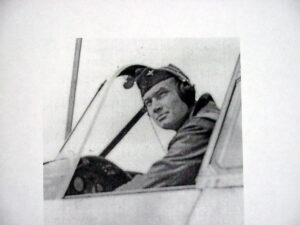 On joining the service: I could have been exempt but I wanted to serve.
On his choice to go into multi engine aircraft: I liked the thought of four engines out there.
On his training: We were lean, fit, well trained, and ready to go to war.
On his pay: I was making $347 a month at age 21 and felt good about that.
On his first mission: All the glory was gone. It was work and being scared.
On losing a friend in combat: It was terrible, going through a friend’s personal effects.
On writing letters: I wrote a letter home before a mission. My return was uncertain.
On the Tuskegee Airmen: They were our friends, and they took good care of us.
On his service: One of the best things I have ever done, and I would do it again.
As a young man, Phil Newman did not believe he would ever fly in an airplane, not to mention, pilot one. That all changed in 1942 when he enlisted in the U.S Army and requested assignment to the air cadets. This request was to change his life and confront him at a very young age with experiences that most men never face.
As a young man, he watched planes take off and land at Greensboro airport. He wanted to fly! He graduated from High School in June 1941 leaving Greensboro to work for his uncle in New Jersey as a machine operator. After Pearl Harbor, he could have been deferred to continue his work in the machine shop, as it was vital work in the national defense effort. However, Newman was impressed with all the military planes regularly flying overhead and elected to join the U. S. Army in November 1942 with a goal of becoming a pilot.
He was assigned to Atlantic City to take his 10 weeks’ basic training. While there, he learned to greatly respect his drill sergeant who had been a sparring partner for ex-heavyweight boxing champion Jack Dempsey.
Newman was finally accepted as an air cadet and assigned to Grove City, Pennsylvania for 10 weeks of training. From Grove City, he went to Nashville, Tennessee to a classification center where he took a battery of motor skill, eye and depth perception tests, as well as physical training. There, aviation cadets were classified as pilots, navigators, or bombardiers or sent to the infantry if a cadet failed the tests. All the cadets wanted fighters except Newman. He liked the idea of four engines on the wings and wanted to go into heavy bombers.
Newman’s next assignments were to Maxwell Field, Alabama and then to advanced flying school in Stuttgart, Arkansas where he met his wife to be. If a pilot washed out during this advanced training, he was usually assigned as a navigator or bombardier.
In June 1944, Newman graduated from advanced flying school as a Flight Officer, which was the equivalent of second Lieutenant. He was making $347 per month, which were outstanding earnings for a high school graduate in those days.
Newman was next assigned to Plant City, Florida to go into transitional training to B-17 heavy bombers and on to Drew Field where he trained night and day for two months under all flying conditions.
In November 1944, he was assigned to go to Hunter Field to pick up his crew and a new B-17G, the latest model of the bomber. He was ready to go to war after one- and one-half years of training. After additional familiarization flights, he flew to Fort Dix, N.J. and prepared for the flight overseas. He and his crew readied themselves for the flight and took off at 11:30 P.M. headed for the Azores, then on to Marrakech, Morocco. Upon leaving the Azores, Newman held the plane to an altitude of 300 feet all the way to Morocco to avoid being sighted by enemy radar. This was the most difficult part of the trip due to the intense concentration necessary to fly at such a low altitude.
After a brief stay in Morocco, he took off with his crew and opened sealed orders which directed him to Foggia, Italy which was a former Luftwaffe air base, which had, been abandoned quickly as the allies advanced up the boot of Italy. Many German aircraft had been left on the field. The aircraft were a strange sight as the Italians had stripped them of anything useful, including the tires, which they fashioned into soles for their shoes.
When Newman arrived at the Foggia base, the weather was rainy, cold, wet, and most depressing. He was now part of the 15th Air Force, 99th Bomb Group, 347th Bomb Squadron.
Every night the crew checked the battle orders for the next day. If your plane and crew were on the orders, you went to bed and got your rest because tomorrow would be a long day. The first day Newman saw his name on the battle order, all the glory of being a pilot faded. It was just work and fear of combat and knowledge that he would have to put his life on the line for his country. The first flight, as was typical, was a milk run. No enemy planes and an easy target. This was to build confidence and allow crews to face some danger.
Targets were typically fighter manufacturing facilities, rail marshalling yards, and oil fields. A typical bombing mission would include 25 to 30 aircraft each one loaded with 10 men, 13 machine guns, 6,380 rounds of ammunition, 2800 gallons of gas and 6,000 to 10,000 pounds of bombs. The most critical problem of the long bomb runs were the anti-aircraft guns which became increasingly concentrated as the Germans moved back into their homeland and brought the guns with them. On a bombing mission, an air group could face thousands of anti-aircraft guns. Before every mission, Newman wrote letters home so there would be a last letter to his wife and family sent if he did not return. The worst duty Newman had was to go through the belongings of a flyer that did not return.
On the days he was assigned to fly a mission he would be awakened at about three A.M. In half an hour, he would do his morning routine and eat breakfast. After breakfast, all crew members would go to their briefing rooms where a large stage was set up with a map covered by a drape. The drape would be removed and the target for the day revealed. The pilots, navigators, and bombardiers would get separate briefings for their specialties. Before takeoff, all had the opportunity to see the Chaplain for spiritual counseling. Most crew members took advantage of that.
It was still dark when the crew rode out to their plane in an open truck or large wagon pulled by a jeep. All crewmembers would go through their check off list to be certain the bomber had, for example, a proper fuel load. The flight engineer would open all 13 separate gas tanks to be certain they were full. More than one bomber took off without a proper fuel load due to a mistake in fueling. On several bombing missions a field toilet was sealed and autographed by all the flight and ground crews with epithets for Hitler that don’t bear repeating. This was the last item put in and rested on the floor of the bomb bay and, of course, was the first thing dropped on the target.
Engines were starting and the flare from the control tower indicated the planes were to line up for takeoff. Planes took off at 30-second intervals, and it took about half an hour for the group to form up and head for the target.
When Newman’s plane was ready, he applied full power and started rolling. Climbing at 500 feet per minute to an altitude of 30,000 feet at a speed of 150 miles per hour on the eight-to-ten-hour flights to the target used two thirds of the fuel supply. When arriving in enemy territory the flak started to appear in the sky. Newman said “if you saw a black cloud, you were ok on that blast, as it had already dissipated. If you saw what appeared to be a match strike in the sky it was too close, and you would probably be hit by flak.” The B-17 had 13 separate oxygen systems for the crew of 10. Some crew members that failed to put on the mask tightly did not survive at high altitude. Heated suits kept the crew from freezing to death, as the waist gunner windows had no way to close. It was always freezing at high altitude. Even at sub-freezing altitude, the pilot was perspiring in his flight suit due to the stress of flying.
At about 15 miles from target, the bomb run began and the bombardier took over to fly the plane through his bombsight controls. Newman explains, “The German gunners knew our altitude and direction and planes were sitting ducks on the bomb run”. These were the scariest times of Newman’s life. Sometimes it was just slaughter with 20% of planes being lost over the target or damaged beyond their ability to return to base. If one engine was lost, you could get back—maybe. Two engines out and you were in serious trouble. If more than two engines were out, you normally could not make it back to base. If fighters were in the air this is when they attacked, looking for damaged aircraft and stragglers. At this stage of the war, fuel shortages allowed the Germans to place strong air defenses at only the most important targets.
During 1944 and later, P-51 fighters were able to escort bombers to and from the targets due to the invention of the fuel drop tanks which vastly improved the range of the fighters. The pilots most often accompanying Newman’s group were the famous Tuskegee Airmen, made up of black pilots. The Tuskegee Airmen, flying red tailed P-51s, never lost a bomber they escorted during enemy action. Even so, tight formations were critical to group integrity and to maximize firepower against the enemy fighters. The trip back was faster because the bomber weighed thousands of pounds less than on the outgoing trip and only needed the last 1/3 of the fuel supply. In a sense, Newman’s plane was coasting downhill back to base. If a crewmember was badly injured during the bomb run, he either froze to death or bled to death, as medical care was extremely limited on the plane. When arriving at home base, the damaged planes landed first to get wounded off and those planes still intact came in last.
`Debriefing followed the return and this was about a 30-minute recap of what was seen and done during the mission. Newman states, “Each successful mission was a victory which allowed me to live and fight another day”. Newman points out that these were, for the most part, 20-year-old boys doing extraordinary things to keep our country free. If you thought too much about what you were doing you would go crazy. Some did.
After the war, Newman returned to Greensboro with his wife and entered the communication business. He feels his time in service was the best experience he ever had because he was doing something very important for our country and learned to bear some very important responsibilities without breaking. Newman has two children, a son and daughter.
He is a founding member of the Combat Airmen of WWII (Now known as Veterans of America) a local organization of war veterans.
Interviewed 5/14/1999