
Collins, William H. “Pansy”
- Service Branch: US Army
- Rank or Rate: Corporal
- Service Dates: 1939-1945
- Theater: U S/Europe
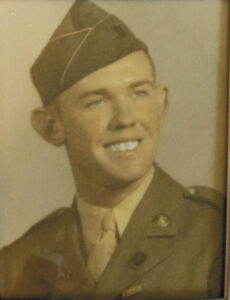 Nineteen-year-old Pansy Collins was encouraged by the Collins’ family physician to join the North Carolina National Guard in 1939. He expected to make extra money while enjoying time with his friends who were also in the Guard. It promised to be a fun, part time job. Collins was shocked three weeks after joining up; his unit was called to active duty. This was the beginning of an unplanned six-year military career.
Collins came from a large family and had to drop out of school at age 16 to get work and help with household expenses. He worked at Washington Mills for a short time but left for a job with the North Carolina roads crew – part of the NC Highway Dept. One day, while a fellow employee was kneeling doing some work, he looked up at the tall, young man standing over him and said, “You look like a blooming Pansy, standing there.” The name stuck and Collins has been known as “Pansy” ever since.
When Collins was called to active duty with the NCNG in September 1939, his division was sent to Fort Jackson SC where Collins was assigned to the motor pool as a mechanic. Even though he was in the motor pool, he also received infantry training. He became adept at helping break down advanced mobile hospital units, moving them and setting up in other locations under combat conditions. This movement was all done in about five hours with Collins one of those transporting the equipment. The officers in charge made the experience as much like war as possible. There were some soldiers injured during maneuvers, so it was not all “make believe” in the hospital tents.
The 30th Infantry Division trained in South Carolina, Florida, and Indiana. The Pearl Harbor sneak attack happened on December 7, 1941, while Collins was at Camp Atterbury IN. The Division immediately went on alert with tanks, artillery, and men getting ready to go to war. The 30th Division was probably one of the best trained in the Army before going to Boston in February 1944 for assignments in England. The convoy was one of the largest to leave the United States carrying men and material to England in preparation for the coming invasion of Europe.
While on the ship, Collins caught the flu, and a division doctor told him he would have to put him in the hospital and he could catch up with his Division later. Collins did not want to be assigned to another unit away from his friends so when the ship arrived at Liverpool, a sick Collins sneaked off the ship and stayed with his division. He recovered from the flu soon after.
England was ravaged by war. The sights and sounds of war that Collins experienced upon arrival were expected but jarring, nonetheless. The training went on at a quickened pace and, while somewhat repetitious, was never boring to Collins. The men were being trained to expect anything they might experience when they faced the enemy, and their reactions were to be second nature. The division trucks were all waterproof so they could be driven partially under water. The intake and exhaust stacks on all trucks extended above the cab of the truck. Collins was the Division transportation special projects man and drove his truck all over southern England. The officers knew if Collins were given an assignment to obtain material, he could get it done.
The trucks and equipment were camouflaged so German pilots would not see the buildup of trucks and material that was happening in England. Collins knew the invasion was coming and was ready to go – he wanted to get over it. The men could not talk about anything they heard or saw while training. The motto “Loose lips, sink ships” had a very serious meaning to Collins and his fellow soldiers.
After the invasion took place on June 6, 1944, Collins’ 105th Medical Battalion was to go ashore on Omaha beach on June 10. The water was so rough that the landing could not take place where they were to go. They finally went ashore on June 12. The Navy Construction Battalion men (CBs) pushed sand out to the LST ships so the trucks on board could get ashore. The water was so deep the trucks could not otherwise make it ashore even with their waterproofing. The orders to the 105th Medical Battalion were to get off the beach to the high ground, then reassembling, awaiting further orders. There were 24 trucks in Collins’ group and hundreds overall. He heard machine gun fire and artillery shells exploding in the distance. There was more noise than Collins thought was possible.
From Omaha Beach, the 105th Medical Battalion went inland about five miles and set up an advanced base hospital for the wounded. First aid was given, and serious cases were sent back to England to an evacuation hospital. Collins was active picking up blood plasma and medical supplies as well as water for drinking and cooking for patients and 30th Division personnel. The mobile hospital Collins was attached to move about every two weeks. They would leapfrog over another mobile hospital to keep up with the advancing troops and to give the other hospital relief from the strenuous workload of the medical personnel. Collins drove between the two mobile hospitals regularly, moving equipment and supplies. The hospitals had everything except x-ray machines to help treat the wounded. Later, even x-ray machines were available to mobile hospitals. Sanitation was always a problem. There was alcohol available for disinfecting hands. Some were used for drinking, without approval, of course.
Captured German soldiers were treated at the hospital and were given the same measure of care as our men. The older German soldiers were happy to be captured and out of the war but the younger ones in their 20’s were hostile for the most part, especially SS troops (the Schutzstaffel – Hitler’s personal troops) – the most fanatic members of the German Army. In July 1944 the 30th Division endured one of the most tragic parts of war, accidental bombing of our troops by our bombers. Eighty-eight men were killed and over 500 wounded in that episode. The highest-ranking person to be killed by our bombers was General Leslie J. McNair. The 30th Division was known as the “Workhorse of the Western Front” because of the heavy combat load.
In late 1944, the 105th Medical Battalion was in Harlingen, Holland. A family with three children befriended Collins and invited him to stay at their home while the 105th Medical Battalion was there operating a hospital for 13 weeks. The 105th was then sent to Aachen Germany to set up a hospital. It was quiet for a time as the Germans were retreating. In September 1944, the Germans counter-attacked but were beaten back. The 105th went back to Belgium for a time and then were involved in combat during the Battle of the Bulge. Collins job was picking up dead and wounded from the battlefield: one of the grisliest jobs in the army. He was near the battle lines regularly during that action. At one point, his unit was to relieve the 99th Division mobile hospital. Several of Collins’ friends, wearing appropriate red crosses on their sleeves, arrived at the site, but were killed by German soldiers. The 30th Division declared “personal” war on the Germans at that point and was determined to avenge those deaths.
After the Battle of the Bulge, the 30th Division advanced under combat conditions all the way to the Elbe River where Russian and American troops met. On May 8, “Victory in Europe” was declared. There was a big celebration and word spread that troops might have to go to the Pacific for the invasion of Japan. Collins did not go home right away. After several of the sergeants in the motor pool returned to the US, Collins was put in charge of the motor pool although only a corporal. The sergeants complained that Collins, as a subordinate, was giving them driving assignments. The Company Commander told them, “If you want to keep your sergeant stripes, follow Corporal Collins’ orders”.
Collins finally got out of the Army in September 1945. The voyage home was rough, and Collins was happy to see dry land again upon arrival at New York. He was sent to Camp Shanks for processing and on to Fort Bragg for discharge from the Army. Collins said he had no trouble adjusting to civilian life but did take several months off to get back into the routine of being home. He worked briefly in the trucking business and at a local grocery store. One day he happened to meet a man who was looking for someone with Collins’ skills to work for the local Lee Telephone Company. Collins took the job and stayed in the telephone business for 50 years, retiring from Sprint Nextel Company as a field engineer.
Reflecting on his years in WWII, Collins thinks often of the friends and fellow soldiers killed while relieving the 99th Division medical crew. He sees their dead bodies again in his mind’s eye and remembers. It could have been Collins that died that day. The 30th Infantry Division lost 3,003 men killed in action, 13,376 wounded and 513 died of their wounds.
Collins and his wife Polly have one son, one daughter, four grandchildren and they enjoy spoiling five great grandchildren.
Interviewed 6/6/2006