
Lashley, William D.
- Service Branch: US Marine Corps
- Rank or Rate: Staff Sergeant
- Service Dates: 1943-1946
- Theater: Pacific
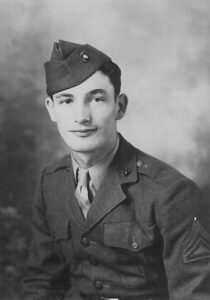 Okinawa was the last battle with Japan during World War II. During that battle, Bill Lashley often had to go undercover to avoid Japanese aircraft, which were strafing his position, as well as dodge projectiles from our Navy ships trying to shoot down those enemy planes. Okinawa was a deadly place and the crossfire was murderous.
After graduation from Leaksville high school in 1942, Lashley worked for a time at Belk’s as a salesperson. When drafted in May 1943, he expected to be in the Army but before induction, a Marine recruiter asked if he would like to become a Marine. Lashley liked that idea and volunteered for the marines.
There were long days and intensive training in boot camp at Parris Island. Lashley still has slightly chipped front teeth from bayonet and hand to hand combat training. It was impressive upon Lashley that there would be high casualties among his unit and to mentally prepare for that. Upon graduation, the drill sergeant told Lashley not to blame him, but Lashley was headed to Camp Lejeune to learn to be a radar specialist rather than become a rifleman. That change in assignment may have saved Lashley’s life. Radar was relatively new to the marines, as the Navy had done all radar work for the marines. Due to heavy enemy bombing and kamikaze (suicide) attacks expected, better radar coverage was needed from ashore as we attacked and occupied the Japanese outlying islands. The Navy would handle shipboard radar, but the marines would handle radar ashore for the Navy.
Lashley took a course on Electricity and Magnetism as well as one on Marine Corps history and general information; passed them and was promptly promoted to Staff Sergeant. Shortly after, with additional training, he was named the first marine radar instructor at Camp Lejeune. After several months as a radar instructor, word came down from Marine Corps HQ; there were two kinds of marines, those overseas, and those about to go overseas. In December 1944, Lashley became one of the marines “about to go overseas”. Before going overseas however, Lashley went to Washington DC for a short time and reported to the Naval Proving Grounds command. Inside a large building on the grounds was a complete three-dimensional model of the island of Okinawa. Lashley’s job was to help determine the most effective locations to place radar installations to maximize coverage of aircraft activity and minimize ground interference. That training served him well on Okinawa.
Lashley had the opportunity to pass in review with his unit in front of President Roosevelt before leaving for overseas from Norfolk, VA. His troop ship “The Florence Nightingale” went through the Panama Canal on the way to the Far East. The heat was stifling aboard ship and there was little fresh water for showers. The sailors rigged up some water lines to bring up seawater for the marines to shower on deck and give some relief from the intense heat.
The troop ship offloaded at Guam, which was the staging area for the invasion. While there, everyone had to turn in their money for safekeeping. One marine had so much money that he was going to be brought before courts-martial (be prosecuted) and punished for thievery. To avoid the courts-martial the marine had to obtain written proof from all the men he had won money from to justify the large gambling winnings he had in his possession.
Before the invasion, Lashley’s Battalion commander stressed to his men that many would die on Okinawa, but a marine is never to shame another marine that has been killed in action by not giving 100% effort. The legacy of the dead lived on through each marine who was alive and fighting. Lashley was trained so well, he states, “My greatest fear was not the enemy but that I would not live up to the high standards of the Marine Corps”.
When he arrived and went ashore on Easter Sunday 1945, as part of the invasion force on Okinawa, he set up his radar equipment at a site called Bolo Point: one of many sites on the island. This location gave excellent radar coverage including Yontan airport a few miles away. The main fight was going on to the north and south of Bolo Point. All around Lashley’s station were dead Japanese soldiers. The radar stations had to be on duty 24 hours a day because the Japanese planes were flying 24 hours a day. Reports were made to the Navy for coordination purposes. Lashley says that the Army, Marines, and Navy all cooperated very well in radar work. His station was very close to the battle lines, and the noise was deafening. There were 1300 ships offshore and the 18 battle ships were firing salvos from their 16-inch guns 24 hours a day. Forty aircraft carriers were in operation around the clock. The Navy guns were aimed so low in the attempt to hit strafing Japanese planes that Lashley and his men feared for their lives from friendly fire.
There were three types of radar used by the marines on Okinawa. 1) Large vans with parabola radar units on top, which were used to coordinate anti-aircraft guns. 2) Air search units, which identified aircraft as friend or foe based on transmissions from the planes. This unit was used to guide the anti-aircraft units in whether to shoot, or not, at a plane that could not otherwise be identified. 3) Radar units, which were coordinated with searchlights to shine on aircraft so any anti-aircraft guns could visually fire more accurately. The anti-aircraft shells used had proximity fuses, which caused the shell to explode when in proximity to the enemy aircraft.
The Japanese also used transport aircraft full of suicide troops to crash land near the airport, exit the transport, and run with satchels containing explosives to blow up planes on the Yontan airfield. This was a similar concept to the Japanese suicide pilots used extensively and effectively against Navy ships during the Okinawa campaign.
Tokyo Rose was on the radio from Japan trying to undermine morale among the troops. She knew which units were in Okinawa and was very well informed. Lashley said he heard her on the radio, and she had no effect on morale at all, but they enjoyed her music. The first time he heard the 1945 hit song, “It’s only a paper moon” was on Tokyo Rose’s program.
One afternoon, word was received that the Japanese were going to counterattack and attempt to capture the airfield. The Japanese usually attacked at night, so Lashley and his men spent a very nervous night, expecting the Japanese to eventually attack his position. The night was a little windy and the tall grass was waving in front of Lashley’s position. There was a strange sound and movement in front of the position. Lashley’s men were tempted to fire a few rounds at the noise to see the reaction. However, their orders were not to fire unless the target could absolutely be identified. As the sound came closer, it was identified as a piece of aluminum from a wrecked airplane blown by the wind on top of the grass and making noise as it came toward the radar position.
While battle was going on, food was in short supply except for the basic K-rations, which were not very tasty. Because of the many souvenirs available to the marines, such as Japanese flags, guns etc., souvenirs were traded for better food with Navy commissary men who came ashore from time to time.
On one occasion Lashley went to get mail at the Yontan airport and had to walk past some tunnels which most thought was empty of Japanese troops. As he approached the tunnels, an officer, only half-jokingly, informed Lashley that he could be a useful “decoy” to bring out the Japanese from the tunnels but not to come this way again if he valued his life. Normally, the only way to get the Japanese out of the tunnels, or to kill them, was by use of flamethrowers or satchel bags of explosives dropped down what were called the “spider holes”.
The Okinawa people had been brainwashed to believe US troops would kill them on sight. This caused many Okinawa people to help the Japanese. Of course, this perception was changed when the people had an opportunity to interact with our troops. The campaign to capture Okinawa was over on June 22, 1945, being the last battle of World War II. This battle was the largest in terms of number of ships lost and casualties in the Pacific war. Over 250,000 people lost their lives in the 82-day campaign. Among the dead were about 150,000 Okinawa civilians. In defeat, about 100,000 Japanese troops died, many of them trapped in caves in the hills or by committing suicide rather than lose “face” by being captured. United States loss of life was staggering as well. The Navy lost 36 ships with an additional 368 being damaged, more ships than in any prior battle in the Pacific. We lost almost 8,000 men with 30,000 more wounded.
After Okinawa was secured, Lashley’s unit was pulled together with other units to develop a combined action against the mainland of Japan. Fortunately, the atomic bombs were dropped and thus eliminated the need for an invasion of Japan. Lashley said his joy over the announcement of the surrender of Japan “defies description. We were victorious and my life was spared.”
Lashley was a military policeman on Okinawa until March 1946. He returned to the US and was released from active duty in May 1946. On the way home however, the ship he was on had a mechanical problem, which delayed his return for about five weeks. Upon arrival at San Diego, a marine came down with Typhus, so debarkation was delayed another week. After a long train ride to Camp Lejeune, he was finally released from active duty.
Lashley says he is proud to be a marine but never saw any glamour in war. He is just glad he survived a very important time in our nation’s history and was able to contribute to our victory. Lashley continued his education and ultimately returned to Leaksville to enter the retail business. He retired after operating Lashley’s clothing store on Washington Street in Leaksville for many years. He is married to the former Mary Noel Foley and they have two married daughters, Debra and Lisa as well as one grandson, Matthew.
Interviewed 9/1/1997