
Shinn, Thomas Pinkney
- Service Branch: US Army
- Rank or Rate: Sergeant
- Service Dates: 1917-1918
- Theater: Europe
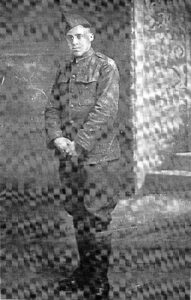
Editor’s note: the complete 75-page World War I diary, Army uniform and other artifacts of Thomas P. Shinn, a longtime resident of Eden NC who passed away in 1988, were recently forwarded by the family to Kenneth R. Samuelson. This material is being donated to the NC Museum of History/Military Collection in Raleigh. Mr. Samuelson has written this month’s article based on one day of Mr. Shinn’s experience, November 11, 1918, the day Armistice ended World War I.
This story represents an edited excerpt from the Diary of
Thomas Pinkney Shinn (age 22)
First Sergeant, Company B
81st Division 321st Infantry
US Army – American Expeditionary Force
Veteran of the Meuse-Argonne Campaign
Monday November 11th, 1918
 At 4:30 a.m., I was trying to get some rest in my little hole dug in the ground. The big shells were falling near me, and I could hear the Boche (German) machine guns puttering away a few hundred yards to our front. About 5 o’clock, the captain was ordered to report to Battalion Headquarters and in a few minutes, he came back and called Lt. Hall and myself and told us we would advance on the Boche at 6 a.m. sharp. We called all the Lieutenants and platoon sergeants and gave them the orders. We walked around and looked at the men sleeping in their shell holes and wondered how many of them would be living at noon that day. I thought how hard it would be to arouse them from a peaceful sleep and go out to kill or be killed. We knew there were two sides to war, and we either would survive or be buried here, so we did not worry. It was second nature to obey orders.
At this time, we called the men and told them what we were to do at 6 a.m. The men rubbed their eyes and tightened their belts for there was no water to drink or use to wash their faces, nor food to fill their stomachs. The men took it in good nature and prepared to go over the top in a few minutes. We formed our lines and got in position to advance on the Boche. The first and second platoons in the first wave were in command of Lieutenants Blackmon and Campbell; the third and fourth platoons in the second wave in command of Lieutenants Howard and Crawford. The men formed their skirmish lines just as though we were in a practice battle and started out. The high explosive shells started falling just as though it was raining from above. We would fall flat on the ground, get up again, and advance a little further. The men kept their heads and advanced according to orders. After we had advanced about 3 kilometers, we could hear the continuous sing of machine gun fire and every now and then a man could be seen going to the rear with a bullet pierced arm or limping back on a leg that had been shot with machine gun fire.
Nothing could stop us if life lasted, for we were to follow our orders in combat or die trying. About 8:30 a.m., we struck a solid line of machine guns, and they fired on us. There was a woods full of them. We fought them there for an hour. They were killing and wounding us, and our men were doing the same to them. I lay flat on the ground trying to keep from being hit by the machine gun bullets that were flying around us and the big shells that dropped everywhere. Only a few feet away, a comrade of mine, Nathan Pennett, said “Sarge, give me a match I want to smoke”. I told him I had a match but could not give it to him without exposing myself to the Germans, so I did not give it to him. We lay there and joked. He told me he had 700 francs in his pocket and if he got killed, I could take it out of his pocket and spend it.
The Boche quieted a little and we advanced again as they retreated for a counterattack. We rushed on for several kilometers and the captain, and I were just behind the front lines. We were lost in fog and wading in water waist deep. The front wave was fired upon from the flank, so the captain sent orders to Lt. Howard to clean the woods on the right and Lt. Crawford, the woods to the left. We saw them disappear but did not expect them to return. We rushed on for some distance and found that we were caught in a trap. They were firing on us from all sides and the rear too. The captain sent orders to the front wave to hold its position until the rear could come up. We fought there in the marsh up to our waist in the coldest water I have ever felt.
We were in an awful fix being in a trap from all sides. The machine gun fire from the front and the rear was killing many men. The woods in front of us were filled with machine guns and barbed wire and it was impossible to advance. The Captain gave us orders to retreat a little way and he would call for an artillery barrage, which he did, and the barrage was a success because in a few minutes we launched our counterattack. Just as we launched our attack, the Boche started putting the heaviest barrage of high explosives on us that I had ever seen. Our scouts were out in advance of the front wave about 40 yards. The fog was so dense that we could not see them at all but we knew very well when they met the enemy for, they opened with what seemed to us a thousand machine guns and a few 75mm artillery, which they shot whiz bang point blank at us. Just then, my good friend, Sgt. Pittman, who was on my left, was killed instantly by machine gun fire. Two more of our boys near me, were killed a few minutes later.
About this time, we struck a barbed wire entanglement about 3 feet high and 30 feet through. We could not get through the wire for it was too strong and wide, but we had a nasty fight at that place. While we “entertained” the Boche for a few minutes, one of our boys by the name of Carpenter crawled through a little path in the wire and came very near jabbing a gunner with his bayonet. Then one of the Huns shot him in the neck with an automatic pistol. He fell and we fought there within a few feet of him for several hours, hearing his pitiful cries for help but could not get to him. It was so foggy that the Boche crawled up and took him prisoner. Our line was only about 130 feet from the Boche line, but they were making it so hot for us we could not move forward only a few men at the time, and it was slow work. Right then I crawled over to cut some telephone wire with my pliers, and a sniper came very close to getting me. His bullet cut a hole in the overcoat I was wearing.
The big shells were falling so thick and fast that I had an idea that I only had a few minutes to live. It was so cold I knew if I did not get killed by a shell or bullet that I would freeze to death. I was wet to my neck and my clothes had frozen stiff on me. The shell holes would fill up with water in a few minutes, so we kept moving to new shell holes as they were made. I was so cold that I was numb all over. I had not seen any fire or shelter for more than 48 hours and two days without food, water or sleep was getting on my nerves. But I could not think much of things like that for my mind was full of thoughts as to how I could save myself and kill a Hun. They made it so hot for us that we had to lay low in a shell hole for half hour or more. While lying in the shell hole one of my friends came to me and asked me to send a man to the rear with him as he had had his left arm blown off between the elbow and shoulder and he was bleeding very fast. It was the hardest thing I ever had to do to tell him I could not send anyone back with him. I had to leave him lying in a shell hole weak and pale. I never saw him again, but I feel sure someone picked him up.
About 10:45 am, the Boche seemed to shoot everything they had at us. They made us keep our heads so near the ground that I had mud in my ears. At 7 minutes to 11 a.m., a runner came up to the captain, out of breath, and handed him an order. I do not know what it said but I know it pleased the captain very much. As soon as he read the order, he called two runners and told them to go to the platoons and give them orders to cease firing at 11 o’clock
As soon at the captain had sent the orders down the line he came over, shook my hand, and said we must try to keep from being killed in the next five minutes and all would be well. At 11 a.m., we ceased fire. The Germans jumped up, threw their rifles down, and came running to meet us. They wanted to shake hands and talk with us, but we made them go back.
We spent the rest of the day gathering up the dead and wounded off the fields and they were plentiful. We hauled many loads of dead bodies and buried the dead in a hole dug like a long ditch. The men were laid close together side by side and covered up. The Company pitched their pup tents and built fires. Our orders were to place a heavy guard along the line we held at 11 am. Late that evening, after the excitement was over, I fell down and could not go any further. My Captain brought me a piece of hard bread and some muddy water from a shell hole and with an hour’s rest I could go on and move again. It was almost like heaven to us cold, wet, tired, and hungry boys to make a fire and sleep a little. The Captain and I slept in a German dugout we captured from the Boche the day before. It had been a German officer’s quarters. We had a small stove and some straw bunks, but it was what seemed to us to be the most ideal place we had ever slept in. The Germans celebrated all night long by sending up flares and lights from the trenches and they were so glad that they would not sleep at all. We were perfectly happy to get some good rest and sleep the night of November 11, 1918.
Mr. Shinn was born April 26, 1896, in Kannapolis NC and was a long-time employee of Fieldcrest Mills in Eden NC. He married Mattie Krimminger of Kannapolis. There are four living children from that marriage. Mrs. Mary Shinn (Kenneth) Ross lives in Rockingham County; Harold lives in Milford NJ and Conrad in Pensacola, FL. A daughter, Jean Shinn Hart, who donated her father’s WW I material to the NC Archives on behalf of the family, lives in Nashville TN. One daughter Peggy and one son Harry are deceased.