
Starke, Robert J.
- Service Branch: US Army Air Corps
- Rank or Rate: Tech. Sergeant
- Service Dates: 1942-1945
- Theater: Pacific
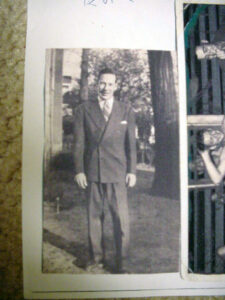 Bob Starke felt a sense of history while being instructed by “Lucky Lindy”, Charles A. Lindbergh, regarding maintenance on newly arrived P-51 Mustang fighters in New Guinea. Lindbergh was an aviation icon, being the first person to fly solo from the US to Europe in 1927. The instruction took place on the same Lae, New Guinea airfield from which Amelia Earhart had last taken off on her flight around the world in 1937. Earhart was never found after her takeoff from Lae. Starke was favorably impressed with Lindbergh’s friendly demeanor, his knowledge and the badly needed help he provided.
Starke’s family moved from Bozeman MT to Nutley NJ while Starke was a child. He finished high school in Nutley and worked as a draftsman for a few years after graduation. On June 3, 1942, he was drafted into the Army Air Corps and told to report the next day for departure to Fort Dix NJ for processing. The Air Corps needed new recruits desperately in 1942! He was at Ft. Dix for three days and then sent to Miami FL for physical conditioning and military basics. The Air Corps had taken over several hotels on Miami Beach. Most of the drilling, conditioning and marching were done on the beach or at a local golf course.
Within a month, he was transferred to Jefferson Barracks MO for basic training. The training was tough, and Starke was happy to get orders to Brisbane, Australia to the 40th Fighter Squadron. It was a 30-day voyage to Australia, which was the staging area for further assignment to New Guinea. He received training in aircraft maintenance in Brisbane. Starke arrived at Port Moresby, New Guinea in late summer of 1942 and became immediately involved in aircraft inspections. His airfield was located close to the enemy’s positions so there were numerous combat missions flown every day. His routine was to get up at 4 am to preflight the aircraft before the mission; wait about four hours for the mission to be completed, and then do it again. During the wait, other aircraft were maintained. There was no break from this routine and little time off. There was a war on and it was close by. It was common to cannibalize damaged aircraft for parts to repair other aircraft which were still repairable. Parts were always in short supply.
All the while, the Japanese were engaged in frequent bombing runs on Starke’s airbase, usually at night. They used “daisy cutter” bombs, which sent shrapnel low, in a wide circle from the point of detonation. It was necessary to have a foxhole outside Starke’s tent so he could literally jump out of bed and be in his foxhole in an instant. Starke recalls at one location it took 100 sticks of dynamite to blast out a foxhole in coral, deep enough for protection. While in the foxhole, it was unnerving to hear the many bombs hitting the ground and “walking” toward his foxhole. He just prayed they did not hit his foxhole.
It was frustrating to take the daily bombings so during time off, Starke volunteered on six combat missions, as a waist gunner on a B 24 “Liberator” heavy bomber. This was a way of getting back at the Japanese instead of just absorbing their bombing every day. One of the cooks also volunteered for combat missions and he shot down two Japanese aircraft. As his symbol of air combat success, he painted two Japanese planes on a frying pan he proudly displayed in the mess tent.
Our troops were making good progress against the Japanese and Starke moved up the island of New Guinea always doing the same work as crew chief on fighters and helping on bombers. It was in 1944 when the combat units received the latest fighter, the P-51 that had a British Rolls Royce engine. This fighter had metric fittings, but Starke had no metric tools and none were on the way. Charles Lindbergh was hired by North American Aviation, the builder of the fighter to help assimilate the aircraft into combat in the South Pacific and instruct the crews how to shape the tools to work on metric fittings.
Starke moved on to the Shelton Islands to a forward airstrip where he stayed for four months. While working a mapping project in one of General Douglas MacArthur’s offices, MacArthur came in late one evening and asked Starke how he was doing on the project and showed concern for his wellbeing. Starke has never forgotten that personal encounter with a military legend.
The combat missions became more frequent and work more demanding. An investigation team came to the islands, headed by Mrs. Eleanor Roosevelt (wife of President Roosevelt) with five senators, concerning the delay in getting enlisted men out of combat on rotation after 18 months. Pilots were rotated out regularly based on reaching a certain number of combat missions, but the ground crews were not. Nothing came of Mrs. Roosevelt’s investigation.
Uniforms became very greasy and dirty from the constant work on aircraft. Crew Chief Starke and the other mechanics used 100-octane gasoline to dissolve the grease. Soapy water was a luxury. There was a “no smoking” sign near the makeshift laundry for good reason.
Food was terrible at the forward locations. Starke recalls eating corned beef hash for 96 consecutive meals. Packages from home did arrive occasionally but only after a delay enroute of 5 to 6 months. Any food in the packages was either stolen before the package arrived or spoiled. Periodically a B-25 bomber would go to Australia for provisions, and the men would get some fresh food. They could also request some personal items to be brought back which seemed real luxury.
The top US ace fighter pilot of WWII, Major Richard Bong was in a fighter group stationed on the same field. Starke watched with interest as Bong’s air combat prowess set a US record for kills.
The men in Starke’s outfit were a very tight knit group, all over worked and tired. It was very informal, even with the officers. There was no saluting, and all were on a first name basis. Everyone just wanted to get the job done and go home. If high-ranking officers came on an inspection tour, things became “more military.”
It was amazing to Starke that some of the natives that worked for food maintaining the runways had never seen a photograph or heard recorded music. If Starke would take a photo of any of them, the natives were afraid that their spirit had been captured, and it could kill them. It took some serious explaining to convince them this was not the case.
Early one morning, Starke was up pre-flighting a fighter and noticed a Japanese soldier crawling up on the wing with a knife in his hand. Starke released the brakes on the P-51 and swung the plane around, throwing the Japanese soldier off the wing and into the whirling propeller. This action killed the soldier before he killed Starke.
His unit was assigned to the Philippines for a few weeks and again the combat missions were heavy and work unending. There were fewer Japanese aircraft in the air because most of them had been destroyed. More missions were flown as US forces worked their way toward Japan, and less time was spent in transit to the target.
It was common for the crews and pilots to get dengue fever, malaria and fungus infections. Starke had all three health problems and probably others he did not know about. He took Atabrine tablets every day, and it turned his skin yellow. He did not get all the Atabrine out of his system until six months after he stopped taking it.
While in the combat zone, he heard Tokyo Rose daily broadcasts. She talked of home and made-up stories about girlfriends and wives being untrue while their men fought far from home. Her broadcasts did not bother Starke, but he feels it did hurt the morale of some others. All the men enjoyed her music. Several of the men Starke knew became psychological cases due to the stress, danger and morale issues faced daily. Some just disappeared, never to be seen again. He also remembers the great morale boost that a visit by Bob Hope and his troupe brought to men in the combat zone.
After the brief time in the Philippines, his unit was transferred to Okinawa. There were still many Japanese soldiers in caves on the island. Being the target of small arms fire and hand grenades was common. Starke once went up in a P-47 fighter that was configured to take a passenger by removing an auxiliary gas tank behind the cockpit. That was the most thrilling ride Starke ever had. He was part of a mission that located a camouflaged Japanese airstrip, which was later destroyed.
After VE day, (Victory in Europe) May 7, 1945, the supplies and aircraft from Europe were sent to the Pacific theater. VJ (Victory over Japan) day followed on August 15, 1945. Starke became ill with malaria at that time, which delayed his return home until October 1945. He went by plane and ship to San Francisco and by train to Fort Dix NJ, where he was mustered out of the 40th Fighter squadron. Starke feels he matured very quickly during his time in the service and is proud that he was part of the fight to save the world from tyranny.
After his time in the service, Starke worked as a Mechanical Engineer for General Electric, Bell Labs and Harris Corporation. His wife Nadia is deceased. Starke has four children, three grandchildren and one grandchild.
Interviewed 7/16/1998