
Wilkerson, Robert I.
- Service Branch: US Army
- Rank or Rate: Corporal
- Service Dates: 1943-1946
- Theater: Europe
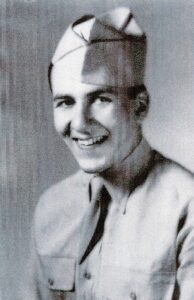 When Bob Wilkerson was assigned to land mine removal school, he knew he would be learning about a serious subject. He had heard that either you passed the land mine removal course, or you were dead. He survived the course but did not enjoy the learning experience.
Wilkerson lived in Virginia for the first 17 years of his life. The family moved to Bluefield WVA after his father was transferred there in 1940. Wilkerson graduated from Bluefield high school in 1942 and immediately applied, and was accepted, at the Virginia Tech branch campus in Bluefield to begin his education in engineering. In November 1942, he signed up for the enlisted army reserve, which allowed him to finish his first year at Virginia Tech before going on active duty. Wilkerson volunteered for the Army Air Corps after his first year at Virginia Tech was completed and was sent to Fort Thomas KY for his induction into active service.
Wilkerson rode a crowded troop train to Miami Beach for his basic training in the Air Corps. His outdoor training in Miami took place on a golf course. His “barracks” was a Miami hotel. Even with the nice conditions, there was not much fun in the military life in Miami Beach. Wilkerson recalls several times when he had KP (kitchen duty) from four am until nine or ten pm. He was better prepared than most men for the rigors of basic training as he had similar experiences when he was active as a boy scout.
After three months of basic training, Wilkerson was given the choice of continuing in Air Corps training or being transferred into the Army Specialized Training Program (ASTP). Wilkerson chose ASTP. The ASTP was established by the United States Army in December 1942 to train and educate academically talented enlisted men as a specialized corps of Army officers during World War II. The plan was to provide a four-year college education over one and one-half years. ASTP soldiers were to serve as Army officers during the war and assist in the restoration of civilian governments in Europe after the war’s end.
Wilkerson joined 400 other students from across the country at Pasadena Junior College for his ASTP training. He went to school for five- and one-half days and had free time from Saturday afternoon through Sunday evening. Being near Hollywood had its advantages. It was not unusual to attend the Hollywood Canteen and interact with movie stars who would talk and dance with servicemen. Churches would open their doors to the servicemen, letting them stay Saturday night in the fellowship hall, serving breakfast on Sunday morning before worship services. Wilkerson was able to attend the Rose Bowl football game in 1944. The following day he and a group of men were allowed to play a game of touch football in the Rose Bowl.
Wilkerson got wind of the impending cancellation of ASTP and heard that all the ASTP students would be assigned to Army infantry units. On a weekend trip to Los Angeles, he went to an Air Corps recruiting station and told the recruiting person his story. He was accepted into the Air Corps and awaiting a call to Air Corps duty while still in ASTP.
The ASTP men were transferred to Brownwood TX and Wilkerson was told that his effort to get in the Air Corps was to no avail. Due to combat needs, the Army disbanded the ASTP program in early 1944. Most of the ASTP soldiers, including Wilkerson, were sent to the Army as privates. Fortunately, he was assigned to an Engineering Battalion in the 13th Armored Division, which was already stationed in Brownwood TX. Wilkerson trained in Brownwood from March 1944 to January 1945 specializing in building bridges, minefield clearance and military construction projects. In March 1945, Wilkerson was sent to Camp Kilmer NJ before embarking to Europe. His unit was put on a liberty ship and started for Europe. One day out, the ship broke down, and it was bobbing like a cork and barely able to return to New York. They were put on USS George Washington and headed for Le Havre France. USS George Washington was a German built ship confiscated by the US during WWI. It was the same ship that had taken Wilkerson’s uncle overseas in WW I. It also took Harry S. Truman overseas, a WW I Army Captain, and later president of the United States.
The hammocks aboard USS George Washington were eight high with 18 inches between them. There was much gambling aboard ship. If there were too many men gambling on one side, the ship would list to that side and the poker games had to be “rearranged’, moving some of them to the other side of the ship to stay on an even keel.
Upon night arrival at Le Havre in January of 1945, Wilkerson’s unit boarded open trucks and were sent to a small village. There, they were put in a large barn in freezing weather with only a bonfire to keep them warm. It was muddy during the day and freezing at night, with not much to do except try to stay warm. This was shortly after the Battle of the Bulge was over and the German army was generally on the run. Fortunately, there was a field kitchen set up for the men, so food was good even though nothing else was.
Wilkerson and some other men were assigned to a mine clearing school at Fecamp, France, the home of the Benedictine order of monks and where the namesake liquor is produced. The Germans had expected the June 6, 1944, D-Day attack at Fecamp, among other places, and had hung over the cliffs, hundreds of artillery shells, which could be detonated by fuses. The town was also full of anti-tank and anti-personnel mines. Wilkerson and his fellow mine clearers had their work cut out for them. It was harrowing to learn to clear mines and more harrowing to clear them from a minefield. Wilkerson poked in the ground with his bayonet looking for mines. A bayonet would not set off an anti-tank mine. However, sometimes anti-personnel mines were buried under an anti-tank mine to kill those removing unexploded anti-tank mines. One had to be very careful!
On the first day they had only cleared an area 20 feet long and 40 feet wide. The next day they used mine detectors, which sped up the process. Eight hundred mines were eventually cleared. The mines were hung over the cliffs near the artillery shells, and all the mines and shells were detonated in one massive explosion. Tiles were broken off roofs and windows blown out of most houses in Fecamp.
After the mine-clearing episode, Wilkerson’s unit was moved to Nancy, France. It had been destroyed. Bodies were still out in the battle fields because the fields were all mined. After removing mines leading to bodies, a ribbon was stretched out to give a safe path to follow for those retrieving the bodies.
His unit experienced a real taste of combat when assigned the task of putting a pontoon bridge over the Rhine River near Düsseldorf. The Germans were surrendering in large numbers but at the same time making a last-ditch defensive effort and killing as many allied soldiers as possible. There were many German 88 anti-aircraft guns in the area to protect industrial sites. The Germans turned the guns down and used them as anti-tank guns firing directly at our tanks with devastating effectiveness. Our forces were bombing and shelling Düsseldorf at the same time and Wilkerson spent much time in a foxhole out of the way of the murderous crossfire with its thunderous noise. Many men were killed. He learned that under the right conditions a person could dig a foxhole very quickly.
The Germans who were doing most of the last ditch fighting before surrender were the young soldiers. The older ones had already surrendered. They were bedraggled, hungry and thoroughly beaten. At one point Wilkerson saw some men in strange looking uniforms walking toward him with their hands up. The Düsseldorf police department had decided to surrender. In another case, two of Wilkerson’s friends were seen approaching with about 200 docile German prisoners in tow. The prisoners presented no problem and were happy to get some good food.
When the operations in Düsseldorf ended, Wilkerson’s unit was sent toward the Alps because our senior officers believed the last stand by the German Army would take place somewhere near the Alps. Wilkerson’s unit headed there but moved so fast they ran out of gas at the Inn River. His unit was ordered to build a bridge over the Inn River on May 1. The next day, orders were to stop building the bridge because the shooting had stopped. Germany officially surrendered May 8, 1945. Wilkerson stayed near Branau, Austria, Hitler’s birthplace, until July 1, 1945. He had limited duties but did play a lot of baseball and rode “liberated” horses at a riding stable the men had set up. On July 1, he rode in a boxcar back to Camp Lucky Strike in France for processing back to the US and transfer to the Far East.
Wilkerson returned to the US in July with a 30-day delay enroute to the Far East. Next, he was going to fight the Japanese. Wilkerson visited friends and family in Roanoke and Bluefield. The atomic bomb was dropped on Hiroshima while he was in Bluefield. After a transfer to Camp Cook CA and six months of duty, he was released 2/14/1945.
Wilkerson took advantage of the GI bill and finished his engineering course at Virginia Tech, graduating in 1948. After two years at Dan River Mills, he began work at Fieldcrest Mills in 1950 and concluded his career there in 1986 as Manager of Mechanical Engineering. Wilkerson said, “My WW II experience broadened my life considerably and because of the great sacrifices of young men and women during the war, we stopped Hitler from taking over the world. This effort cost many lives, including some of my friends and fellow soldiers.”
Wilkerson and his wife Addie, live active lives in Eden. They have a son and daughter, and they enjoy spending time with their children as well as two grandsons and two granddaughters.
Interviewed 1/9/2003