
Brown, Robert
- Service Branch: US Army Air Corps
- Rank or Rate: Master Sergeant
- Service Dates: 1943-1945
- Theater: Europe
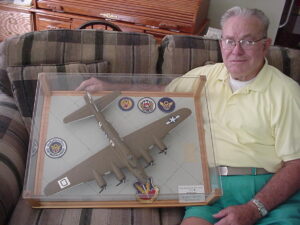 IN HIS OWN WORDS
On bombing missions: I do not know how I survived. The 100th bomb group was a very specific target of the Germans. The first four or five missions were exciting but then the fear set in. It was very unnerving knowing someone was shooting to kill me.
On the B-17 “All American Girl”: She was weary but just felt good in the air. Solid and safe like a good automobile. She had a lot of holes patched but brought me back safely every time.
On being a tail gunner: I had a great view, but it was very tight and I was very exposed back there.
On the Bloody Hundredth: It was well named. We spilled too much blood due to loss of crews in combat.
On P-51 fighters: When the P-51s got drop tanks for extra fuel and could accompany us, we felt a lot safer.
On D-Day: We knew it would happen but did not know when. Before we left, our colonel said, “Good luck and God bless you”. The view I had that day would live in my memory forever. A thousand ships spread as far as I could see.
On his service: If I had to do it all over again, I would.
The first time Bob Brown saw his father cry was when the Japanese attacked Pearl Harbor on December 7, 1941. Brown’s father had fought in WWI and had been gassed as well as seriously wounded. His two sons were of draft age and he knew they would be involved in war as he had been some 23 years earlier.
Bob Brown, however, was excited and ready to go to war. Brown turned 19 shortly after Pearl Harbor occurred and had a good job at Fieldcrest Mills but wanted to get into the defense industry. After registering for the draft in Leaksville, he went to Baltimore to work for the Glenn L. Martin company building airplanes. Feeling he was about to be drafted, Brown came back to Leaksville in early 1943 and enlisted in the Army.
While in basic training at Camp Croft, South Carolina, Brown decided he would rather be in the Air Corps and a corporal friend in the personnel office changed the records so Brown would be assigned to the Air Corps. It was not questioned and Brown quickly found himself in the Air Corps just as he desired.
After further training in gunnery and aircraft maintenance in various locations, Salt Lake City was the next stop where the ten member crews for B-17s were made up for assignment overseas. The crews were sent to Camp Kilmer, New Jersey to be assigned to a troop ship for the voyage to England. By this time, Brown had been promoted to sergeant and earned $46 per month; a far cry from the $21 per month a private earned.
In England, Brown’s crew was part of a replacement pool, which meant they would be assigned to a squadron that had lost a crew for some reason and needed replacements for combat duty. His crew was eventually assigned to the Bomb Group known as the Bloody Hundredth (100th Bomb Group). It was called the Bloody Hundredth because the German fighter pilots were determined to decimate the Bomb Group due to a German pilot having been shot down by a 100th Bomb Group B-17 bomber after he had lowered his wheels indicating surrender. As it happened, during a period of 2 years the Bloody Hundredth lost 177 aircraft to enemy fire and another 53 due to mechanical problems on combat missions.
Brown’s first combat mission was on June 6, 1944, which was D-Day. He learned about his mission at 10 p.m. on June 5. He did not sleep well and was awakened at 2:30 a.m. for the mission with a briefing at 4 a.m. and takeoff shortly thereafter. After takeoff, part of his duty, from his tail gunner position, was to use a flashing light to signal other bombers to form up behind his plane. There were hundreds of aircraft in the air and it was very confusing, especially in dawn’s early light.
His war weary B-17 bomber, “All American Girl” was assigned with other bombers to a tactical bombing mission in support of the troops that landed on the beaches. Brown’s view was magnificent from his tail gunner position as he flew over the English Channel. Brown says “it will live in my memory forever. There were a thousand vessels from battleships on down.”
While on bombing missions at high altitudes, Brown wore a heavy knit cap, long underwear, electrically heated boots, and suit with a fatigue uniform over that and lastly a sheepskin jacket. Electrically heated gloves were also issued and if these were lost or fell off for some reason, fingers could be lost due to frostbite. An oxygen mask was used at altitudes over 12,000 feet, tethered to an oxygen valve at the tail gunner position. Brown also carried a Colt 45 and a combat knife. With all this equipment Brown had to crawl to the tail gunner position and sit on a seat much like a bicycle seat. Once in combat Brown also had a flak jacket to wear and a steel helmet. There was nothing to lean back on so all missions were very fatiguing in very tight quarters. Protecting him were a 2-inch-thick Plexiglas windshield to the rear of the bomber and 1 inch Plexiglas on both sides of the tail gunner position, near his head. Facing out the back of the airplane were two 50 caliber machine guns, with ammunition cases holding 1000 rounds of ammunition next to Brown. During the maximum effort missions, sometimes ammunition was in short supply and Brown only had about 200 rounds of ammunition for the guns.
Brown flew 16 missions as a tail gunner over Europe and five more as a toggler (similar to bombardier). His job was to drop bombs on signals from the lead aircraft. Fighters were not seen very often due to shortages of planes, pilots, and fuel in Germany. However, flak was very heavy and took a terrible toll on the bombers. Brown says, “It was very unnerving to know someone was shooting to kill me. We did not shoot at many fighters but did dodge a lot of flak.”
On one mission, an enemy plane approached from the side and was firing directly at the tail gun position. Brown leaned back and a bullet hit where his head would have been. He missed death by an inch or less. One of his superiors said the only reason Brown was alive had to be because he had abandoned his tail gunner position under combat and should be courts martialed. In other words, because he was not dead, he should be punished. Witnesses supported the fact that he had not abandoned his position, so the courts martial never happened.
On one occasion, while on the way back to England after a bombing mission, a B-24 heavy bomber named Cabin in the Sky slid in formation behind Brown’s plane. When flak came up, the plane flew away but came back when the flak stopped. The next day, crews were informed that Cabin in the Sky was flown by a German crew and should be shot down. Typically, such an aircraft would shoot down planes from the rear knowing it would not be chased due to low fuel on the returning bombers.
All American Girl flew 99 missions, one of the longest service records during the war. She was finally shot down on her 99th mission with a new crew aboard and with loss of all lives.
Due to illness in the family, Brown was allowed to come back to the United States in December of 1944 to further duty in aircraft maintenance in Illinois and Virginia. Brown had enough points to get out of the Air Corps in November 1945 and returned to Leaksville. He began work as an aircraft mechanic on the following Monday after returning home. Brown’s career was primarily in machine shop management until retirement in 1986. He remained with the Air Force reserve for 18 1/2 years retiring as Master Sergeant. He is married to Edna, and both are deceased now.
In 1982, Brown was reading an aircraft magazine, and he noticed an ad for a print showing planes from the 100th bomb group on a mission, painted by well-known aircraft artist Keith Ferris. Brown ordered the print and when he received it, to his surprise, Brown saw the print featured All American Girl, the plane that he had flown in for 20 missions. That print was proudly displayed in Brown’s home and is shown in the picture included with this article.
Concluding his thoughts about World War II, Brown says if he had to do it over again he would. He was proud to be part of the effort to save our world from tyranny.
Interviewed 5/7/2001