
Harden, Robert Allen
- Service Branch: US Army Air Corps
- Rank or Rate: Captain
- Service Dates: 1941-1945
- Theater: Pacific
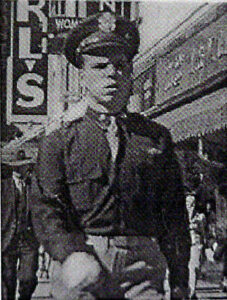 Engine trouble! Navigator Bob Harden did not want to hear those words while flying in a B 29 Superfortress over the Himalayan Mountains. Engine problems were all too common on these huge bombers. There was no choice; Harden and the rest of the crew had to bail out at 20,000 feet or perish in the skies over China.
It was a long journey to China from Harden’s Burke County, Georgia birthplace. His family moved to Birmingham AL when he was two and then to Greenville SC for Harden’s last two years of high school. After graduation from high school, he was accepted at Georgia Tech in an engineering program that allowed him to work a quarter and then attend school for a quarter. While Harden was in his third quarter at Georgia Tech the Japanese attacked Pearl Harbor. Harden wanted to fly and joined the Army Air Force pilot training program as soon as possible after the December 7 surprise attack.
He was called to active duty in January 1942 and assigned to Kelly Field in Texas for basic training. After basic training, he and his fellow enlistees were given aptitude tests and assigned to pilot, navigator, or bombardier training. Due to Harden’s math and science background, he was initially assigned to navigator training. Navigator classes were full so Harden was sent instead to bombardier school at Albuquerque NM. He received his commission as second lieutenant – bombardier in October 1942. At this point, Harden learned about the B 29 Superfortress destined to be the long-range bomber needed desperately in the Pacific due to the extreme distances between air bases and bombing targets. There was a “catch” though as bombardiers on B 29s also had to be trained as navigators.
Harden went on to navigator school at Hondo Air Base TX, graduating in June 1943. At Hondo Air Base, Harden practiced his navigation skills by flying between Hondo, Amarillo, and Big Springs Texas. As B 29s were not yet ready for deployment to the Pacific, Harden taught at bombardier and navigator schools for a time.
The development of the B 29 is called the “Battle of Kansas” due to the problems in developing this new bomber on a rush basis without the normal testing and modification of new equipment before deploying for combat. Engines were a weak point!
Finally, B 29s were available, and bomb groups were formed for Pacific duty. Harden was sent to Salinas KS assigned to the 58th Bomb Wing. The B 29 was just what was needed in the Pacific, but it was so complicated that a “Flight Engineer” position was created to handle the complex equipment.
Each of the new B 29s had two crews. One flew the bomber to an airbase near Calcutta – 11,500 miles away. The other crew, including Harden, went by navy ship, leaving March 10 and arriving April 4 in Calcutta. Distances were so great in Asia that four airfields had to be built in Chengdu, China as stopovers on the way to bomb Japan. Unfortunately, the Himalayan Mountains stood between the India base and the China base. The B 29s in India supplied the bases in China with fuel, bombs, and supplies to allow arming and refueling the B 29s before leaving on a bombing run to Japan. It took four six-hour one-way flights to China to support one bomb run to Japan. This was a perilous route called the “Aluminum Trail” due to the number of aircraft going down in the Himalayan Mountains. Flying at 25,000 feet in a pressurized aircraft allowed the B 29 to fly over most of the Himalayas – the hump. However, plane crews still looked up to the peak of Mount Everest.
In April 1944, Harden took his first flight over the “hump” on a supply run. He was substituting for a navigator on another crew. During the flight, an engine began to overheat and lose oil pressure. The pilot feathered the propeller, but the plane was heavy with gasoline and a spare engine that could not be manhandled to dump it out to reduce weight and perhaps allow the plane to make it to its destination.
This was Harden’s first experience bailing out of an aircraft. The Air Force did not practice bailing out at 20,000 feet as too many crew members were injured when they practiced. The aircraft was over northern India and Harden was concerned about the danger of wild animals. The crew went out the nose wheel hatch with one crewmember killed in the process. When Harden bailed out, he had supplies to help him survive including food rations, Indian and Chinese currency, a machete, 45 caliber pistol, poncho, first aid kit, compass, water purifying tablets and other helpful items.
Once safely down, they followed jungle trails and a river until they came upon some natives who recognized them as US airmen. The next day they reunited with the other crew members and were rescued by Army personnel who flew them back to the air base. A few days after returning to base, he left on his first bombing mission – the target – Sumatra oil refineries. It was one of the longest missions of the war, totaling about 20 hours over water, including one fuel stop. The plane flew 100 feet above water, as the plane was too heavy to climb to higher altitude because of the heavy fuel consumption required to do so. Due to cloud cover, Harden had to fly by dead reckoning, factoring in wind, course, speed, time and distance. Harden was right on target, and the mission was successful, catching the enemy by surprise.
Harden’s next mission was over the Himalayas to supply the China air base. The load was very heavy with gasoline, bombs, and supplies. The plane had a skeleton crew, was stripped of gun turrets and the bomb bays had auxiliary tanks filled with fuel. The B 29 flew over the Himalayas and arrived on the Chinese side of the mountains, but one engine started to overheat and lose oil. Too much oil escaped before the pilot could feather the propeller, so the propeller began wind milling with consequent loss of air speed and altitude.
Again, Harden and other crew members had to bail out from 20,000 feet. The tail gunner broke his leg in the process. The crew came down close enough so they could get together and plan their next move. A retired Chinese General – Ren-An Yang, who lived in the nearby small village of Fulin heard the noise of the plane coming down and sent some men to bring the crew to the village. Three or four days later, a rescue team came but only had room for three crewmembers in the rescue vehicle. The pilot, copilot and injured tail gunner were given priority to go back first to give details of the plane crash. It was monsoon season, and rain was constantly causing a delay of six weeks for a team to rescue the reminder of the crew. While the crewmembers were at Fulin in General Yang’s home, they became very friendly with the Chinese villagers, young and old, including Shu-Jon, the eight-year-old daughter of General Yang: more about her, later.
The rescue team took the crew to the China base and then flew them back to their India base. In the meantime, some of Harden’s other crewmembers not involved in the six-week delay were sent out on a tanker supply mission to China. They crashed in the Himalayas with all killed. With most of his crew gone, Harden substituted on another plane and completed several low altitude missions to Shanghai, mining the harbor, as well as bombing missions to Rangoon, Burma.
In late 1944, Harden’s 58th Bomb wing was transferred to Tinian in the Mariana Islands. This was within bombing range of Japan. Harden made 19 bombing runs to Japan out of Tinian. Several were high altitude daylight raids, but these were not effective. General Curtis LeMay changed the tactics to night saturation incendiary bombing. The object was to create firestorms and destroy the Japanese will to resist. The nighttime scene over the target was surreal with 500 or more planes in the air, searchlights with daggers of light in the sky and anti-aircraft shells exploding. These low-level missions had their own set of hazards of barrage balloons, antiaircraft flak, and suicide planes trying to crash into the B 29s. Many planes were lost with crews killed or captured. Every time Harden took off, he was concerned about his chances for survival. He was troubled by the firestorm of devastation created by the bombing; on the other hand, he knew if he went down and were captured, he had a very remote chance of survival.
A typical flight for Harden was leaving in the early evening, arriving over the target at night, and returning to Tinian in the morning. Many in the crew could sleep periodically on the way out and back but not the pilot, copilot or navigator. After the return was debriefing and then rest. In his off time after a mission, Harden sometimes listened to Tokyo Rose to enjoy the music, disregarding her propaganda. Harden says she knew a lot about his bomb group and its missions.
The Enola Gay and Bochs Car, the planes that dropped the bombs on Hiroshima and Nagasaki, were on Tinian and kept separate from the rest of the B 29s. Harden learned of the dropping of the atomic bomb on Hiroshima after the fact. Several days after the bombs were dropped, Japan officially surrendered on September 2, 1945. It was October 10, 1945, when Harden received his discharge orders and flew back to the United States in his B 29.
Harden returned to Georgia Tech and earned an Engineering degree, marrying his sweetheart Jean, during his senior year. He worked briefly for B.F. Goodrich and in 1953 came to Fieldcrest Cannon where he rose to be Director of Engineering. Harden retired in 1983. He believes his four plus years of military discipline and service helped him succeed in later years. Harden and wife Jean have two daughters, two granddaughters and enjoy an active life in Eden.
As a postscript to Harden’s military experience, he received a letter from China on November 12, 2003. It was from Shu-Jon Yang, the daughter of General Yang who took care of the crew after they bailed out over Fulin, China August 26, 1944. Her letter says in part “…during the 1980s I had tried to find you but failed. Now 60 years have passed, but I can clearly remember everything happening in those days. When Mr. Liu brought me your address, I was overcome with strong emotion that I could not hold back my tears.” Harden had similar emotions when he received her letter and replied to her promptly. He has been in touch since. He hopes that Shu-Jon can someday visit him in Eden.
Interviewed 5/14/1999