
Williams, Ralph R.
- Service Branch: US Army
- Rank or Rate: Sergeant
- Service Dates: 1940-1945
- Theater: Europe
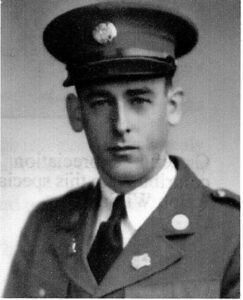 Ralph Williams came back from his service in World War II with a deep appreciation of the sacrifices veterans of military service had made for their country. This is demonstrated by the work he has done on behalf of veterans in Rockingham County for many years. Williams is 95 now and residing in Annie Penn Nursing Center. While presently unable to participate in many of his former activities, he is regularly on the phone to local leadership, inquiring about veteran events in which he has long held an interest and previously was a prime mover.
Williams was born in Rockingham County not far from where his home he built in 1949 is located. His father was a tenant farmer, and Williams moved many times depending on the work situation of his father. He attended Rockingham County schools but dropped out of school in 1925 at the age of fourteen. His parents were ill, and he had three younger sisters. The situation required that Williams help support his family. He worked on the farm and did odd jobs for several years that allowed his family to survive those difficult depression years. Williams’s father died in 1935.
From 1935 to 1940 Williams was fortunate to get intermittent work with John Smith and Company in Leaksville when he was not working on the farm. As another “part time job,” Williams joined the National Guard in 1938. Events in Europe caused the NC National Guard to be called to active-duty September 16, 1940, and Williams began his military career as a carpenter for his regiment in Fort Jackson SC because of his woodworking ability.
Congress passed a law in 1941 that allowed anyone 27 years of age or older to be discharged from active duty if they desired. Williams took advantage of the new law and was discharged in September 1941. He returned to North Carolina and got work in Charlotte in construction. The Pearl Harbor attack on December 7, 1941, changed everything. In January 1942, he received notice to return to active duty and go back to his unit in Fort Jackson. He went back as Supply Sergeant but found he was “surplus” in that position so was reassigned to a unit that needed a Supply Sergeant. He was made part of a cadre to help form the 333 Special Service Engineers in Camp Claiborne LA. Professional engineers were recruited from across the US to make up this elite engineering unit. Williams’s job was that of typical supply activity to keep the unit furnished with material necessary to do their job while it was being formed.
The fledgling unit was sent to Toledo OH for six months to be trained to build airstrips, field hospitals and other unusual projects. They were taught how to build projects quickly and to use explosives to clear obstacles such as heavy boulders. In September 1942, Williams returned to NC to get married. He was able to spend three weeks with his bride, Mary and then was gone for three years.
After Toledo, the unit was assigned to Yuma AZ for further training. Williams remembers the signs on hotels in Yuma, which said “Your room free if it rains.” It did not rain while the 333rd was there except the last day. Tents had been packed, and the men slept a very uncomfortable night outside in rain ponchos. It was terribly hot in Yuma. Wind and sandstorms occurred frequently and were so severe that light poles would be blown over. Sand was everywhere, in the food, clothing, eyes, and sandy grit in the mouths of the men. It was a long six months. Pomona CA was the next duty station for two months.
The unit was still training while sending certain men out to combat zones. While in Pomona, Williams was able to go into Los Angeles with some frequency and visited the USO for inexpensive evenings of entertainment.
The 333rd was ordered to New York for assignment overseas in mid-1943. The trip to England was idyllic for three days. Then, storms hit, and there were 12 days of discomfort. Most men were seasick and could not eat. The seas were so rough; there was constant cleanup in the mess hall of spilled trays of food. Williams had look out duty for two of every eight hours, standing on the bow with binoculars to look for German submarines. This was a very wet job with a pitching deck and heavy waves.
The 333rd arrived in Southampton England. Almost every US service member in England, including the 333rd personnel, was being constantly trained for an invasion, which all knew would be coming but they did not know when. The invasion took place June 6, 1944.
The 333rd arrived at the port of Cherbourg, France in late June 1944. Allied bombers had decimated the port. William’s Engineering unit was assigned the task of cleaning up the port so allied shipping could readily get in and out. The cleanup took place while German bombers were overhead trying to stymie the cleanup and help retake the port. The 333rd worked 24 hours a day under extreme pressure to get the job finished as soon as possible. It was open for very limited business in a matter of days, but it took seven months to complete the work. Ironically, German prisoners of war helped in the cleanup.
From Cherbourg, the 333rd followed allied infantry, staying a few miles behind the front lines rebuilding bridges, repairing railroad tracks and train marshalling yards. In one instance, William’s unit built a railroad bridge over the Main River in Germany in 10 days. The motto of the 333rd Engineers was “The difficult we do immediately, the impossible takes a little longer.”
The most sobering sight Williams saw was that of the Buchenwald concentration camp. Williams saw dead bodies piled up like cordwood. He saw the ovens and the gas chamber “showers.” To this day, Williams does not understand how man can treat other human beings as was done in Nazi Germany, but he knows it happened because he saw it with his own eyes.
Williams says he did not fire one bullet in WW II, but he worked harder than he ever worked in his life, many times around the clock. Other days, it was like a civilian job with regular hours. Statistics show that for every soldier in the front lines there are nine others behind the lines supporting him or her. Williams was one of the supporting soldiers who helped win the war by doing “behind the lines” work that had to be done. He remembers the great group of men making up the 333rd Engineers who were brought together quickly to do a job that would be considered impossible by many standards. The chance occurrence of being classified “surplus” in his original unit in Fort Jackson kept him out of front-line combat.
After the war ended in Europe, Williams stayed for five months in the Army of Occupation. He was near an air base and had many opportunities to go for “joy rides” in military aircraft. He saw much of the European continent from the air. He also had the opportunity to do sightseeing so enjoyed his five months on occupation duty. He finally arrived home in late 1945, to his bride Mary, whom he had not seen for three years.
Williams became a building contractor as well as founding and later selling Rockingham Realty, which is still in business today under other ownership. He has tried to retire but there always seems to be that job that needs to be done that he can do – and he does it. His beloved wife Mary died in 2003.
Ralph Williams’s legacy, beyond his dedicated work at Bethlehem United Methodist Church, is on behalf of veterans in the county. He is the chair of the Wentworth Veteran’s Park Committee and has organized the memorial and veteran’s day events there for years. He is chaplain for the Monroeton VFW and is regularly involved in military funerals in the county, giving a eulogy and thanks for the service of veterans. He is an active member and past leader of the Disabled American Veterans, The Veterans of Foreign Wars and American Legion. Williams has been a tireless advocate for veterans in Rockingham County for years and deserves our gratitude.
Williams remarks, “I lost time in my career due to World War II, but I did what
had to be done.”
Interviewed 5/14/2003