
Myers, Ralph E.
- Service Branch: US Marine Corps
- Rank or Rate: Sergeant
- Service Dates: 1942-1946
- Theater: Pacific
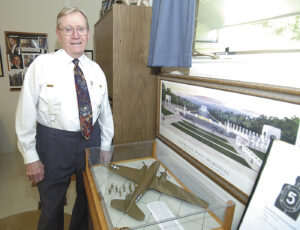 Ralph Myers learned to fly in the late 1930s. The US Marines would later use this skill when as a Staff Sergeant, Myers was assigned as pilot of a military transport to carry US paratroopers invading the South Pacific Island of Bougainville. That mission took a deadly turn, and Myers was fortunate to survive.
Growing up as the son of a farmer and grocer in Florida in the 20s and 30s had its good points. The country was in a depression for a major part of that time, but Myers remembers his family always had enough to eat. They did not have much else in those “boom and bust” times. When a senior in high school, Myers took courses at Florida Southern College and for extra money, did carpentry work on a new building at the college designed by world-renowned architect Frank Lloyd Wright.
On December 7, 1941, while attending college, he was at his fraternity house and heard the news of the sneak attack by Japanese forces. On Monday December 8, all fraternity members gathered around a radio and heard President Roosevelt deliver his famous “Day of Infamy speech” to congress and the nation. On December 18, Myers went home on a Christmas holiday but did not return to college; instead, he went to Tampa to take a physical to enter the Army Air Corps aviation program.
He failed the Air Corps physical exam due to low blood pressure, so he joined the Marine Corps instead in March 1942. The Marines told him to go home temporarily and in May 1942, he was assigned to boot camp at Parris Island SC. Upon his arrival late in the evening, his drill instructor said, “…I plan to make you suffer! Hit the sack because you will be up at 4:30 am.” This set the tone for his training, and the drill instructor was a man of his word.
After thirteen weeks of boot camp, Myers graduated in late 1942 with a great deal of respect for his tough drill sergeant. He felt well trained as a Marine fighting man and believed he could lick anyone.
After two short assignments in the states, he was sent by ship to an airfield in New Caledonia to drive an “Oshkosh” a tractor that is used to position aircraft on an airfield. In January 1943, Myers was sent to Guadalcanal to take part in mop up operations on that embattled island – our first offensive action in the Pacific. As part of that effort, Myers grimly realized the Japanese wanted to kill him. On his two patrols in the jungle, Myers said his unit concentrated on snipers in trees and a space 10 feet wide and 20 feet in front of each man. One had to pay close attention or be a casualty.
After the mop up, Myers was brought back to New Caledonia. Naval ships were bringing in transport planes (DC-3s) with their wings off, to be attached after unloading. There was a shortage of pilots and headquarters was searching service records for men with pilot training. When they discovered Myers had pilot training, he was “told” he must be trained to fly the transports. He was promoted to staff sergeant and after three weeks of training was certified as a pilot. He would fly co-pilot initially in carrying men and materiel on dozens of flights to and from Australia. Myers made two combat missions as pilot, to Bougainville during invasion operations. The first flight was only a 45-minute flight, so a bare minimum of fuel was carried, and all unnecessary equipment was removed from the plane to maximize the number of paratroopers carried. Slowly gaining speed and lifting off with full throttle, the plane was so loaded it could only climb 100 feet per minute. While gaining altitude, machine gun fire from a Japanese Zero fighter caused Myers’ plane to crash in the ocean. Myers made a good pancake landing in the water and fortunately, the partially filled gas tanks aided floatation. Just as help arrived, the plane started to go underwater. Myers and all the paratroopers were saved.
The second mission to Bougainville was also to drop paratroopers. As Myers gained altitude after dropping the paratroopers, his twin-engine transport was hit by cannon fire, which killed his radioman, tore off the right propeller, and blew a hole in the wing. The propeller flew through the cockpit, instantly killing his co-pilot but miraculously missing Myers except for minor pieces of shrapnel in his arm. The aircraft was almost uncontrollable on one engine and with large holes in the wing and cockpit areas. Myers was dazed but alert enough to put the plane on autopilot and struggle to the rear door of the plane to bail out. Ironically, Myers landed in a group of landing craft that were taking troops to shore as part of an invasion force. He was rescued by personnel on one of the landing crafts and became part of the landing force. He embarked from the landing craft and got halfway up the beach when it felt as though he had been hit in the back by a large baseball bat. He saw flashes of lights and stars. That is all he remembers. The man next to him had stepped on a land mine and he had been killed instantly while Myers received 17 pieces of shrapnel in his back.
Myers was evacuated to a hospital on New Caledonia for an operation to remove the shrapnel. All shrapnel was removed except three pieces too close to his spine for a routine operation. A specialist would have to handle that. While waiting some weeks for the specialist to arrive on New Caledonia, Myers recuperated enough to allow him to take a rest and recreation leave in Australia. While there he was involved in an automobile accident, which was not his fault, and the person with him had a broken leg, punctured lung and was unconscious for several days. Myers was not injured but would not leave until his friend was conscious. This caused Myers to be AWOL (absent without official leave) and when he returned to New Caledonia for the operation to remove the shrapnel he was punished by demotion to sergeant from staff sergeant. His time in the hospital counted as part of his punishment so that was the end of the AWOL episode. The surgeon took out only two pieces of shrapnel and Myers did not fly again.
He was assigned to headquarters duty on Bougainville, handling mail and other administrative duties while dodging sniper bullets. He was classified as walking wounded as he still had one piece of shrapnel in his back. On Bougainville, he had many opportunities to hear Tokyo Rose’s music and her propaganda broadcast from Japan in English. One night while listening to Tokyo Rose’s music, there was an astounding announcement by Tokyo Rose that the Japanese were currently mounting a large-scale attack on Bougainville to retake it. Myers jumped up, accidentally breaking the light bulb in his tent and listening for further information. It was deadly quiet and nothing was happening. It was determined later that the Japanese were perpetrating a hoax on their own troops to inspire them to fight with more determination on other islands because of “their success on Bougainville”.
The most courageous man that Myers remembers from WWII was a friend nicknamed Smitty. Myers visited him at the hospital after the battle for Bougainville was over. This man had operated a machine gun against one of the Japanese suicidal attacks on our lines and killed hundreds of Japanese soldiers. A grenade hit him and blew off most of both hands. The Japanese assumed he was dead but a day later when the area was retaken, our troops found him still alive. Smitty embodied all Myers had learned about courage in combat.
Myers came home on a hospital ship in October 1944 and was returned to Camp Miramar in California, being assigned to military police and security duties until May 1946. Myers was discharged and entered the University of Florida under the GI bill, majoring in Architectural Engineering. This led him to a long, successful career as a building contractor in Florida. In the latter part of his career, he took a job in Greensboro as NC State Director of Public Housing, living in Reidsville.
Myers is married to Isabelle and has three children and six grandchildren. They continue to lead very active lives in civic and church affairs in Reidsville. He sums up his WWII experience by saying “I am proud to have served my country in time of need”. Oh yes, the last piece of shrapnel worked its way out in 1992 with some minor surgical help. The scars in his memory remain.
Interviewed 7/23/1999