
Czelusniak, Paul A.
- Service Branch: US Navy
- Rank or Rate: Torpedoman 1st Class
- Service Dates: 1943-1945
- Theater: Pacific
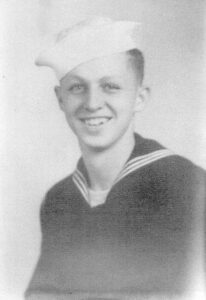 Paul Czelusniak’s submarine USS Billfish was trapped on the bottom of the Yellow Sea. An aggressive Japanese destroyer was firing depth charges, which exploded all around Billfish. The crew was quiet and tense. Softly, over the loudspeaker Captain Farley, the commanding officer, read a passage from Holy Scripture as the submarine settled to the bottom – then silence. Most crew members were on their knees praying, fully expecting the next explosion to put them in a watery grave. Miraculously, the destroyer lost contact, saving the lives of the Billfish crew. “It was way too close for comfort”, says Paul Czelusniak.
Czelusniak was born in Nanticoke PA, one of eight children. In Nanticoke, his father relied heavily on coalminer business in his automobile garage, but the unions had virtually shut down the mines in the late 30’s. Czelusniak’s father was unable to survive financially, so he moved his family to Amsterdam NY, getting work at the Mohawk Rug Mill in Auburn NY. Paul quit school after the 11th grade to help support the family and worked in a cotton mill for a time, then Mohawk Rug Co. and finally at the Army Supply Depot near Amsterdam.
Czelusniak remembers well when Pearl Harbor was attacked, having heard the news over the radio while sitting in his living room. He immediately went down to enlist but his parents did not grant permission. When he approached 18 years of age, he told his parents he did not want to be drafted into the Army, so he asked, and received, his parents’ approval to join the Navy. A heart murmur found during his physical prevented his entry into the Navy. When he registered for the draft, Czelusniak fully expected to be rejected because of the heart murmur. During the examination for induction, no murmur was found. Czelusniak was bound for the Army until he happened to see a Navy recruiter who allowed him to join before his official induction into the Army. A heart murmur was not detected in the Navy physical.
Boot camp followed at Sampson NY in December 1943. Because of his carpentry experience in High School, he was assigned work to build a large wooden cabinet, among other items, for use by one of the senior petty officers. Consequently, he missed four out of eight weeks of boot camp while working on carpentry projects.
His aptitude tests indicated he would make a good Torpedoman, so he was sent to Newport RI to an eight-week Torpedoman school. He learned all aspects of the Mark 14 and Mark 15 torpedoes, which were the mainstays of the submarine fleet. The Mark 14 and 15 Torpedoes are 21 inches in diameter; about 20-1/2 feet long and weigh well over 3,000 pounds. They carried about 600 pounds of a special high explosive called Torpex. The torpedoes ran on steam generated in a combustion chamber within the torpedo. A trip lever in the torpedo tube as it is launched starts the whole process working to activate the combustion and steam. The torpedoes were beautifully made of polished stainless steel built to withstand 3,000 lbs per square inch pressure.
A Torpedoman, when firing a torpedo, opens the inner doors of the torpedo tube and using winches, inserts the torpedo in the tube. Information on the target ship’s speed, range, and bearing from conning tower observations is put into the Torpedo Data Computer built into the torpedo. The outer doors are opened and upon receiving orders from the conning tower, the torpedo is fired, using compressed air to blow it out of the tube. The work of a Torpedoman was one of many jobs critical to the survival of a submarine during combat.
Czelusniak then volunteered for submarine school in New London CT where he was immersed in all aspects of submarine operations. Aboard a submarine, a crewmember could be caught in any area of a submarine during battle as watertight doors are closed during combat. If you were in a particular space, you had to know what to do in that space – your life depended on it. When a submarine crewmember was thoroughly trained, he would receive his “dolphin” insignia indicating he was part of the elite undersea force – a SUBMARINER.
Czelusniak was also trained in the use of the “Momsen lung” a breathing device which allowed submariners to escape from a sunken submarine. During the training on the Momsen lung, the psychological fear of water at great depth was enough to “wash out” many of the aspirants for submarine service. Czelusniak’s fear was not of the water but only of failing to attain his goal of being a submariner. During a pressure test, he was put in a small airtight chamber, and the air pressure was increased every few seconds until he thought his eardrums would burst. He had to swallow often to equalize the pressure. It grew very hot in the chamber, and he perspired profusely so that his Navy jeans were stuck to his skin. His skin was blue from the dye in his pants. He passed the pressure test!
His only dive in a submarine at New London was in an old WW I submarine that leaked. As the boat went down a heavy stream of water came from a fitting, and the students were frightened. The grizzled chief petty officer told the students that the leak would “seal” as they went deeper. No one believed him at the time, but it did. Another psychological test!
Czelusniak was then assigned to San Diego to be trained in electric torpedoes. The steam torpedo looked like an elegant piece of machinery with all the polished stainless steel while, Czelusniak said, the electric torpedo “looked like a large old, weathered tin can”. Seventy-two battery cells drove it. The electric torpedoes were simpler and were coated with Cosmoline, like heavy Vaseline, to avoid rust. Their cost was small compared to the stainless-steel torpedoes, but they were effective.
After the voyage to Pearl Harbor, he was assigned to USS Billfish. He was a second-class seaman at the time. The captain had to approve all new crewmembers and said, “we only have first class seaman or above on this vessel, so I am promoting you immediately to 1st class seaman.”
Due to the heat aboard the submarine Czelusniak typically only wore cut off Navy jeans, a tee shirt, and special noiseless sandals. The decks of Billfish were also padded to eliminate noise. Typically, Czelusniak had four hours on duty and eight off, around the clock. When off duty he was either sleeping or working on something related to his job. He had limited time for personal things.
Czelusniak’s bunk was in the “bridal suite” as it was called, located in the forward torpedo room, the best bunk on the submarine for an enlisted man. He did not have to alternate use of his bunk with anyone else while all the other sailors had to alternate use of a bunk. There were no sheets, and he slept with his clothes on. When fresh water was available, he could shower and wash his clothes. His gear locker was the size of a normal suitcase. He only had his work uniform aboard the submarine with a couple changes of underwear as well as the standard foul weather gear. His dress blues and any dress outerwear were stored at Pearl Harbor.
On the eighth war patrol, USS Billfish sunk one Japanese cargo vessel and experienced the depth charge attack mentioned earlier. While on the surface on August 6, 1945, a lookout saw the flash of the atomic bomb explosion. The Billfish crew did not learn the war was over because they could not break radio silence. After the Billfish crew learned the war was over, the worst part of the return to Pearl Harbor was going through a minefield aware that a mine could sink the vessel “after the war was over”. Czelusniak heard some mine cables scraping the side of Billfish, which was very unnerving.
After short stays at Eniwetok and Pearl Harbor, the Billfish was going home via the Panama Canal to Houston TX for the first Navy Day celebration and on to Staten Island NY. Czelusniak was released from active duty at Long Island NY. It was Christmas Eve 1945 and Czelusniak took the train to Amsterdam and surprised his parents who came home from catholic mass to find him sleeping on the couch.
Czelusniak returned to the Army Depot for a while and then worked for Mohawk Rug Co. He was offered a job with Karastan Rug Mill in Auburn NY and then transferred to Eden NC. He retired as a Creative Product Specialist with twelve patents regarding rug and carpet manufacturing to his name.
He is married to the former Betty Ingalls and has five children scattered across the country. He is very proud that his two sons and grandson have served in the military. Paul Jr. served on nuclear submarines during the cold war. His son Vernon served 21 years in the Coast Guard, earning a PHD degree after his time in service. His grandson is a pilot with the US Coast Guard.
Czelusniak is proud to have served his country on USS Billfish with such a great group of fighting men.
Interviewed 5/1/2002