
Blanchard, Manfred T.
- Service Branch: US Army
- Rank or Rate: Captain - DDS
- Service Dates: 1944-46
- Theater: China
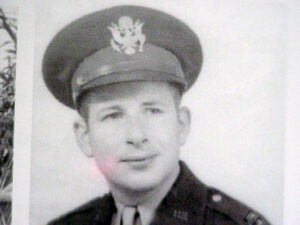 The 1079-mile Stilwell Road in Burma was not a road you would want to travel for a Sunday afternoon drive in 1944. It was named after tough General “Vinegar Joe” Stilwell, who by force of his office and personality built a military road which most persons thought, was impossible. It was a brutally rough military road hacked out of the jungle, traversing through the Himalayan Mountains, known as the “roof of the world”. This was a jungle inhabited by nature’s most vicious beasts and insects, racked by monsoon rains, and inhabited by fierce native tribesmen. Manfred Blanchard traveled this road 15 times from Ledo, India to Kunming, China to help supply the Chinese army with material to fight the war against Japan. Why was a US Army licensed dentist assigned work so far removed from his profession?
Blanchard was born in Elizabeth City, NC. His father was a medical doctor and very early in life, Blanchard became known as “Doc”. This continues as his nickname today. Hunting was his passion and the Dismal Swamp, with ample supply of deer was his hunting ground. Many times, he saw bears in the swamp but never had a good shot at one. Ironically, even before he graduated from high school Blanchard had a desire to have a professional career as a US Army dentist.
After graduation from Wake Forest University, he continued his education at Emory University in Dentistry. Early in his senior year at Emory, he was drafted into the Army as a Private but was able to continue his dental training until graduation in June 1944. On weekends during his senior year, he took basic military and physical training. After graduation, he went to Officer Candidate School at Carlyle, PA to learn military history and strategy as well as other courses to qualify for his promotion to First Lieutenant. Professional medical personnel skipped the rank of Second Lieutenant.
Surprisingly, after OCS, Blanchard was assigned for several months to Ft. Leonard Wood, MO for training as a Combat Engineer. The Army needed combat engineers more than they needed dentists.
Long Beach, California was Blanchard’s next stop, to board an old cargo ship with a Hindu crew to go to Calcutta, India. When the ship crossed the International Date Line, Blanchard and others, were the subject of hazing that was typical for those crossing the line for the first time. As a minor part of the hazing, Blanchard received a crew cut. He liked it and continues with a crew cut to this day. His ship encountered severe storms that sank some ships but Blanchard recalls his ship’s captain was very astute and made the voyage without damage.
In late 1944, Blanchard finally arrived at Calcutta and continued on to his duty station in Ledo, India, which was the beginning point of the Stillwell/Burma Road. The famous Merrill’s Marauders combat unit had cleared the road of Japanese troops and the Stillwell road was then a primary route to get supplies to Chinese forces.
Blanchard was assigned to be the dentist for the troops stationed at Ledo. Conditions were poor for good dental work at Ledo and Blanchard could only handle emergency cases. He used old, slow, painful drill equipment powered by a soldier on a treadle similar to that of an old sewing machine, to turn the drill. There was little Novocain for pain. He worked in a Bamboo hut with a concrete floor, and patients had to spit in an old bucket during treatment. As a professional dentist, this was not satisfactory, so Blanchard requested an old headlight from the motor pool and used the base for a spittoon with a watering can rigged above to spray water in the spittoon. He had a pipe put in to drain water and debris from the makeshift spittoon to the outside. Blanchard’s commanding officer was impressed with the “new equipment” and Blanchard was commended for his ingenuity.
After most of the emergency dental problems were handled, Blanchard, being very adventuresome, asked to be more involved in the transporting of supplies to Chinese forces. The request was granted, and he was part of the next convoy to Kunming, China. Blanchard’s responsibility was to drive a Jeep as leader of about 40 trucks. It took a week to travel 1079 miles to Kunming. On the way, the road went through tropical jungle as well as reaching an altitude of about 9,200 feet. There were fueling stations, which were overnight stopping points along the way. Bulldozers were positioned to repair roads and literally push trucks through otherwise impassable, washed out, portions of the road. After the monsoons and roads, the worst enemies of the men in the jungle were mosquitoes, and annoying bugs. Atabrine tablets (anti-malarial) were part of the daily diet. Upon return to Ledo, his commanding officer was pleased with the results of the convoy Blanchard led and assigned him as a convoy leader until further notice.
The trucks normally used were GMC or Studebaker. GMCs had doors but Studebakers did not. Several drivers suffered court martial (formal legal punishment) rather than drive a GMC. The Studebaker trucks had nothing to hinder getting out of the truck if it went over the side of the treacherous road. On one occasion, the driver of a truck went over the side of the road and was never found. These were all new trucks full of supplies, and they remained with the Chinese upon reaching Kunming.
The trip back to Ledo, India over and through the Himalayas was another dangerous venture. The convoy members, about 100 men, flew back on twin-engine C-47 transports nicknamed “Gooney Bird” over what was called “The Hump”. Each aircraft held 21 passengers. It was a three-to-four-hour flight to cover the 500 miles back to Ledo and was extremely dangerous. The weather was unpredictable. Visibility could change from good to poor quickly. Due to the height of the mountains, pilots had to pick their way between some mountain peaks rather than over them. Cold weather caused ice buildup on wings and propellers. It was common to hear ice thrown off the propellers hitting the side of the aircraft. Frequently the aircraft might drop hundreds of feet in a downdraft giving the feeling of the aircraft breaking apart. Many times, in bad weather, Blanchard could see anxiety on the pilot’s face, which reinforced Blanchard’s anxiety.
Blanchard logged 15,000 road miles to Kunming and 7,500 air miles on return flights to Ledo. Ledo was a primitive Hindu village, and the Army post was on the edge of the village. The local people did not welcome service members in the village, so time was spent on base usually. There was much rain accompanying the monsoon winds, along with generally gloomy weather. Spare time was spent resting up for the next grueling convoy.
The supply route from the US to Kunming via Calcutta and Ledo was more that 14,000 miles. The longest supply line in the world. More than 500 planes were lost in the years the US supplied war material to Chinese forces by air. Many more lives were lost building and defending the Stilwell Road.
On one occasion, the adventuresome Blanchard took a jeep for a recreational ride in the jungle. A storm came up and he got lost temporarily. He approached a native village and was surprised to hear bullets striking trees near him. He quickly turned around and was thankful to find his way back to Ledo before long.
In mid-1945, after his 15th convoy, Blanchard received orders to Shanghai as a dentist for the General Hospital. Blanchard’s duties were limited, and he was able to spend some time sightseeing and enjoying cosmopolitan Shanghai. While he was in Shanghai, it was as if there was no war on in the world. The war ended officially on September 2, 1945. Although Blanchard could have been released from active duty, he remained in Shanghai until October 1946 fulfilling his dental responsibilities while continuing to enjoy Shanghai.
In October 1946, Blanchard received his orders back to the US for release from active duty. On the flight from California to Ft. Bragg, he had the most frightening experience of his life. The twin-engine aircraft took off from the air base and while climbing, lost power in one engine. There was no place to land and a crash on the rocky coast seemed certain. A panicked pilot asked any passenger with flying experience to come to the cockpit. There were none. The pilot told all passengers to assume the crash position and to start praying. As the aircraft almost crashed, the engine coughed and started again. With additional power, a crash was avoided. The plane landed at the nearest airport, and all passengers boarded another plane to continue the flight.
Blanchard was released in November 1946 and returned to Elizabeth City for a time, practicing dentistry with a friend. In 1948, he learned of the need for dentists in Leaksville. Former mayor John Smith Sr. and local attorney Floyd Osborne encouraged Blanchard to come to Leakesville to help fill the need. In 1948, Blanchard and his late wife, Lola (deceased), came to Leakesville to establish his dental practice.
Blanchard says his World War II experience brought him closer to God as evidenced by his long-time active membership in First Baptist Church in Eden, NC
Interviewed 8/23/2002