
Griffith, L. Bethel
- Service Branch: US Marine Corps
- Rank or Rate: Private First Class
- Service Dates: 1943-1945
- Theater: Pacific
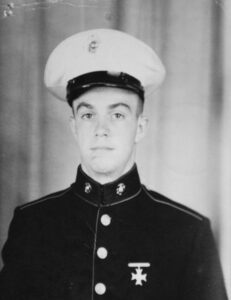 Bethel Griffith was part of the “Lost Company”. In 1943, Company A, Tenth Amphibian Tractor Battalion, became separated from their Battalion and was in combat with various other units without pay or mail for seven months. A birthday cake sent by mail in August 1943 was finally received by Griffith in August 1944 – as a pile of dust. Company A was on no official roster or supply list. They survived by “procuring” as necessary, what they needed to function as a fighting unit.
Griffith was born in Virginia but grew up in Leaksville NC. He was drafted in 1943 but was in the Army only three days. His trip to Fort Jackson was in a converted cattle carrier with seats on the side walls, pulled by a truck. When at Fort Jackson, some marines came up to a group Griffith was in and said, “We need 10 good men.” The Marines appealed to Griffith, so he requested, and was granted, a discharge from the Army and joined the Marines.
Upon arriving at Parris Island for boot camp, his head was shaved, and Drill Sergeant Croft began calling Griffith and the other “boots” every name in the book to break them down and start building them up as Marines. Griffith says he was afraid of Sgt. Croft but did get used to the verbal abuse. His uniform consisted of two each, of t-shirts, under shorts, pants and fatigue jackets along with shoes and socks and a pith (a cork-like material) helmet. He had to wash clothes every day to be sure he had clean clothes. They were hung out to dry behind the barracks and frequently were stolen by other marines. Griffith’s T-shirts were stolen, and he had to steal one to be properly dressed because he could not buy one. It happened that one Griffith “confiscated” had Sgt. Croft’s name stenciled on it.
Intense training was going on every hour of the day and night. It was not unusual to be awakened at three a.m. for educational movies, calisthenics or rifle drills. Griffith said “I went in as a 17-year-old boy and came out a man. There was not an ounce of fat on me – I was all muscles. He was taught to kill or be killed. Unlike most, Griffith graduated as a Private First Class rather than Private.
Griffith was transferred to Camp Lejeune to begin Landing Vehicle Tractor (LVT) training. This was new, but necessary, as many of the Pacific islands had coral reef barriers that could not be crossed by a “Higgins boat” like those later used on D- Day landings in France. While in Camp Lejeune, Griffith heard regularly of German spies coming ashore from submarines and being caught.
In October 1943, Secretary of Navy Frank Knox came for the graduation of Griffith’s unit and later wanted to ride in an LVT. Griffith was the chosen driver and had the opportunity to shake hands with Secretary Knox. He told Griffith, “That was a good ride”.
The LVT, also called an amphibian tractor, could travel on water or land. They had a 250-horsepower engine, tank like treads with cup like cleats which allowed the vehicle to attain speed of 6 mph in the water. They could go 12 mph ashore. They carried 24 men or 4,500 pounds. They were about 20 feet long, seven feet high and weighed about 33,000 pounds. The LVT had two 50 cal. and one 30 cal. machine guns as armament. Griffith was slated to be a crew chief on a LVT.
It was a five-day trip to Griffith’s next duty in San Diego for further departure overseas. The troops were in two rail box cars that had two bathrooms for 125 people and one of those had all the bags in it. Griffith, at Private First Class, was the second highest rank in the box car so was designated co-leader of the group. They had chicken and eggs in some form every day. Several men got sick, and the box car was a mess upon reaching San Diego. Griffith’s LVT required some extra armor plate so it could not leave San Diego with the others. He later went on a new LSD (Landing Ship Dock), with no accompanying convoy. Twenty-four LVTs and a company of Marines were aboard for the lonely voyage across the Pacific. Fortunately, no Japanese submarines were sighted.
In what was the longest invasion voyage on record, Griffith’s ship went from San Diego directly to the island of Namur in the Marshall Islands. Griffith’s job was to take Marines from ship to shore on the LVT; then follow up with ammunition, food, and water. Griffith did not know where he was until the captain gave tactical information to the men before going in on their first run to shore. Most of the men Griffith carried into shore were killed within 100 yards of their landing position. It was gruesome, frightening and demoralizing work. It could not have been done without those tank-like treads which allowed the LVTs to go over the coral reefs.
On one trip to the beach Griffith picked a Marine out of the water who was cold, half naked and incoherent. Griffith gave him his outer clothes and took him to a hospital ship for care. That night he and his crew on the LVT were invited to spend the night aboard a Merchant Marine vessel anchored in the area. It was the first night with good food and in a good bed, in weeks. They were surprised in the middle of the night because the ship was moving. The captain told Griffith that he had a sudden order to return to Pearl Harbor. He could not put Griffith and his crew off because they would be killed by our own men if they tried to go ashore at night. So, off on a ten-day voyage to Pearl Harbor and a long explanation to authorities as to why they were there instead of Namur.
At this time Griffith was in Company C and when he returned found that the 10th Amphibian Tractor Battalion had been transferred to another island and Company A had accidentally been left behind. He joined Company A and became part of what is known as the “Lost Company”. The commanding officer of Company A found a ship going to Guadalcanal where the 10th Amphibian Battalion was supposed to be but he found they were not there. The 3rd Marine Division added Company A because they needed the LVTs, but it was not authorized. Company A was not on any payroll list, nor did it have a mailing address so mail could be delivered. No supplies or any support was available. The men had to get food and water and transportation from other units any way they could. Many men were suffering from jungle rot, dengue fever and malaria. It was a pitiful scene in the sick bay.
Griffith’s Company A went with the 3rd Marine Division to Guam for the July 1944 invasion. On Griffith’s run to the beach, he and others missed the spot they were headed for by about 600 feet. Twelve LVTs that hit the beach exactly where Griffith should have been, were blown out of the water. That mistake saved Griffith’s life as well as the other men in the LVT. He later had to go pick up the bodies of the men who were killed.
Particularly interesting to Griffith while on Guam there were the Navajo Code Talkers in his company. He occasionally heard them pass information by radio to headquarters in the Navajo language, which could not be interpreted by the Japanese. In Griffith’s opinion we would have lost the Pacific Island war without the Navajos.
The night after the invasion Griffith’s sergeant sat down next to Griffith and said, “I have been hard on you but I really like you and appreciate what you do”. That same night Griffith’s sergeant was shot and killed by a Marine guard because the sergeant did not remember his own password, he had given out to be used that day.
Griffith’s brother was in Saipan and had been on the battlefields with some officers checking the casualties. He stumbled upon a body with no dog tags or other ID but with the name on the fatigue jacket of L B Griffith. This was the body of the marine that Griffith had pulled from the water at Namur and to whom he had given his clothes. His brother assumed it was Bethel Griffith lying dead on the battlefield but was able to take leave and visit Griffith on Guam to be sure he was still alive. Griffith recalls a very happy meeting with his brother.
Guam was a dangerous island because there were so many Japanese soldiers still alive and infiltrating the Marine compounds at night looking for food. There were many Japanese shot by guards close to where Griffith lay sleeping. While on guard duty, Griffith had the same experience of seeing Japanese soldiers creeping in the tall grass surrounding the encampment. In one case a Japanese soldier entered Griffith’s tent and was shot just before attacking Griffith’s tent mate.
About this time Griffith had seen so much combat with accompanying stress that he was allowed to leave Guam and be returned to the US for rest prior to discharge from active duty. It has just been the past few years that Griffith has been able to put to rest some of the visions he has of what he did and saw during his combat duty. He feels he is fortunate to be alive and was saved for a purpose. His compassion for his fellow soldiers and marines is exemplified in his work over many years with Disabled American Veterans. He founded the service in Rockingham County to take veterans to the VA hospital for appointments, driving thousands of miles a year in this service.
Griffith was discharged in March 1945 returning to Rockingham County, working primarily in automobile and motorcycle sales. He was married to Francis (now deceased) in 1946 and has three daughters and one son. He continues to give unselfishly of his time to help fellow veterans in their hour of need.
Interviewed 11/15/2002