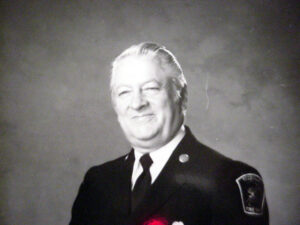
Monsees, John Hilton
- Service Branch: US Army Air Corps
- Rank or Rate: Sergeant
- Service Dates: 1942-1945
- Theater: Europe
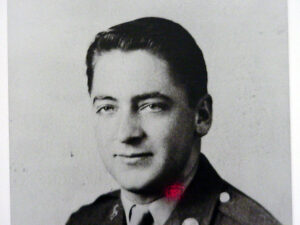 In action over Germany
“Everything happened so fast that you didn’t have time to think”
On approaching a bombing target
“You could see this big black thunderstorm ahead only it wasn’t a thunderstorm,
It was flak as far as you could see and we were heading right into it. We prayed a lot”
On losing an engine over Germany
“We threw overboard everything we could except our parachutes, in order to stay in the air”
On Axis Sally – German radio propaganda personality
“She knew who we were, where we had been and how many losses we took before we knew”
On loss of plane in the squadron
“Planes alongside me with my buddies inside just disintegrated in midair”
On his time in the Army Air Corps
”I am proud to have served, and I would do it again – right now!”
John Hilton Monsees was born and raised in Reidsville, NC but lost both parents before WWII and lived with his sister Hazel Fitz until entering the service. While in the 12th grade in November 1942, many of his friends were being drafted and Monsees enlisted in the Army Air Corps rather than wait for the draft to call him into the Army.
He reported to duty at Fort Bragg 2 days after enlisting. After 2 weeks of indoctrination at Ft. Bragg, he was sent to Keesler Field in Mississippi for basic training. The Master Sgt in charge (a good friend of the family) was from Rural Hall NC and intended to spare Monsees some of the indignities trainees usually endure. However, he spent 13 days peeling potatoes and washing pots and pans which was worse than the training he missed. At Keesler Field, Monsees spent 6 months in basic training as well as intense training in aircraft mechanic training and aircraft maintenance. This included 7 am to 5 pm in class during the week and on Saturdays for inspections.
In mid-1943, Monsees was transferred to Laredo, Texas for intensive gunnery training. As part of this training an aircraft would tow a target sleeve and Monsees, in another aircraft, would shoot at the target sleeve with a 30-caliber machine gun. Bullets were marked with paint that would come off when the sleeve was hit so the accuracy of each gunner could be determined by examining the target sleeve.
After gunnery training Monsees was transferred by train to Salt Lake City. This was a 5-day trip with only hard seats to sleep on and one bathroom for 100 men in each railroad car. Salt Lake City was a replacement depot and a stopping point before being assigned to Clovis, NM for transition school which was to prepare for assignment with a bomb group overseas. Monsees was assigned as a flight engineer. His duties were to stand behind the pilot and co-pilot to maintain, repair equipment or replace if possible, or do anything to keep the plane airworthy. This included watching gauges, transferring gasoline from tank to tank as necessary, keeping the four engines in synchronization, and generally keeping the aircraft in flying condition.
At Clovis, air crews were formed for overseas assignments and Monsees chose to volunteer for the crew of Lt. Joe MacAlister’s plane. MacAlister is the toughest man Monsee has ever known. He was accepted as Flight engineer and his job at that point was to choose the remainder of the enlisted air crew. He was 19 years old at the time.
From September 1943 to December 1943 he was assigned to Charleston, SC for overseas crew training and then back to Clovis and on to Mitchell Field Long Island where his crew and others were given brand new, combat equipped, B 24 Heavy Bombers. While at Mitchell Field, more training ensued with close formation flying and simulated bombing runs on 50-gallon steel drums in the ocean. On 12/18/1943 his crew left Mitchell Field and except for the pilot and navigator, had no idea where they were going. Morrison Field, Fl was the destination. After 2 days at Morrison Field, on 12/20/1943 the crew left for Trinidad and then in Brazil. While in Brazil one of the crewmen lamented “I miss America already”. Thus, was born the name of their B 24 – Miss America ’44. A Varga girl graced the nose of the B 24 above the name “Miss America ‘44”. At exactly midnight on 12/31/1943, the crew of Miss America ’44 left to cross the Atlantic Ocean bound for North Africa.
A heavy storm was encountered on the way and along with low fuel, caused a Mayday call to be sent. A British Air base responded and fortunately, it was close to Miss America 44’s location. The ceiling was about 200 feet and after a frightening approach and landing, Miss America “44 was safe on the ground. As this was a small fighter base, the wings of the giant bomber barely cleared the fighters parked near the runway. The crew was met by British machine guns until identification was verified.
The aircraft and crew went on to Algiers for 4 weeks close formation flying and then to San Giovanni, Italy. Twenty-five allied air bases were within 50 miles of San Giovanni.
Hilton Monsees flew 50 combat missions from that base during the next 8 months. Before each mission, he wrote a letter home, believing it might be the last correspondence he would ever send.
On a typical bombing mission day, he would get up at 3 am to a wakeup call from his pilot. There was no hot water, so a cold-water shave followed the wake-up call. Oxygen masks are very close fitting, so a shave was necessary each flying day to avoid any loss of oxygen due to seepage around the face mask. These masks were required on all missions because of the high-altitude operations. He ate a breakfast of powdered eggs, toast, marmalade and grits. After breakfast he went to the briefing room where a map was displayed showing the weather, route to and from the target, pockets of anti-aircraft artillery and enemy fighter air bases which could cause trouble enroute.
Pre-fight checking of the bomber was followed by last minute comments from the ground crew chief on anything of significance regarding the aircraft. Squadrons lined up and when the flare from the control tower was fired, take off started and bomber formations began forming in the sky. Typical targets were ball bearing plants, tank manufacturing locations and rail marshalling yards. Two bombing runs to Rumanian oil fields were included in the 50 missions Hilton flew.
German fighters usually attacked the formation about 2 hours after leaving the base and continued intermittently until 2 hours before arriving back at the base. On the bomb run itself, the German fighters held back because they did not want to be destroyed by their own anti-aircraft fire. Many aircraft were lost due to enemy fighters or anti-aircraft fire. Most of the bombing missions Hilton flew were unescorted by our fighters due to endurance limits of the fighters. This improved later when the fighters were able to use droppable gas tanks.
Upon returning to the base, the crew was debriefed concerning number and type of enemy aircraft met, anti-aircraft fire concentration points, weather encountered and any aircraft lost. Except for one man injured by flak, several engines shot out and hundreds of bullet holes in Miss America ’44, the crew was unscathed after 50 missions.
On 9/3/1944, Hilton embarked back to the states on a Liberty ship which also held 700 German POWs. After turning down an offer to “enjoy” a B 29 bomber assignment in the Pacific, Hilton spent the remainder of his time in the service in Denver, Colorado, teaching aircraft maintenance to air crewmen. While in Denver he finished his High School requirements which were transferred to Reidsville in time for him to graduate with the Reidsville High School class of 1946.
Hilton Monsees later became Fire Chief of the City of Reidsville, retiring in 1984.
He is married to the former Juanita Talley. They have one daughter Lynn, married to Ray Carter. They have one grandson, Nolan Monsees Carter. Interviewed 5/14/1999