McGlohon, John A.
- Service Branch: US Army Air Corps
- Rank or Rate: Sergeant
- Service Dates: 1941-1945
- Theater: Var/Pacific
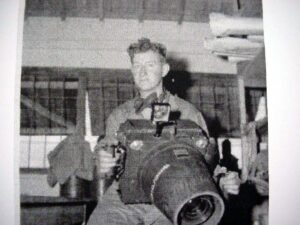 This reconnaissance mission was like any other mission. The B-29 Super Fortress crew got up in the wee hours of the morning to get ready for the 15-hour round trip flight to Japan to take reconnaissance photos. John McGlohon was the photographer and had his cameras ready and a full load of film canisters. However, this day, August 6, 1945, was different as it marked the beginning of the age of atomic warfare and McGlohon and the crew of his aircraft Shutterbug was to be an accidental eyewitness to history.
John McGlohon has lived in Asheboro virtually all his life. He attended local schools and graduated from high school in 1940 at age 16. After graduation, he worked for a time at Rose’s Dept Store and left for a higher paying job at Sun Spun Chenille Co. There was not much going on in Asheboro, and he knew he did not want to work in the mill much longer. The draft was just getting started but few men from Asheboro had been called. On June 3, 1941, his 18th birthday, he joined the Army Air Corps to see something beyond Asheboro. He wanted to be a parachute rigger.
On June 10, 1941, McGlohon was on his way to Charlotte to be sworn into the Air Corps. Later that same day, he went from Charlotte by train to Maxwell Field AL, arriving at two a.m. the next morning. He was assigned to an empty hanger with only one cot in it, his own. By the end of June 1941, the hanger was full of new recruits. There was not much to do yet, so his days were filled with sweeping streets, digging ditches, KP duty, marching and general orientation to the Air Corps.
McGlohon learned a photo squadron was being formed at the base and he volunteered. When asked what he could do, McGlohon replied, “I can type”, His first job in the Air Corps was as a typist with the 3rd Photo Mapping Squadron in September 1941. McGlohon had become very interested in photography in earlier years. He hung around the squadron photo lab so much it was clear he had an interest in that line of work. He was put in charge of developing and copying photos for the squadron.
War was heating up in Europe, and he was aware of increased activity on his base. In November, his unit was moved to a textile mill in Montgomery AL to provide more space for operations. Four weeks later, on December 7, 1941, Pearl Harbor was bombed. McGlohon has been a regular attendee of church since his youth. He was attending church that day and went to a movie afterwards. In the middle of the movie, the lights were turned on and all military personnel were told to return to their duty stations. When he arrived back at his base, he was told to get rid of his civilian clothes and wear only his Air Corps uniform. His squadron was sent briefly to Tampa FL and then assigned to Recife, Brazil. The first plane in his squadron, with the Commanding Officer aboard, crashed on takeoff to Recife and all were killed. This delayed the beginning of the project for a few months.
The plan was to map the east coast of South America. Our aircraft going to Europe would leave from South America when the route to destination was shorter. Our pilots needed good maps to make the flights over South America safer. Three cameras were mounted in the photo planes, one pointing vertically down and two at 45-degree angles, one to the left and one to the right. With overlapping exposures, the cameras would give 100% coverage from horizon to horizon. Each camera weighed about 50 pounds and carried film 9 ½ inches wide and 500 feet long in each of the many canisters on board the plane.
One time, a photographer got sick and asked McGlohon to fly for him. From that time on McGlohon started to fly regularly. The 3rd Photo Mapping Squadron operated almost independently with little support from anyone in the area. The crew scrounged for food and water and felt as though they were orphans. It was known there were German spies in their area and that made the mapping work even less comfortable.
One night a message came in asking the sizes of the crew for arctic clothing. That seemed unbelievable since they were in sweltering heat in South America. Soon, orders were received to go to Alaska and western Canada to map the area in advance of our invasion of the Aleutian Islands to rid it of Japanese troops. The crews were assigned B-25 Mitchell bombers fitted for photo mapping. The weather was very cold, foggy and uncomfortable. Volcanic ash pitted the propellers so badly they had to be refurbished every three missions. The Japanese abandoned the Aleutians, and an invasion was not necessary.
McGlohon’s squadron was transferred from Alaska back to the states and then on to the China-Burma-India (CBI) Theater in late 1943 to map the Himalayas. The squadron was now flying four engine B-24 Liberator bombers fitted for photo mapping. Upon landing at stopping points, they slept under the planes in hammocks. One night in India, a cobra was discovered, poised ready to strike a sleeping crewmember. The cobra was seen just in time and killed. During the mapping of the Himalayas, McGlohon was in the forward gun turret helping the pilot avoid mountains. On the outward portion of the flight, the plane had to fly low because it was heavy with gasoline. On the way back, the plane was lighter, and they could fly over most of the mountains and get good pictures. About this time, McGlohon caught malaria and was out of action for several days. He recovered and shortly after, his squadron was transferred back to McDill Air Base FL.
McGlohon got leave to go home for a few days. While home, he suffered a malaria relapse and was delayed in returning to McDill. When he got to McDill some days later his squadron had been transferred to Salinas, Kansas and was to be given a brand-new B-29 Super Fortress reconfigured as an F-13 photo recon aircraft. The plane was named Shutterbug by the crew.
It was the sixth one produced by Boing. This long-range aircraft was needed to fly extreme distances in the Pacific. McGlohon flew to Salinas and arrived before his crew did by train. As a side note, one of McGlohon’s fellow crewmembers was “Stocky” Stockdale. The navigator was Lt. Mac Hyman who later wrote “No Time for Sergeants” which was made into a movie starring Andy Griffith. Griffith’s role was based on crewmember Stockdale.
About this time, McGlohon’s brother, a pilot in the European Theater, was killed in action. McGlohon returned home for the funeral and upon return, his squadron was transferred from Salinas to India for mapping of the Burma and Lido roads through the Himalayas. In the spring of 1945, his squadron was transferred to Guam to fly mapping missions to Japan, Korea and western Russia, preceding a planned invasion of Japan by Allied Forces.
Departure for these long-distance flights was usually at 3 a.m. and arrival over target at daybreak. On some of the 15-hour recon flights, his aircraft faced enemy fighters and much anti-aircraft flak. It was common to patch holes in his B-29’s fuselage. Japan was running out of gas for its war effort, so enemy fighter aircraft were not faced very often. On another occasion while flying through the clouds, McGlohon’s plane nearly collided with a Japanese bomber. The crew could alternate by taking naps on the long, tiring flights. Typically, the recon flight would go in advance of a bombing mission to help pick targets, or after the mission to assess damage. The plane would just skim the water to avoid enemy radars until climbing to altitude for taking pictures.
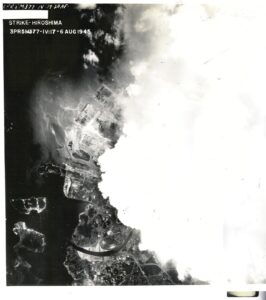
The flight on August 6, 1945, started routinely. Of course, there was no knowledge of the momentous event that was to take place that day. On August 6 – at 8:16 a.m. – McGlohon’s plane was headed toward Hiroshima, Japan and as Shutterbug crossed the coast of Japan, the crew was surprised by something akin to a million flashbulbs going off at one time and all crewmembers were momentarily blinded. Shortly after the blast, they noticed another B-29 going past, presumably headed to Tinian. McGlohon thought to himself, “Wow, that bomber must have hit a huge fuel or ammo dump right on the button.” They later learned the mystery bomber was the “Enola Gay”. The combined speed of the planes was about 600 miles an hour, so they were approaching each other rapidly. As McGlohon’s plane continued to Hiroshima, McGlohon turned on his cameras and recorded the “hit” for the mystery B-29 and Shutterbug continued its photo mission to northern Japan.
Upon arrival back at Guam, officials heard about McGlohon’s plane and its experience earlier that day. Two marine sentries were at the photo labs as the truckload of film was delivered from McGlohon’s plane. Shutterbug was isolated at one end of the field and checked for radiation. There was none! McGlohon saw some of his pictures, which were already stamped “top secret”. McGlohon’s pictures were flown to Tinian where the Enola Gay, the plane that dropped the bomb, was stationed and then on to the United States for evaluation. He did not see any of the pictures again for about 50 years because of the top-secret classification. The former photo lab chief on Guam, gave him a copy at a squadron reunion in 1995.
With the quick release of service members after surrender documents were signed on September 2, 1945, McGlohon was sent to the US for discharge. After a flight across the ocean and a seven-day train ride, McGlohon was discharged at Fort Bragg. He was home that same night, October 6, 1945, for dinner with his surprised mother and dad.
McGlohon feels strongly that the atomic bomb ended a war that could have gone on with untold loss of life. As horrific as the bomb was, in McGlohon’s opinion the consequences of not dropping it would have been much worse. He has vivid memories of August 6, 1945.
McGlohon’s primary occupation after the war was as fire chief in Asheboro for 25 years. He also has been elected as city council member in Asheboro where he lives with his wife, Jane. They have two sons, two grandchildren and five great grandchildren. John McGlohon is one of the very few eyewitnesses to the atomic bomb explosion over Hiroshima.