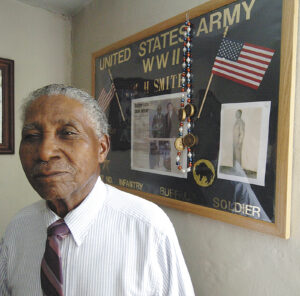
Smith, Jim
- Service Branch: US Army
- Rank or Rate: Tech. Sergeant
- Service Dates: 1942-1945
- Theater: Europe
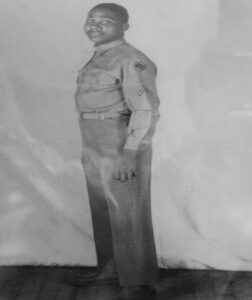 Jim Smith was a “Buffalo Soldier” of the African American 92nd Division during World War II. The origin of the legendary name “Buffalo Soldiers” which was coined by American Indians around the time of the civil war is murky. Some say when the American bison was wounded or cornered; it fought ferociously while displaying uncommon courage, identical to the black man in battle. Others say it was because the short black hair reminded the Indians of the coat of the buffalo. Buffalo Soldiers fought with distinction in WWII and all wars beginning with the Civil War.
Smith was born not far from where he lives now in Pelham and attended Caswell County schools. After graduation, he worked as a brick mason, a cook for a local family and in farming. When he learned about Pearl Harbor being attacked, he had just come in from a field after plowing. He, like so many, had no idea where Pearl Harbor was located but he knew the attack was bad for our country and for him.
Smith signed for the draft but was deferred for a time due to farming work. On October 12, 1942, he was ordered to report to Fort Bragg for 13 weeks of basic training. The bus to Ft. Bragg was filled with African American draftees, the only white person being the bus driver. Upon arrival at Ft. Bragg, he took his physical, received his uniforms, and began basic training with his all-black unit. Occasionally, Smith would receive a 36-hour pass giving barely enough time to hitchhike to Pelham and return. It was easy to hitchhike in those days because everyone wanted to help our military personnel. A driver would stop and ask, “where are you going soldier” and frequently the soldier would be taken right to his doorstep.
After basic, Smith was sent to Fort Huachuca AZ for advanced training. Ft. Huachuca housed 40,000 or more African American troops from the rural south, with a few white higher-ranking officers assigned to it. Smith was used to segregation so felt at home in his all black unit. It was at Ft. Huachuca that Smith was assigned reconnaissance as his specialty.
Smith went to Louisiana on maneuvers to hone his reconnaissance skills with further training in M-1 Garand rifle, M-1 Carbine and 45 caliber pistol, all of which he would later use in combat. After maneuvers, the 92nd Division left Ft. Huachuca to report to Camp Patrick Henry VA for embarkation to Italy on the Queen Mary. She was loaded with black troops on the trip to Naples, arriving in July 1944.
Smith was assigned to reconnaissance immediately and went to the front lines, primarily during the night, and on into enemy territory, to report on their movements. Daytime reconnaissance was very dangerous. Typically, a” recon” soldier did not have long life expectancy. His leader, Sergeant Curry, was fearless and said, “if you are afraid to go with me, stay here, I don’t want you”. Smith normally carried an M1 carbine and a German “burp gun” taken from a dead German soldier. The burp guns would fire six or seven rounds with a heavy “burp” sound, if you just touched the trigger. The good thing was, if Smith had to fire it under combat conditions, the Germans would think it was one of their soldiers firing it.
On occasion Smith heard Axis Sally the female propagandist for the Germans. She would try to destroy morale by saying the girls back home were unfaithful to the soldiers in combat. Her music was good, but she had little effect on morale. The Germans also dropped leaflets asking our troops to surrender, a mark of desperation on the part of the Germans.
On one mission to the front lines, an enemy recon squad came into sight before the enemy saw Smith’s squad. Smith and the men jumped into a deep ditch and the enemy walked by. Smith said he could have killed them all with his burp gun but did not as it would have given away their position. They were surrounded by German troops so he and his squad would have been killed in return. Smith said he was afraid the Germans could hear his heart pounding as they walked by.
Some Indian (from India) troops were near Smith’s squad at one time and they were wearing guns along with glistening sabers, which slowed them down significantly. Smith never saw the sense in that, as one would never be close enough to a German soldier to use a saber effectively. Smith also was astonished by British troops he encountered occasionally, who would stop for a spot of tea at 4 pm unless the enemy was too close.
As the German troops were chased up the Italian peninsula, Smith’s unit used jeeps to keep up with the retreating Germans. On one occasion, Smith was second in a line of three jeeps on the road. The Germans had mined the road, and the first jeep hit a mine and blew up killing all passengers. Smith stopped his jeep immediately, feeling fortunate he had not yet hit a mine. Looking under the right front tire, he saw a land mine was under the tire and tilted up on one side, the tire just missing the detonator. He got out of his jeep, unscrewed the detonator on the mine, disabling it. He was very thankful the jeep tire was just an inch to the left of the detonator. They backed up and called in the minesweeper trucks to clear the road of mines.
Most of the time, Smith and his unit were on the front lines and beyond. They used walkie-talkies to report to artillery units in the rear. They would frequently guide the artillery barrages by calling back to the unit, for example, “north 50 yards”, “to the right 100 yards” to bring the artillery shells in on the enemy. The transmissions had to be coordinated to the split second and they could only talk in short bursts. The Germans were using listening devices and could triangulate using the transmission to determine the position of Smith and his men if the transmission was too lengthy.
On a water channel, some tanks were being unloaded, and the Germans held a commanding position in a house some distance away. With their accurate 88 mm guns, they had blown up some tanks as they left the ship. Smith observed that a red-tailed P-51 aircraft had been called in and approached the building where the gun was located and took it out with one well-placed bomb. He later learned the pilot of the P-51 was Colonel Benjamin O. Davis of the famed Tuskegee Airmen, who became the first black general in the history of the Air Force.
Smith was never injured in combat but many of his fellow soldiers were wounded or killed. In one case, the German troops were waving a surrender flag and the Lieutenant in his unit raised up to see the “surrendering“ Germans. As soon as he raised his head, a German sniper shot and killed him instantly, hitting just below the helmet. The whole group of Germans was killed for their duplicity. A warrant officer brought up to replace the Lieutenant was killed a few days after he assumed command, during a German counterattack. The unit had to retreat but Smith helped retrieve the officer’s body that night.
Some Italians were friendly during the day but at night they used whatever information they had gained during the day to come back and kill American soldiers. This added to the uncertainty of combat. The stress of combat was too much for some and they became dangerous to themselves and fellow soldiers. One man, instead of turning off lights at night shot out the lights with his 45-caliber pistol. He spent time patching holes in his tent the next day. Those that became mentally unstable were sent to the rear for further evaluation.
Fortunately, due to the youth of the soldiers they were generally in good health, mentally and physically. The Red Cross was of help in family emergencies, which relieved some stress. There was a young black, Red Cross woman at headquarters who would help get men home in case of a death in the family or other emergency. As time passed in combat, Smith says he felt himself grow mentally tough and almost immune to the stress of battle. A person had to consider himself dead to deal with combat stress.
As the Germans fled north, they left ammunition and guns behind. There was no danger of running out of ammunition for the captured German burp guns. The young recruits that joined Smith from time to time were most likely to be killed early on, as they had to learn not to panic under fire. The deadliest situation was under machine gun fire when they would panic and stand up and run instead of quietly crawling to safety. A soldier with two weeks service in combat became a hardened veteran. The new soldiers were also susceptible to German booby traps. Beautiful fountain pens on dead German soldiers would blow up if moved. Any desirable “trinket” on a dead German soldier was likely booby-trapped. Also, fine steel wires, invisible to the naked eye, would be placed across a road at throat level and kill jeep occupants. The men had to put up a vertical rod on the jeep front bumper to break such wires.
German troops left rear action forces to delay allied advances to allow the main force to escape north. These were in effect suicide troops because they were all killed during the allies’ rapid advance. Resistance became lighter as Smith advanced up the Po valley. As Smith’s unit advanced, he heard that Mussolini had been hung in the Milan town square a day earlier.
In early May, the Germans surrendered. Smith was very happy that he could get out on “points” before long due to his heavy combat record. He was sent home in December 1945 by ship, docking in Newport News. The only passengers on the ship were Buffalo Soldiers from the 92nd Division. They went over together and came back as a unit. Six hundred sixteen members of the 92nd did not come back as they were killed in action. An additional 2,187 were wounded in the Italian action.
Smith returned to Pelham in December 1945 after being in Europe about 19 months. What bothered him the most upon his return was that the black men who fought bravely for our country had to face discrimination and difficulty getting a job when they returned to the US.
After the war, Smith went back to work raising tobacco and cattle. Eventually, Smith transferred his superior map reading ability learned in the Army to reading blueprints for machining work at Dan River Mills. Smith worked at Dan River for 40 years becoming a master mechanic as well as an accomplished carpenter and brick mason.
n his private life, he is a lay preacher and was engaged in a prison ministry for 16 years. He values his military experience because it put him a “step ahead” in his return to civilian pursuits. He learned to be a stable person, able to deal with stress and discomfort.
He has been married to wife Nellie for 54 years. They have one son who has a master’s degree in engineering and works for Boeing and one daughter who has a master’s degree in business and is a building contractor. They are also very proud of their three grandchildren, one, a musician, another a pharmacist and another a teacher and vocalist. Jim Smith says living by Biblical principles is the reason for any success he has had in life.
Interviewed 1/18/2001