
Waynick, James Fletcher
- Service Branch: US Navy
- Rank or Rate: 1st Class Electronics Tech.
- Service Dates: 1943-1945
- Theater: Pacific
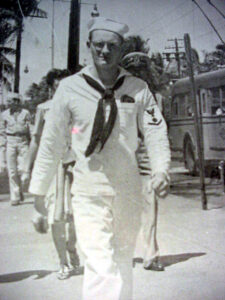 In September 1945, some of the most pleasant words Jimmy Waynick ever heard were these over the loudspeakers on the USS Audubon: “This is your Captain speaking! Coxswain set your course for San Francisco. The war is over!” After almost two years in the US Navy and participation in the invasion of Okinawa, Waynick was going home.
James Waynick was born in Greensboro but lived his entire life in Reidsville except for his time in the Navy. His father was a farm blacksmith and operated a repair shop for the newfangled automobiles that were now appearing in Reidsville. As a young person, Waynick was very interested in all things electrical. He hung around Irving Electric Co. in Reidsville doing odd jobs and picked up some of the electrician skills he used in his life’s work. He built his first ham radio at the age of 13. At Reidsville High School he helped keep things electrical operating, including repairing school clocks so they would run on time.
After graduating from Reidsville High School in 1937, he began work at Irving Electric full time for a salary of $6 per week. After a time with Irving Electric, he received an offer from American Tobacco as an electrician at the handsome rate of $18 per week. He could not refuse the 200% salary increase so he took the job.
Due to the poor health of his father, Waynick helped support his parents until he entered the Navy. After World War II started, draft rules allowed the sole financial supporter of a family to be deferred from military service. All his friends were in the service, and he began to feel a little embarrassed about his deferment even though it was appropriate considering his parents’ plight. In December 1943, he elected not to extend his deferment and was immediately drafted into the service.
Waynick was sent to Camp Croft, SC for processing and as part of the process was asked which branch of the service he was interested in and what qualifications he had for military service. Waynick quickly responded that he was an electrician and wanted to be in the Navy. In three days, he was at the Naval Training Center, Bainbridge, Maryland.
He and the rest of the recruits were stripped down, given a physical examination as well as their fill of “shots”. He put his skivvies back on and was given a duffle bag, which was gradually filled as he walked down a line and was provided with shoes, socks, underwear, uniforms and other items of equipment; all he would need for the next two years of active duty. Waynick could hardly carry his duffle bag after it was full. He was then assigned to a Company and began his basic training.
All recruits had to learn to swim in case a ship went down at sea. His swimming instructor, Ensign Keefer, was a champion swimmer. Waynick just could not get the hang of swimming, but Keefer said Waynick had to swim as well as jump off a 40-foot tower into the water to graduate from basic training. On the last day of basic, Keefer said if Waynick would just climb the tower and climb down the cargo net next to it he would pass him. Waynick went up and Keefer tried to push Waynick off the tower into the water, but Waynick grabbed Keefer and they both went in the water, Keefer with his dress blue uniform on. This “jump” qualified Waynick so the next day, he graduated from basic training. Keefer was not happy.
While in basic training, the recruits were assigned to their specialties. Waynick, as he requested, was assigned as an electrician and sent to Camp Perry VA for a three months course in Navy electrical training. During his duty at Camp Perry, Waynick received a 72-hour pass and went to Reidsville by train. Unfortunately, the nearest train stop to Reidsville was Danville VA. The next stop was Greensboro. The conductor said “Sorry, you have to get off at Danville or Greensboro”. As his girlfriend – wife to be Virginia – was waiting in Reidsville, when the train drew near the Reidsville station; Waynick pulled the emergency stop cord. The conductor found out that the train did stop in Reidsville if you had a determined sailor on board who only had a 72-hour pass.
After his training at Camp Perry, Waynick was assigned to Washington DC for further training. In Washington, along with many other navy men and women in the area, he was invited several times to the mansion of Mrs. Evelyn Walsh McLean, a former owner of the fabulous Hope diamond. She was a widow, owner of the Washington Post newspaper and one of the richest women in the United States but died tragically as a pauper years later. Waynick remembers wonderful parties at her magnificent mansion.
In late 1944, Waynick was transferred to the west coast ultimately to be assigned to the USS Audubon, an attack transport. His train ride to the west coast in December 1944 was a very uncomfortable one. The ancient rail cars had no heat and ragged, uncomfortable seats. On the way, there was a stopover at Salt Lake City, Utah. Waynick visited the Mormon Tabernacle auditorium to see the grand organ as well as other sights. It happened that while in the Tabernacle auditorium he noticed a small man trying to tune the organ. He would play a note and then go up to the organ pipes and make an adjustment. Waynick asked if he could help by playing a note on the organ while the other man made the adjustment. That was satisfactory so Waynick did that. The man introduced himself later as Alexander Schreiner the organist for the Mormon Tabernacle Choir whose tenure lasted 50 years.
The attack transport USS Audubon was commissioned in Astoria, Oregon on December 20, 1944, and Waynick was on the shakedown cruise, which lasted several days. While on the cruise, there was a mysterious tapping on one of the steel plates in the propeller area. To determine the problem, it was necessary to take off a large steel plate covering the entrance to what is called the propeller shaft alley. When the steel plate was removed, to everyone’s astonishment, a woman crawled out who said she had fallen asleep in the shaft area a day or so earlier. Waynick never heard any further explanation.
After minor repairs, the Audubon went to San Francisco to pick up 83 WAVES (women sailors), 3 WAVE officers, and 10 marines to guard them. It was clear that no one would be able to get near the WAVE quarters while they were on the Audubon in transit to Hawaii.
In January, the Audubon sailed to the island of Ulithi, picking up 1350 soldiers and 71 officers plus cargo to join a huge attacking force for the invasion of Okinawa. While on the way to Okinawa, the crew heard Tokyo Rose broadcast from Japan with the popular music of the day as well as propaganda about all the Japanese battle successes. These were fictitious reports, and the listening crew knew it.
There were ships of every description in the attacking force. The Audubon was assigned the task of carrying assault forces near the coast of Okinawa and getting them into the landing craft that would take them to the beach. The men went down cargo nets to the waiting landing craft. If a craft was not in the correct position, the momentum of many men going down the nets forced the lowest ones on the net to drop off into the water. Fortunately, they had life preservers on, which they saved their lives. Then they had to be picked up out of the water to get on another landing craft. In the process, there were incoming Japanese artillery shells as well as Japanese kamikaze (suicide) planes attacking the ships. The noise was deafening with the battleships firing 16-inch guns incessantly and aircraft flying overhead. One suicide plane sank the ship next to Waynick’s.
After the Audubon off-loaded its assault forces, during the next four days it became a first aid ship for wounded men coming off the beaches. Waynick will never forget the carnage he witnessed by way of the injured and dying men that were brought aboard the Audubon. Waynick used a winch to lift men from the landing craft to the Audubon’s deck. A shell from a Japanese plane broke the winch lever so Waynick made one out of a broom handle. Waynick says, “The little part I had to play in this major invasion was horrific to me”.
After taking the wounded men to some safe islands for treatment, the Audubon sailed to San Francisco for repairs and then back to Guadalcanal to ferry troops to the Philippines. During this voyage, USS Audubon crossed the Equator, which called for the time-honored tradition of initiating polliwogs – those who have never crossed the equator- into shellbacks – those who have. As part of the process of initiation as a shellback, sailors dressed in robes such as King Neptune and Davey Jones and other deep-sea figures and carried homemade tridents. They hazed the polliwogs with all sorts of phony accusations and as a final insult dumped them into a pool of kitchen garbage from a chair on a stand next to the “pool”. This was an all-day affair and even the ship’s captain had to be initiated. Waynick remembers the humiliating event well and still has his certificate identifying him as a shellback. This tradition continues today in the Navy.
In the Philippines, the Audubon became part of a task force preparing to invade Japan. Fortunately, the surrender ending WWII was signed before the invasion was necessary.
Waynick finally received his discharge in December 1945, returned to Reidsville, and went into business as an electrician, wiring many of the farm homes in the county for electricity. After a time, he sold this business and reclaimed his position with American Tobacco as Chief Electrician. Upon retiring early from American Tobacco in 1980, he fulfilled a lifelong ambition to join the circus as an electrician. With his wife Virginia’s blessing, he traveled several months of the year, returning to Reidsville in the off-season.
Waynick retired for good at age 69 and actively enjoys his lifelong fascination with the circus, all things electrical, pipe organs, as well as many other interests. He has three children, son Fletcher and daughters, Joan and Betty. His beloved wife Virginia, who was a well-known local artist, passed away in 2001.
Waynick says he saw parts of the world most people never see and is very proud to have served his country during WWII.
Interviewed 1/13/2005