
Clark, James E. Jr.
- Service Branch: US Army
- Rank or Rate: Lt. Colonel
- Service Dates: 1978-2006
- Theater: Var/Iraq
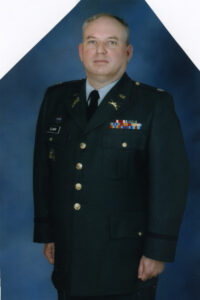 Jim Clark Junior’s father was a marine. This accounts for the fact that he was born in Quantico VA, a home base for marines. Jim Jr. liked military life and aspired to it but was diverted for a time before becoming a career soldier. After 28 years of service, Clark is slated to retire from the Army in November 2006.
Clark’s early years were spent in Greensboro NC. He moved with his family to Georgia, graduating from High School in Powder Springs. Clark went on to Kennesaw College, joined the ROTC and became one of the first Army Officers to graduate from the ROTC program at Kennesaw. Clark’s first duty station was Fort Hood with the First Cavalry, Second Battalion, Company B. Clark had chosen “Armor” as his specialty and became a platoon leader for five M 60 tanks and 20 men. His work at Fort Hood included arranging visits to the facility for high profile people including congressional representatives and military dignitaries.
Clark speaks of the danger in being a tank crewmember and says, “Tanks are designed to kill, and they don’t care who they kill, the enemy or a crewmember.” Being a tank crewmember is dangerous work for many reasons. There were 63 shells of various types in Clark’s tank – high explosive, smoke, beehive (anti-personnel), and armor piercing. The M 60 could also be used as an artillery piece. After firing, the shell casing would be ejected within the tank. The spent shell casing could cause death or serious injury if a crewmember happened to be in the wrong position within the tank.
Clark left the Army for a few years to work in private industry. However, the allure of military life and the camaraderie he enjoyed gave him the desire to go back to active duty from reserve status. Clark calls it Divine Intervention that he was selling computers in the late 1980’s and happened to meet an Army Reserve officer who needed the computer skills Clark had gained in his civilian work. This chance meeting resulted in Clark going back to “active guard reserve” status in 1989. He was again on a career Army officer path.
Clark had a varied series of assignments in the next 12 years in Marietta GA, Fort Huachuca AZ, Fort Devens MA and Alaska. During the Fort Devens assignment, he was involved in mobilization of reserves for the United Nations peacekeeping effort in Bosnia. This experience paid dividends for Clark in his own deployment to Iraq in 2005.
In 2001, Clark was assigned to an “operations center” position in the Pentagon in the office of Chief of the Army Reserves. Clark was one of 400 people working for the Chief of Army Reserves. His office was in Crystal City VA while permanent offices were being renovated in the Pentagon. On September 11, 2001, American Airlines flight 77 crashed into the very space that Clark would have occupied had he been working at the Pentagon. His Crystal City office was only a short distance from the disaster at the Pentagon. Clark remembers well the horror and confusion in the DC area. The building he worked in, and the entire District of Columbia was evacuated. Roads were clogged. It took about eight hours for him to get home that evening. Telephone lines were jammed. After two days, he was recalled to his office and began manning the operation center phones. Finally, life began to return to some semblance of normalcy as it did across the United States.
After several months, Clark interviewed for work at the Inspector General (IG) of the Army’s office at the Pentagon. He was chosen and began work as the Assistant Officer in Charge of the Inquiry Dept. The IG handles a myriad of investigations, inspections, inquiries, assists military personnel, and ensures compliance to regulations. This organization sometime strikes fear into the hearts of those being “inspected.”
Working at the Pentagon was a drastically different experience after 9/11. Heavily armed personnel with ready machine guns were now on guard. The subway that ran under the Pentagon could no longer be used. Parking was, and is, at a premium. Clark says, “Do not drive your car to work if you do not have an assigned space.” Ride sharing, vanpools and bus transportation are commonly used. After 9/11, Clark volunteered for service in Afghanistan. He was deferred because of his duty in the IG Dept. On Thursday April 28, 2005, Clark decided to send his retirement request through channels on the following Monday. However, on that day, his superior, a Colonel, called in the five Lt. Colonels reporting to him and said, “I must assign two of you to Iraq.” Clark volunteered to go. He had qualms but felt it was his duty. His concern was for his wife and those he would command. Clark did not want to have anyone harmed because of a decision made by him.
His experience at Fort Devers made it easier for him to deploy as Clark had been through the process so many times with others. Checking accounts changes, an updated will, power of attorney, updated security clearance, new ID card, immunizations, dental exam and physical examination – all this needed to be done quickly. Great support from Clark’s wife Ginny helped ease the process. Two weeks’ indoctrination at Fort Carson CO followed. He joined up with the others being deployed and left on a commercial charter flight from Fort Carson to Kuwait with some intermediate stops.
It was night and it was hot – 120 degrees – when he arrived in Kuwait. He boarded a bus with curtains covering the windows, headed for Camp Buehring, Kuwait for two weeks of training before moving forward into Iraq. Clark had been told he would be in combat but instead was assigned to “intelligence” work. He was sent to Doha to an “in transit” center – a large warehouse with cots – awaiting assignment. The facility left much to be desired. He could not shower for days and to wash clothes he had to use “boxes” of water located some distance away. Clark’s superior officer told him he would be going to Taji, Iraq as Commandant of Phoenix Academy. Clark was issued his desert combat uniform along with Kevlar helmet, IBS (interceptive body armor), and ammunition for his weapons.
The mission of Phoenix Academy is to train US soldiers to train, in turn, Iraqi soldiers to defend their country. This was part of our strategy for victory in Iraq. The Academy has space for about 380 trainees and is a self-contained base surrounded by Iraqis. The soldiers stationed at Phoenix Academy are aware of the danger but as soldiers, do not think about it much. They are focused on doing their job, knowing that by doing so they will help the total effort and get home sooner. Facilities were good, as there was water, plumbing and decent food. The students arrive by convoy or helicopter for two weeks of training. The program of instruction is primarily given by battle-hardened veterans. Cultural awareness is also taught. For example, seemingly harmless gestures can be misinterpreted and may be offensive to one of another culture. On the other hand, a common gesture we use may be meaningless or perhaps have an entirely different meaning to an Iraqi. Clark was impressed with the Iraqi Army personnel he worked with, finding them friendly, courteous and cooperative.
Security is an issue that Clark personally addressed by walking all the grounds and removing any abandoned buildings or impediments to a good field of view around the compound. The compound was previously used by Saddam Hussein’s Republican Guard with markings clearly visible and was located near the Sunni triangle – a dangerous place. The headquarters of Clark’s superior officer was in one of Saddam Hussein’s many beautiful palaces – in stark contrast to the poverty and poor living conditions seen near the palace.
On an occasion when Clark was on an investigative assignment, one of the vehicles in his convoy was struck by an IED (Improvised Explosive Device). There was a time of shock and concern until it was clear there were no casualties. The device was an artillery shell detonated from a distance away.
Clark indicates he was never afraid in Iraq although in danger. He feels the prayers of family and friends helped him to cope and feel secure that he would come home after his one-year service. Clark is home from Iraq now and he remembers the people he saw and with whom he interacted. He could come home but the Iraqi people must remain there. Clark believes our military will help make the profound changes in that country that are needed.
Clark was honored July 25, 2006, with the prestigious “Legion of Merit” by the Army for his distinguished service in Iraq as Commandant of the Phoenix Academy. On November 30, 2006, he and wife Ginny will retire to New Hampshire after his years of Army service.
Interviewed 6/10/2006