
Davidson, James C. (Jimmy)
- Service Branch: US Army
- Rank or Rate: Corporal T-5
- Service Dates: 1943-1945
- Theater: Europe
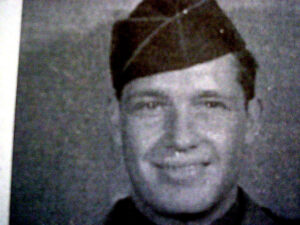 It was a long way from a family farm near Asheboro, North Carolina to the horror and death of the Battle of the Bulge in Belgium during December 1944. Jimmy Davidson traveled that road to war and earned five battle stars along the way.
Davidson graduated from High School in Asheboro in June of 1941, was well aware of the war in Europe, and was concerned about how it would affect he and his friends. On December 7, 1941, Davidson and his father were in the family car and they heard the news flash of the attack on Pearl Harbor. Like all men his age he registered for the draft, expecting to be called quickly. Davidson got work at a local textile mill and surprisingly a year passed before he was called to active duty on January 8, 1943. When Davidson received his letter to report for duty, the depressing news from the front lines in Europe and the Far East during the first year of United States participation in the war was disturbing to him.
Davidson was sent by troop train to Camp Croft, SC, for processing and further assignment. He received all his uniforms and shots and due to the needs of war was assigned immediately to the 385th Anti-Aircraft Artillery unit. The needs were so great for anti-aircraft batteries that his basic training was done within the 385th unit. The 385th was sent en masse to Camp Edwards, MA where his training was completed. From Camp Edwards, his unit was assigned to other locations for war games and training for combat.
War games completed, Davidson’s unit was sent to Camp Shanks, NY and put on a converted luxury liner, Aquitania, headed to Glasgow, Scotland. The trip to Scotland was a nightmare due to heavy seas and resulting seasickness among the men. Aquitania was unescorted on the way to Scotland and there were several submarine alerts. The ship had no defensive armament and could only zig zag as a defensive measure. She was a sitting duck on the high seas. Fortunately, no submarines attacked Aquitania. All the troops were either sick, about to be sick or just getting over being sick during the trip. Davidson’s unit finally reached Glasgow and immediately went into training mode for D Day and combat. Men, their rifles, artillery pieces and all equipment were in first class condition ready to go across the channel. Davidson’s duties were as a supply person whose responsibility was to get whatever was needed at the time. By the time his unit finally went to Normandy, Davidson had learned the location and the best way to drive to every supply depot in England. England reminded Davidson of a balloon about to burst with all the men and material ready to go to Europe on D Day and beyond.
D Day, June 6, finally arrived and Davidson’s unit went into a staging area to follow up the infantry to the Normandy beaches after a few days when Anti-Aircraft Artillery would be needed. Landing Ship Tank (LST) vessels were loaded with artillery pieces, trucks, and bulldozers to help unload on the beaches. The 385th went into Utah beach and the soft sand created a problem in unloading the heavy artillery pieces but with bulldozers and winches the guns were brought ashore ready to go inland.
Davidson recalls some of the advance infantry troops were responsible for lighting smoke bombs to guide the bombers to the front lines so they could bomb the retreating Germans. Unfortunately, the smoke drifted back over our lines, and we bombed some of our own troops. This was a tragedy in that many of our men were killed along with the highest-ranking officer killed during the invasion, General Leslie J. McNair.
Davidson’s Artillery unit advanced quickly and set up the artillery pieces several times a day. German fighters and bombers were active but not in abundance due to shortages of gasoline and pilots.
His unit advanced steadily toward Paris and arrived immediately after it was liberated on August 25. Davidson’s recollection is that the people were overcome with joy, and it was difficult to go through the streets due to people on the side of the roads throwing kisses and hugging the troops.
After Paris, Davidson’s unit went to Belgium to defend the St. Trond airfield, which was under frequent attack by the German air force. While there, the 385th shot down 3 German fighters and 2 bombers. Even with the retreat of the German army, there were still many pockets of resistance and Davidson states “You could get shot at from any direction and some of our troops were killed by sporadic sniper fire”.
Davidson’s unit was sent toward Bastogne, Belgium but before it arrived the German attack called the “Battle of the Bulge” began. The Colonel in charge passed down information that all units were to abandon their equipment due to the sudden attack and get to safety before being overrun. A tough old gun sergeant told Davidson “We are not leaving our gun, hitch it to your truck, pull it out and take it with us”. In 15 minutes, the truck and gun with Davidson driving went down the side of the hill and with the truck back firing, popping, and shaking they reached the bottom of the valley, went across a bridge and hid behind some houses. Looking up, Davidson could see the Panzer tanks line up and they began firing. The Battle of the Bulge was underway. The men of the 385th got out of the trucks and hid in culverts so shrapnel from the German artillery would not hit them. In the meantime, a British unit came up to help and allowed the 385th to get out of harm’s way but not before some of the British tanks were blown up by the German Panzer 88 guns. A remarkable occurrence happened during all this chaos and fighting; the British troops stopped to have a “spot of tea” at 4 PM.
During the night the sounds and sights were beyond description. It was as though the greatest Fourth of July celebration ever had been transported to Belgium. The “screaming meamies” made the most dreadful sound. This was a mobile rocket launcher the Germans used and it was designed to be destructive as well as terrifying in the noise it made.
Davidson’s unit advanced toward the Ardennes Forest not knowing the Germans had completely surrounded his and other units in the area. In the Ardennes, the Germans fired phosphorus shells, which lit the sky and could maim or kill if they hit a soldier. Also, shells were fired at the tops of trees to explode and rain shrapnel on the troops in the forest. As history tells us, the Battle of the Bulge failed, and huge numbers of German troops began surrendering. This was one of the defining moments in the battle in Europe; a failed last-ditch effort by the German high command to win the war but at the cost of many allied lives. Davidson recollects the German troops that surrendered were very docile and quiet – thoroughly beaten. There were very young as well as very old men in the groups that surrendered; the last of the men the 3rd Reich had available to call for service.
Davidson’s unit went on across Germany to meet the Russians at the Elbe River. It su0rprised him to see women driving some of the Russian tanks. The Germans surrendered and the war was over for Davidson. He had enough points with his five battle stars to get out of the service and was assigned to Camp Lucky Strike in France for debarkation to the US. While there, victory over Japan was declared. Davidson traveled by ship to New York and then to Ft. Bragg, NC for discharge.
After discharge, Davidson returned to Asheboro but later came to Eden (Leaksville) to enter the loan business. After eight years in that business, he bought and operated the Leaksville Hardware store on Washington St. in old Leaksville for 38 years. Davidson is married and has two daughters, one of whom is deceased, and two granddaughters who give he and his wife Jewel, great joy.
Davidson feels fortunate to be alive and to have suffered no injuries while in the service. His experiences are priceless to him, but he misses his dear friends who were not so fortunate and remain in the military cemeteries in Europe.
Interviewed 3/28/2000