
Underwood, Howard L.
- Service Branch: US Army Air Corps
- Rank or Rate: Sergeant
- Service Dates: 1943-1945
- Theater: Europe
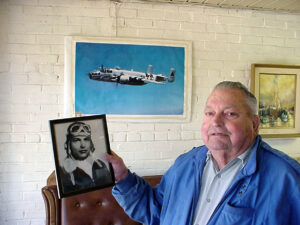 In April 1944, Howard Underwood could see the German Army was in retreat from his vantage point looking out from his waist gunner position on a twin engine B-25 Mitchell medium bomber 12,000 feet above the Italian countryside. He could almost taste the inevitable victory in Europe that would occur within a month. However, that did not diminish the effectiveness of the remaining German 88 mm anti- aircraft artillery shooting at his aircraft and trying to kill him. The German 88 was a fearsome weapon capable of firing 25 rounds a minute with extreme accuracy. Crewmembers of all our aircraft flying against the Nazis were very respectful of that weapon. It could send shells with flak so thick you could walk on it at 37,000 feet, according to Underwood.
It was a circuitous route from his birthplace on a farm in Alamance County to the Italian battlefront in 1945. Underwood graduated from high school and worked for his uncle for a while in the grocery business. He was certain he would be drafted and was not surprised to get his induction letter in late 1942. He was on active-duty January 8, 1943.
After induction at Camp Croft, he was assigned to Fort Jackson, MS and there was given an aptitude test, which indicated he would do well in the Air Corps. After the usual marching, calisthenics and classroom training at Miami Beach, FL and occasionally enjoying the warm sun and water he was issued a heavy overcoat and sent to Lincoln NB in March 1943 to be trained in aircraft engine repair. Underwood had applied to pilot training school, but his preliminary orders did not come through until he had been at Lincoln NB for 3 months. He took the physical for pilot training from Doctor Penn who asked Underwood where he was from. Underwood replied that he was from NC and Dr. Penn said, “So am I”. Underwood passed all the Pre-Flight tests, perhaps with a little help from Dr. Penn. As there were no specific openings for pilot training at that time, he was sent along with other aspiring pilots to Oklahoma A&M for college training in Physics, Chemistry and other technical courses.
Upon being assigned to San Antonio for pilot training, Underwood was put in charge of his barracks and one of the aviation students was the man to be the pilot of the B-25 bomber which Underwood was later assigned. For nine weeks, Underwood toiled in the flight-training program, and he really wanted to fly. Underwood’s transfer to Pine Bluff AR for further flight training coincided with an Air Corps cutback in pilot training, reflective of success in the air war in Europe and the Pacific. One rough landing on a training flight put Underwood out of pilot training and into radioman school. The day he washed out of pilot training there were hundreds more being washed out.
Radio school and gunnery school prepared Underwood for his combat duty to come in Italy. He learned to take a 50-caliber machine gun apart and put it together again while blindfolded with gloves on. While in combat, typically a bomber crewman is at freezing altitudes and vision could be limited due to fogged goggles or flying in darkness. Hands would freeze without gloves on.
Underwood had not been home on leave for twenty-two months and when transferred to Columbia SC to join a B-25 crew, he had 10 days leave enroute to visit his family. While home, his father was putting up hay, so Underwood requested, and was granted, an additional seven days leave to help his father.
While in Columbia he met an officer who had been an Aviation Student in San Antonio assigned to the barracks Underwood. oversaw and the officer said, “You are in my crew as of now”. Interestingly, the pilot had been one Underwood had to chastise for poor behavior while a student and now he was Underwood’s pilot and ultimately a good friend.
As radioman, Underwood had to unreel a 30-foot antenna with a 3-pound lead weight at the end from the belly of the B-25 to pick up radio signals. He could not see outside from his position. On one mission, as the plane was coming in for a landing in Columbia, the pilot did not warn Underwood that a landing was about to take place. When Underwood heard the engines cut off, he knew the landing was imminent and started to reel in the antenna, but it was too late. The lead weight flew loose at 90 miles an hour and was never found.
Underwood finished his training in December 1944 and on Easter Sunday 1945, he went aboard the Mariposa, a luxury liner, headed for Europe. About two weeks later, after a train trip from Naples, he arrived at a B-25 base at Farno, Italy. Underwood was in the air on bombing missions a few days later. While in the air on a mission to Brenner Pass in Austria, the airplane’s radio was tuned in to BBC and on April 12, he learned of the death of President Roosevelt over the B-25’s radio. It was not unusual to tune in to Axis Sally, German propagandist, and hear the names of individuals in squadrons and their targets for the day.
The view from the B-25 was excellent and Underwood could see below the massive retreat of the German army as it was taking place in April 1945. While the German troops were in disarray, the German 88 guns were in full force against the allied aircraft. In some cases, because the guns were in caves, it was necessary for small fighter-bombers to fly directly toward the caves and, in effect, throw a bomb into the cave. The 88s took their toll on aircraft and several planes were lost due to enemy fire.
Most of Underwood’s missions were to blow up railroad marshalling yards and bridges at Brenner Pass and in the Po Valley. Frequently the famed Tuskegee Airmen, a squadron made up of black pilots, accompanied Underwood’s squadron on its missions. On bombing runs, part of Underwood’s duty was to be certain all bombs released from the bomb racks properly. If they did not, his responsibility was to push them out of the rack. He could not do this with his parachute on, so it was a very dangerous activity. Fortunately, he never had to do that.
Sometimes a bombing mission was against German troops, and the plane was armed with fragmentation bombs, which were deadly against personnel. Dropping fragmentation bombs was like dropping hand grenades on the troops. On one bomb run, a plane accidentally dropped fragmentation bombs on another plane in the formation, and they exploded upon hitting the plane. Fortunately, the plane made it back to base but with some injuries to crew members.
Underwood’s last few missions were to fly over the retreating German troops and drop leaflets written in German asking them to surrender to our forces. On the first mission to drop leaflets, instructions were not good on how to do it. Before throwing the leaflets from the bomb bay doors, Underwood and his fellow crewmember took the binding from around the leaflets and tried to throw them from the plane. Due to the wind tunnel effect with the bomb bay doors open, all the leaflets flew back inside the plane, and it was a massive cleanup job picking up paper from the interior of the aircraft. This happened on more than one plane so headquarters made it clear that the propeller airflow would break the bindings of the leaflets as they were thrown out of the plane.
The food was not very satisfying at the Farno base as the crews had an overabundance of horsemeat and Spam to eat. Underwood still does not like Spam. As unsatisfactory as the military food was, the Italian people were under much poorer conditions for food. It was not unusual for Underwood and his fellow crewmembers to take extra food and give it to the Italian children through the fence surrounding the base. Boxes of food from home were especially welcome and even though the boxes might be broken and the contents a bit stale, they were still good because the airmen appreciated the ‘love” from home that was also in that box.
When the war in Europe was formally over, on May 8, 1945 Underwood did not have enough points to be released from duty and was retained in Europe for a time. Finally, he was sent home on leave and it took 10 days via Algiers, Morocco, Liberia, Ascension Island, Brazil, and Puerto Rico back to Savannah GA. Underwood’s stop at Ascension Island as a refueling point was precarious as fuel was running out and the Island was not in sight. Finally, after circling for a time, it was sighted and the plane landed.
Upon completion of his 30-day leave, the atomic bomb had been dropped on Japan, and the war was over. Underwood’s final months in the service were spent in Greensboro NC, and he found himself mustering out several of the officers he served with in Europe. Mustering out day arrived for Underwood on December 1, 1945.
After release from the service, he undertook electronic training in Chicago and eventually moved to Reidsville NC. In 1947, he established Underwood’s Radio and TV Service. He continues to operate that business 57 years later, at the same location. Underwood married the former Frances Stadler in 1947 and has a son and daughter and several grandchildren.
He appreciated the close friends he made during the war, and he remains in close contact with them. His WWII friends are still as close as brothers, even 58 years later.
Interviewed 1/5/2000