
Hundley, H. Grey
- Service Branch: US Navy
- Rank or Rate: Ship Fitter 1st Class
- Service Dates: 1940-1946
- Theater: Pacific
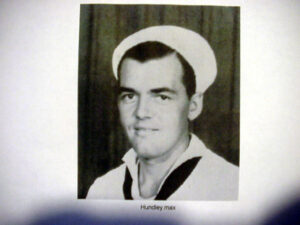 Grey Hundley says “In 1940, it was a big world out there for me. I had never seen the ocean. I had hardly been out of Draper, NC and needed a steady job.” Hundley joined the US Navy in 1940 for 6 years and started an odyssey that took him halfway around the world. His service involved him in historic combat operations that changed the course of World War II in the Pacific theater.
From Hundley’s birthplace in Schoolfield VA, Hundley’s father took work in Leaksville, NC, during the depression. The family lived in the country in a log cabin constructed by Hundley’s father. Later the family moved to town on Boat Landing Rd. After Hundley’s father died in 1939, family finances were limited so Hundley had to find steady work. There being very limited employment opportunities locally, joining the US Navy appeared to be a way to get a steady job as well as good training that would help him after a return to civilian life. His brother, who was in the Army, said the Navy was a good option as your bed was always with you on ship and you did not have to sleep on the ground.
After joining the Navy in June 1940, Hundley was assigned to Norfolk, VA for basic training. After 12 weeks of marching, classroom instruction and calisthenics he was graduated from basic training and sent by crowded troop train to Long Beach CA for assignment to the battleship USS New Mexico. It was commanded by none other than Captain Chester Nimitz, later to be the Commander in Chief of the Pacific Fleet during World War II. Due to Hundley’s strength and physical condition, he was assigned as “first loader” on the 14-inch main battery on USS New Mexico. This required lifting 100-pound shells and putting them in the gun before firing. This job did not last long as there was an opening for ship’s bugler and having been a bugler for certain military events in Leaksville, his experience allowed him to get the assignment. Being bugler required Hundley to be able to play 136 different bugle calls, such as calls to go to battle stations, to prepare for torpedo defense, to prepare for air defense, a call for mealtime and, of course, reveille and taps. He did this by blowing the bugle call into the ship’s main microphone with the call sounding throughout the vessel. Because of the assignment as bugler, his station was on the ship’s bridge and was a great vantage point to see what was going on during ship operations.
USS New Mexico was sent to the Pacific and stationed at Pearl Harbor with her berth being the one USS Arizona was berthed in when Pearl Harbor was attacked. Had New Mexico been there on December 7th, Hundley wonders if she would be the ship at the present Pearl Harbor memorial site instead of USS Arizona.
In May 1941, New Mexico was sent back to the Atlantic on convoy duty, seven months before war was declared and on occasion, as he was stationed near the ship’s bridge, Hundley was in position to observe anti- submarine activity by our ships. During one convoy he participated in, seven German submarines were sunk. Sometimes the excitement ran so high, Hundley says his bugle calls during anti-submarine operations were recognizable but a little “uncertain.”
After Atlantic convoy duty, USS New Mexico was sent to Reykjavik, Iceland on more anti-submarine duty for a time. When Pearl Harbor was attacked on December 7th, New Mexico was in Portland, Maine and he heard the news over the ship’s loudspeaker. Hundley still does not understand how the Japanese made a successful sneak attack on Pearl Harbor considering the daily air patrols. As the New Mexico was an old battleship launched in 1917, she was sent to Norfolk, VA to be fitted with 20 mm. and 40 mm. anti-aircraft guns to improve air defense capabilities. After a brief stint as a training vessel for new recruits,
New Mexico was sent back to Pearl Harbor and the sight that greeted Hundley’s eyes was most disturbing. Many ships were still underwater with repair efforts going on and Hundley says “the Pearl Harbor base was still a mess” after the attack. On USS New Mexico, Hundley participated in the start of the island-hopping campaigns to retake the Pacific islands the Japanese had conquered, beginning with the island of Guadalcanal. During one battle near the island of Tarawa, battle stations were called and a torpedo headed for USS New Mexico missed and sunk a small aircraft carrier. When the torpedo struck the aircraft carrier, Hundley was drinking a cup of coffee, and it was knocked out of his hand and Hundley was thrown to the deck from the concussion. Two hundred men from the carrier were rescued by Hundley’s ship.
About this time in 1942, Hundley was promoted to the damage control department of USS New Mexico. His bugling days were over. This job consisted of maintaining the integrity of the vessel by containing damage or fires due to torpedo attacks, aircraft, etc. After his promotion and his position as leader of 12 men in his damage control section, he got the nickname of “Radar.” Hundley always seemed to know the location of any men that were “goofing off.” He did not tell them he knew because he had been there too, before his promotion.
It was difficult to transfer from New Mexico after his years aboard her but he was transferred for a short time to the military police unit guarding the WAVE (female Navy personnel) barracks in San Francisco. For many reasons, this was one of Hundley’s most interesting tours of duty.
In late 1943, Hundley was transferred to the newly built USS Guam, a Battle Cruiser, one of two built during the war. On one of Guam’s shakedown cruises Hundley came up with an idea which reduced the time it took to empty the fuel tank at the end of the day from the catapult float aircraft assigned to Guam. He was promoted from 2 nd Class Ship Fitter to 1st Class Ship Fitter immediately when his Chief Petty Officer learned of the improved procedure.
Hundley was on USS Guam when she was assigned to the Pacific to engage in more island-hopping campaigns. Guam was involved in heavy combat for months on end. In all, he earned seven battle stars for action in the Pacific. He endured Kamikaze (suicide) air strikes and torpedo attacks against his ship and in one period, went 60 days without seeing land. One of the most frightening events happened when a torpedo struck USS Guam right in line with Hundley below deck. He heard the clunk, and it did not go off. It was a “dud.” It dented the ship and had it exploded it would have taken Hundley’s life. Looking back, Hundley says “The Lord had other plans for me.”
Guam went to the Ulithi islands for some rest for the crew and while there the Atom bomb was dropped on Japan, and the war was over. While in the Ulithi area Hundley had the opportunity to see his brother who was on a hospital ship after being wounded. Guam was then assigned to do cleanup work on islands where Japanese were still fighting because they did not know the war was over.
Guam’s next assignment was to transport army and marine troops back to the US for
release from active duty. Some 1500 troops were aboard Guam at one time and bunks
were used 24 hours a day for sleeping. Three men were assigned to a bunk with eight
hours use of the bunk for each man. Many of the men had just been paid after several
months and an informal casino was set up on USS Guam in an obscure place, without permission but small fortunes were won and lost on the trip home. Guam was decommissioned and put in “mothballs” in early 1946 and Hundley oversaw some of that work. According to an historical note, USS Guam sold for scrap in 1961.
Hundley says, “I was frightened every time the ship’s guns went off as I knew we were under attack.” He says “I was very busy in my Navy career and didn’t have time to worry too much about what was going on around me. I just did my job.”
Hundley married in March 1946 to the former Alice Carroll of Leaksville and has one son and one daughter as well as several grandchildren. His career after his release from active duty was primarily in production with Karastan division of Fieldcrest Mills in Eden, NC.
Interviewed 5/28/1999