
Zeigler, George E.
- Service Branch: US Navy
- Rank or Rate: Lt. Commander
- Service Dates: 1941-1946
- Theater: United States
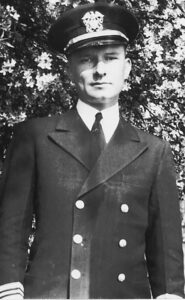 Critical to the success of any military campaign are those who supply the resources necessary to wage war. George Zeigler was a US Navy officer during World War II who helped earn the Allied victory by building ships that carried men and material to combat zones around the world.
Zeigler was born in Thomasville GA but moved to Columbus GA at the age of 14. After graduating from Columbus High School, he received an appointment to the US Naval Academy. A failed eye examination prevented his admission to the Academy, so Zeigler applied to Georgia Tech where he earned a degree in Mechanical Engineering June 9, 1941.
During his senior year at Tech, he learned that the US Navy was seeking Engineers. Zeigler fulfilled his long-held interest in the Navy by applying for a commission. He received his commission July 1, 1941, just two weeks after graduating from Georgia Tech. Conveniently, Zeigler’s first two months of duty were at Georgia Tech where he received his uniforms as well as indoctrination into the Navy. At the end of two months, the officer engineers were divided into three groups for further assignment. The men in Zeigler’s group were sent to various navy yards to be involved in ship construction.
On September 3, 1941, Zeigler reported for duty at the Norfolk Navy Yard, Portsmouth VA, assigned to the Construction Department. It was an exciting time for this new Ensign in the Navy Engineering Corps. The battleship USS Alabama was just being completed, and Zeigler eagerly explored every part of her. Although the United States was at peace, the Norfolk shipyard was on a wartime basis with tight security. Europe was at war, and this was clear to Zeigler as he witnessed the repair work being done to the battle-damaged British aircraft carrier HMS Illustrious at the Norfolk Navy Yard.
On December 7, 1941, Zeigler was at the movies and in the lobby. He heard a sailor shouting and swearing about the Japanese sneak attack on Pearl Harbor. Most patrons of the theater thought the sailor was drunk but of course found out rather quickly the news was accurate. Zeigler got into uniform and immediately went to the shipyard. He got no other information except that the attack reports were true. On Monday December 8, we were officially at war.
On December 8, Zeigler was named Assistant Ship Superintendent on the USS Santee, a small aircraft carrier and the USS Russell, a destroyer. On December 10, Zeigler went out on sea trials of USS Santee. There were German submarines in the area but no problems during the trials.
Living conditions were not very desirable in Portsmouth VA as the shipyard was extremely busy and housing was limited. Many shipyard workers were making more money than they ever dreamed of due to long workweeks with overtime pay. We were at war, jobs were plentiful, and pay was good. The shipyard was on a 24/7 production schedule. Zeigler worked six or seven days a week depending on the needs. He used a bicycle to get around the shipyard during the day. Surprisingly, so did the Admiral in charge, often in a full-dress white uniform. Zeigler also had duty every few weeks when he would be on call 24 hours that day. His “duty” day sometimes did not end until the early hours of the next morning due to ship production going 24 hours a day. Sleep was a bonus.
Several major combatant ships headed for the Pacific theater came in for fitting of 20 mm gun mounts to provide additional protection against Japanese air attacks. The USS Russell was one of the ships going to the Pacific. Zeigler oversaw its reconfiguration by removing torpedo tubes and adding 20 mm gun mounts. When Zeigler first reported to Norfolk Navy Yard it took 2 years to build a destroyer. Due to the needs of the Navy, that time had to be reduced so outsourcing of major ship components was done. Huge assemblies built elsewhere were brought into the yard and put on a ship, saving months of work at the shipyard.
On February 16, 1942, USS Alabama was launched. Zeigler was involved in improving the technique by which the tallow lubricant was applied to the “ways” before launching a ship. Tallow was the traditional lubricant to help the ship slide into the water, but it was difficult to apply. Zeigler helped improve the procedure.
One week after the Alabama launch, Zeigler was assigned to the US Naval Academy for a 30-week course on Naval Architecture – ship design. Life was good at the Naval Academy. He lived with three fellow students. It was a tough course, but the schedule allowed time for weekend sailing on the Severn River. A maid cleaned his living quarters and prepared good meals.
After the course at Annapolis, Zeigler received orders that sent him to Maryland Dry Dock Company in Baltimore MD. At the age of 24 as Ship Superintendent and Hull Officer, Zeigler had a great deal of responsibility and was intensely interested in his work. He was in a stressful environment where lives depended on how well he did his job. Zeigler’s responsibility was to watch the progress of construction and repair of vessels to be certain the Navy was getting what it was paying for from the contractor.
It was clear how the changing priorities of the war determined the types of ships worked on at Maryland Dry Dock Company. Attack Transports were needed to take troops to land on the remote islands of the Pacific. Tankers were needed to refuel the ships around the world. Transport ships were needed to carry supplies to the troops. Repair ships were needed to keep the ships in good operating condition. Motor Torpedo Boat tenders were needed in the Pacific to repair the PT boats, which harassed the Japanese Navy. All Maryland Dry Dock ships had a role to play in the war effort.
Construction was an intense process. There was rarely enough time to do a job “by the book”. In many cases, changes to designs had to be made on the job and the official drawings of the ship were changed to conform to the reality of construction. Many things could not wait for official approval because the speed of construction would not allow it. One day while walking by a welder, Zeigler was asked to hold a piece of material while being welded. He did it and was happy to do so as it saved precious minutes for the welder.
While getting material to build ships, sometimes the material could not be obtained on time as a mysterious higher priority project got first call on the material. Not until the Atomic bomb was dropped did Zeigler learn the mysterious project was the Manhattan Project leading to the construction of the atomic bomb.
When the war was over in Europe, things changed dramatically. The shipyard began operating on a five-day week instead of seven. Decisions had to be made concerning which ships to finish and those where construction should be stopped. When victory over Japan was declared further issues came to the fore. The question was which ships to decommission, which to scrap and which to put into “mothballs” i.e. put aside in a manner where they could be reactivated. Several ships not too far along in construction were changed to general merchant hulls so they could be sold to civilian shipping companies.
Zeigler was about to be released from active duty in early 1946 when he inquired of a friend in the Bureau of Ships in Washington about observers needed to assess ship damage during Operation Crossroads (the Bikini Atoll atomic bomb tests). The friend said Zeigler could be a person to help do that job if he wanted to do so. He had to agree to extend his time in the Navy until the tests and evaluation were completed.
Zeigler agreed and in May 1946 was on his way to Bikini Atoll in the Pacific as an observer to the atomic bomb tests. These would be the fourth and fifth bombs that were to be exploded since the invention of the atomic bomb. On July 1, 1946, there would be an explosion in the atmosphere and on July 23 an underwater explosion. Zeigler’s job was to help evaluate the damage caused by the explosions to obsolete US ships and foreign captured ships as well as guns, tanks and other major military equipment. There were about 100 ships and 25,000 people involved in the project.
The first explosion was 17 miles away from the observation point and formed the classic mushroom cloud. Many ships sank and all of them were damaged. The heat and thunder of the blast took 90 seconds to reach the ship Zeigler was on. Surprisingly, Zeigler remembers no sound from the blast. He was told to face the outside bulkhead (outer wall) of the ship he was on and to cover his eyes with his arms. The protective goggles were not considered sufficient to watch the fireball without risk of blindness. Even so, he remembers the impression of a great light from the explosion. When he turned around to look, he remembers many of the ships with a gray “plume” over them. This was caused by the great suction from the explosion pulling debris from the ship out the funnels and from other ruptures in the hull. After a long day, Zeigler would write up a lengthy report from the day’s findings and have it typed up in the wee hours so it could be sent to higher authority early the next day.
On July 23, the routine was the same except the observers were allowed to watch the underwater explosion from 11 miles away using safety goggles. The violent shock could be felt through the water and of course, untold fish were killed and surfaced from the explosion. Again, ships were sunk and heavily damaged. The only ship that withstood the blasts was a floating concrete repair dock. The radioactive contamination made it necessary to scuttle most ships still afloat. Some were returned to the United States for further study but eventually were sunk.
Zeigler finished his Bikini project reports and was released from active duty on August 30, 1946, but with 101 days of leave, his official day of separation was December 9, 1946.
His first significant job after the service was for several years with the Kendall Company, a textile manufacturer. In 1964, he moved to Eden and began work as an engineer at Fieldcrest Mills. He completed his working career at Fieldcrest as Manager of the Mechanical Development Department, retiring in 1982.
Zeigler is married to his wife Betty, and they have two children and three grandchildren. He and Betty remain active in the Eden community. Zeigler states, “the experience I gained during WWII was invaluable, and I was happy to serve”.
Interviewed 3/24/2000