
Atkins, George Albert (Bert)
- Service Branch: US Navy
- Rank or Rate: Lieutenant US Navy Reserve
- Service Dates: 1941-1945
- Theater: Pacific
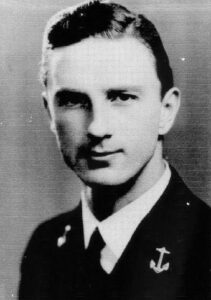 A lasting vision Bert Atkins has of his time in combat during World War II is that of USS Chicago, a navy heavy cruiser, being torpedoed during the Battle of Rennel Island and sinking on January 30, 1943, with a loss of 6 officers and 56 enlisted men. Atkins had often admired USS Chicago; it had been commissioned in 1931 but was still one of the most beautiful ships in the fleet. Five torpedoes from Japanese planes sank her.
George Albert Atkins was born in Vermont, but his family moved and he lived his early years in Sewanee, Tennessee. Atkins’ father was chaplain at the hospital associated with University of the South. After high school, Atkins attended University of the South, graduating in 1941 with a major in philosophy. He felt led to be an Episcopal priest and considered attending seminary. Atkins was aware of events in Europe and felt he would be in war eventually. A career as an Episcopal priest would give him a deferment from military service but he decided to be available for military service as one brother was already in the Navy and another in the Army.
As the end of summer 1941 approached, he went to be with his family in Richmond VA where they had moved in 1938. His father encouraged Atkins to go into the ministry but Atkins enlisted in the US Navy on September 25, 1941, in the V-7 program, which prepared men to be Naval officers. Atkins said, “I liked a good bed instead of mud holes and wanted to eat three square meals a day.” On December 7, 1941, the Japanese attacked Pearl Harbor, Hawaii. Atkins heard news of the attack over the radio, and he was concerned about the possibility of further attacks and how the events would affect him.
Atkins was called to active service in January 1942 and assigned to the USS Prairie State. This was the old battleship USS Illinois tied up to a pier on the Hudson River in New York City. The Navy had taken USS Illinois’ superstructure off and built a barn like building on the main deck. The building was large enough to handle 500 trainees. The goal was to provide 4 years of Navy deck officer training in 3 months. At the conclusion of training, Atkins felt ready for his duty aboard ship. He graduated in April 1942 and was assigned to Navy Torpedo School, Newport RI. Atkins graduated from Torpedo school in July 1942. The final exam was to take all the individual parts of a torpedo and put them together to make a functioning torpedo. At that time, the Navy was having many problems with torpedoes because they would not detonate upon hitting a target. Fortunately, this problem was largely solved by the time Atkins arrived in the South Pacific several months later.
After torpedo school, Atkins was ordered to Bath ME to assist in building the USS Conway, DD 507. The ship had just the keel laid so he was not as busy as he would later be. Atkins had met his wife to be, Grace, at a church event a few years earlier, fell in love and they were engaged to be married. Atkins felt comfortable asking his Commanding Officer for 10 days leave and he and Grace were married July 28 1942 by Atkins’ father.
Atkins’ responsibilities were to organize the ship’s records with all official Navy publications as well as working with anti-submarine sonar, depth charge and gunnery operations. He also learned typical submarine operational tactics to aid in using depth charges effectively. Conway was launched on August 26 1942.
Final additions to Conway’s armament and other key equipment were put on at Boston Navy Yard. Conway was commissioned December 9, 1942, and ready for action. Atkins was assigned official duties as chaplain, torpedo, depth charge, smoke generator, assistant commissary, coding, censor, welfare and assistant gunnery officer. The first captain of USS Conway was a true leader. Atkins said, “The men loved his style of leadership and would follow him anywhere.”
A two-week shakedown cruise to check on operating efficiency of USS Conway was done off the coast of Portland ME. The weather during the cruise was freezing. Atkins duty station while on watch was the gun control tower, the coldest and most exposed place on the ship. One had to be very careful or heavy seas, wind, rain and ice could cause loss of life due to falling overboard. Conway had a complement of 16 officers and 300 enlisted men. Atkins’ lodging aboard ship was a small stateroom he shared with another officer consisting of bunk beds, small clothing lockers, small safes and a tiny desk.
After shakedown, Conway went to Norfolk VA to help form Task Force 68. This force included heavy cruisers, USS Chicago and USS Cleveland, three small aircraft carriers and five destroyers. By December 5, 1942, Task Force 68 was ready for war. Task Force 68 zigzagged across the Pacific on the lookout for submarines. It crossed the International Date Line and the equator without the usual celebration: no time for that. Eight hours a day were spent on watch with additional time spent on training. Conway had eight torpedo tubes all loaded with torpedoes and eight more torpedoes in reserve below deck. A smoke generator was aft and when in operation with its powerful blowers, could obscure a whole fleet of ships.
Atkins oversaw scores of depth charges aboard, which were engineered to roll off the deck when needed and explode at a predetermined depth. Smaller depth charges were designed to be launched in the air in a wide pattern. The powerful depth charges could split the seams on a submarine due to the transmission of great underwater force to the submarine hull.
Conway was headed for the Solomon Islands to be involved in a series of battles initially ranging from New Caledonia, New Hebrides and Guadalcanal. On January 29, 1943, Conway experienced its first air attack shooting down two enemy planes and barely escaping being hit by Japanese bombs. During the attack, Atkins dove for the pyrotechnic box, which was not a good choice, and bumped heads with the Chief Signalman who also dove for the box for protection. USS Chicago was hit by four torpedoes and the next day was sunk when hit by one more torpedo. Conway picked up members of the crew and took them to safety.
In all the activity in the island-hopping campaign, Conway’s job was to soften up the beaches for landing and lead and protect the troops as they went ashore. Conway went on to Vella Lavella looking for Japanese ships and on to Bougainville for another landing. Atkins was qualified as an Officer Of the Deck by this time. He was responsible for conning the vessel at high speed and missing coral reefs on the way in for landings. The navigators used old National Geographic maps, the only ones available and they were not too accurate. navigation equipment. Conway was getting old and worn out.
Refitting finished, Conway returned to the Pacific and went on to the Philippines where she encountered the first of many kamikaze suicide planes. New proximity fuses using radio transmissions for the 5-inch gun ammunition, allowed better results in defending against the kamikazes. Deadly results would be obtained with near misses on a target using the new fuses.
When Iwo Jima and Okinawa were attacked, Conway stayed in the Philippines and Atkins saw operational plans for Conway to take part in the invasion of Japan should that invasion be necessary. While the Okinawa battle was raging, Atkins got orders to return home. He took a tanker back to Panama and an old Liberty ship to New York. He called Grace to meet him in Philadelphia, and they had a great reunion. He had 30 days leave before reporting to Naval Training Station, Miami FL as an instructor. On the way, Victory over Japan (VJ Day) was declared. After a brief time in Miami, Atkins was released from active duty, exactly four years to the day from entering service, and he returned to civilian life.
After a few years of teaching, he bought a Firestone retail store. He sold that business after a few years and took a position at North Carolina Finishing Co. that was later bought out by Fieldcrest. This ultimately brought him to Eden. Atkins retired in 1985 from his position as Insurance and Risk Manager for Fieldcrest. Atkins and his wife Grace have been very active in the community and are now focusing on enjoying their grandchildren and just doing what they like to do. Atkins says, “There is nothing like combat, but seeing it makes one never to want to see it again. It is a horrible way to settle disputes, but we need to be prepared for it.”
Atkins and his wife Grace have a son, two daughters and four granddaughters.
Interviewed 3/7/2003