
Adkins, Donald V.
- Service Branch: US Army
- Rank or Rate: Lieutenant Colonel (Retired)
- Service Dates: 1958-1979
- Theater: Vietnam
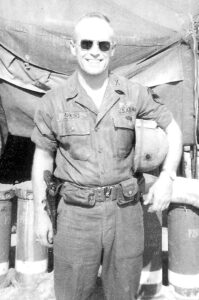 In Vietnam air combat, from 50 feet above the ground to an altitude of 2000 feet is the “dead zone”. You had to fly a helicopter below 50 feet from the ground to surprise the enemy or else over 2000 feet altitude, which was outside the effective range of small arms fire. You did not survive in the dead zone. Donald V. Adkins avoided the dead zone and survived his 750 Vietnam combat missions as a helicopter pilot to enable him to later retire with many honors from the Army.
Upon graduation from high school in Charleston WVA, Adkins enrolled at Marshall University on an athletic scholarship, participating in football, wrestling, and track. His father, who was a World War II veteran, encouraged the military life, so Adkins joined the Army ROTC. He was obligated to two years of active duty upon graduation. Shortly after graduation from Marshall, he was commissioned as a second lieutenant and assigned to an Armor (tank) unit in Fort Knox, KY. It was only four months later when he was sent to Korea, assigned to the Seventh Infantry Division to assist in guarding the two-mile wide demilitarized zone on the 38th parallel between North and South Korea. On the way to Korea, while waiting in an airport, Adkins heard John Foster Dulles, US Secretary of State; say, “If necessary, we will fight to the last man in Korea”. Adkins and his fellow soldiers looked at each other and remarked, “He is talking about us”.
When not on the DMZ border, Adkins was assigned as reconnaissance platoon leader, commanding two tanks, and five machine gun jeeps doing “war games” and training exercises. His mission was to find the enemy and suppress their activity.
Adkins had been married to Jane for a year when assigned to Korea and she could not officially join him for the thirteen-month assignment. She did come over as a “tourist” however, and lived in an apartment in Seoul. Adkins’ first daughter was born in Korea.
After his 13-month Korea duty, Adkins was able to choose his next assignment to Fort Knox KY, training soldiers in tank operations. Upon returning to Fort Knox, Adkins decided to make the Army his career and applied for a regular commission.
Adkins remarked that the worst job in a tank is that of “gunner”. The other tank crew members can look out a hatch or slit opening but the loader cannot see outside from his position except through an optical viewfinder. The confined tank space can cause problems for a crewmember who is not psychologically suited for the task. There is much foam padding inside a tank, but crew members still must wear head protection for the frequent jolts and bumps. Firing a gun is very dangerous in a tank. A crewmember could be crushed by the gun’s recoil if he is not in the proper position.
After receiving his regular commission, Adkins applied for Airborne and Ranger training – a 13-week course. This was both physically and emotionally demanding. It included hand-to-hand and bayonet combat training. Several men dropped out before completion of the courses. The instructors were known to say “Completion of the course is a matter of mind over matter – we don’t mind and you don’t matter.” Going five days without sleep and food, except what could be dug up or found growing, worked on a man’s mind more than the physical aspects of the training. Earning a Ranger badge is an extraordinary achievement.
The airborne portion of the training included that of building up the whole body, especially the legs, as well as practicing the acrobatic part of the landing, which allows a person to absorb the shock over his whole body. The instructors joked that all parachutes were guaranteed, saying, “If a parachute does not open, you can always come back and get another one”. After the required five jumps, Adkins earned his parachutist wings. This, not being enough for Adkins, he volunteered to attend a jungle-training course in Panama. This taught him how to navigate and survive in primitive conditions.
Upon return to Fort Knox, Adkins applied for flight school; first at Fort Rucker, Alabama as a fixed wing observation pilot and later to Fort Walters Texas for helicopter training. He graduated in October 1962 in the middle of the Cuban Missile Crisis and was assigned a special command going into Cuba as part of an attack force. These orders were countermanded, and he returned to Fort Knox to an Advanced Armor course. Germany was his next duty station for two years as Adjutant of an Aviation Battalion. About this time in 1966, combat in Vietnam was heating up. Pilots qualified in the “Huey” helicopter were needed badly in Vietnam. Adkins was not trained in the Huey so was sent to a quick instruction course. His instructor told Adkins that he “could not fail” the course because he was needed in Vietnam. Adkins received orders to the First Cavalry Division in Vietnam for one year, arriving on 8/11/66 at Pleiku. Upon arrival, he observed ambulances moving about and wounded being treated – not a good omen. Adkins was promptly sent to An Khe, his base camp, called a Landing Zone, where he would live the next year. His new home was a tent.
Captain Adkins was put in charge of a scout platoon consisting of ten OH 13 light observation helicopters. These had two seats and a bubble canopy with machine guns on either side. His job was to find the enemy. The night before the mission, he would be briefed and then go to bed. He would get up before daylight, eat a good breakfast, and look at maps showing recent trails where Viet Cong were traveling. If he found VC, he would call in the lift helicopters with their troops to deal with the enemy. If much enemy activity was found he would fly for his limit of 2 hours and 40 minutes of fuel, return, refuel, and go out again until the problems were handled – that sometimes was from dawn to dusk. Then came the reports of the day’s activity to mission interrogators before concluding the day’s work. Every day was the same. The way Adkins kept up with the day of the week was; each Monday he had to take a large malaria “horse pill” in addition to the small one he took every day. Worship services did not help him remember because services could be held any day of the week due to the chaplain’s erratic schedule.
The same ground was fought over several times during Adkins’ time in Vietnam. In September of 1966, he was sent to Phan Thiet near Saigon to clear out enemy strongholds. The base always had razor wire around the perimeter and guards on duty, to watch for infiltrators. Adkins typically had “first light” and “last light” missions. The first light missions frequently caught the VC guerrillas still marching to their destination. Sometimes smoke from breakfast fires gave away their location for later attack by our forces. Last light missions were flown to keep the enemy from advancing near the base for a night attack. Flights had to be close to the ground to see the enemy in the jungle. Many times Adkins’ helicopter skids almost hit the treetops. Sometimes, he could not tell where the enemy was until he was fired upon.
In his cavalry troop, there were scout helicopters, gunships, lift ships, and platoons of infantry. The scouts would find the enemy; lift helicopters would take the troops to the enemy with fire support from gunships. Adkins stayed in Phan Thiet until December 1966 and returned to troop headquarters where he was promoted to Major and made Troop Commander. Adkins then began flying gun ship missions. Adkins’ Huey gunship had mini guns like Gatling guns on both sides capable of firing 5000 rounds per minute. It had 14 rockets, which were fired two at a time by aiming the helicopter at the target. Some gunships also had grenade launchers.
The cooperation with the Air force was superb. Adkins could call in B-52 strikes on large targets he found, and the sensation was similar to an earthquake when the bombs struck their target. The bombers could obliterate a square mile of countryside. It was routine that civilians be warned of the impending strikes so they could evacuate the area.
Adkins was often in the position of helping his fellow soldiers escape from dangerous situations. On one mission, two helicopters had been shot down and Adkins put himself in an exposed position while hovering over the downed helicopters, suppressing enemy fire as other helicopters came to rescue the crew. Adkins himself was shot down twice. The first time, he was rescued by an Air Force helicopter and the second time by an infantry platoon, which provided security to escape. The medals and commendations Adkins earned are testimony to his valor under fire.
One of the most difficult problems was identifying the enemy. Viet Cong guerrillas would live inconspicuously in the villages but while friendly today, tomorrow they would try to kill you. Some of the VC were only 14 years old and some of the VC women were tougher fighters than the men. Adkins had no animosity toward the Vietnamese people per se and liked some of the civilians very much. However, the atrocities he heard about made him eager to rid the earth of the enemy who could do such things.
Adkins had opportunity to take rest and recreation leave to Hawaii while in Vietnam and Jane could have traveled to be with him but they elected not to do so. As difficult as it was the first time he had to say goodbye to Jane as he left for combat, it would be doubly difficult now that he knew what awaited him upon his return to Vietnam. He did finally take a few personal days off and his destination was wherever the “next airplane” was headed. It happened to be Penang, Malaysia where he enjoyed a brief respite from combat.
The Ahn Lo valley was called the valley of death. Nothing lived there because it had been bombed and fought over until no living thing survived. When Adkins was sent home after his year in Vietnam, it sickened him to hear of later battles in that same valley where some of his men had been killed while capturing it.
Adkins is proud to say that his unit never left a man behind. Every crewmember down was rescued and brought to safety. All bodies of those killed in action were also recovered. One of Adkins’ most heart wrenching duties was to write home to the wives and parents of those killed in action.
Adkins is proud of the young soldiers he served with. Without exception, they did a good job in an unpopular war and would not let their friends down in very trying circumstances.
Adkins completed his duty in Vietnam and enjoyed a happy homecoming with his family, one of whom was an 18-month-old child who did not know “daddy”. Adkins career continued with assignments including Command and General Staff School, Force Development in the Pentagon (obtaining a master’s degree in systems management while there), Physical Education Instructor at West Point, Commander of an Air Cavalry Squadron at Ft. Bragg and Recruiting Duty in WVA. He was then offered an assignment in Germany but because of his family needs decided to retire and take a position with Morehead High School as ROTC Commander, and where he later became Athletic Director. He retired a second time after serving as principal at Holmes Middle School.
Adkins appreciates every day and is proud of his career as a soldier. It helps put life in perspective for him. In Vietnam, every decision he made caused someone to live or die. He vowed never to let life’s small problems disturb him. In comparison to combat, all other problems he has faced since then have been small ones
Lieutenant Colonel Adkins flew 750 combat missions, earned the Silver Star, Distinguished Flying Cross, and 30 Air Medals, one for valor, among other medals. All the awards commended Adkins bravery and valor under fire. He still serves his community in significant ways and continues an active life. He and wife Jane also enjoy being with their six children and their families, including seven grandchildren.
Interviewed 12/3/2004