
Easter, Coy Edward
- Service Branch: US Army
- Rank or Rate: Staff Sergeant
- Service Dates: 1944-1946
- Theater: Europe
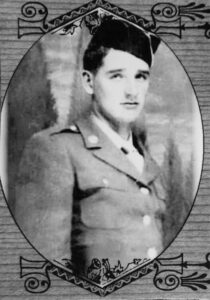 Coy Easter had never traveled further from his home in Stoneville NC than to Winston Salem NC. This changed when he was 19 years old and drafted into the US Army. He was destined for combat in faraway places and exposure to a world of weapons, battles, misery and death.
Easter reported to his basic training station at Camp Blanding, FL August 31, 1944. In the indoctrination process the Army interviewer learned that Easter enjoyed hunting small game. He later proved his skill on the rifle range and was good enough to have been selected as a sniper – but instead was assigned to the infantry.
The war in Europe was going well for the Allies. The Pacific theater was now the larger problem. After completing basic training, men drafted in late 1944 were sent to Florida to be trained in jungle warfare to fight the Japanese. After Easter had received his medical shots for the Pacific, an ominous event occurred on December 16th, 1944; the German army unexpectedly attacked our forces in an action called the Ardennes Offensive or the Battle of the Bulge. Easter’s destiny changed suddenly. His unit undergoing jungle training was required to support combat operations in Europe. They would be replacements troops for the 95th Division.
In January 1945, after two days leave, Easter went to Ft. Meade MD to regroup and then to Boston to board the luxury liner “Ille de France” for the voyage to England. When the ship left Boston, it was snowing, and the ship had six inches of snow on deck. The ship was crowded and a far cry from “luxury” status. Stewed tomatoes were served every day on the eight-day trip. The men had to eat from their mess kits but were unable to wash them adequately. They became unsanitary and caused most men to get sick while at sea. It was a challenge to sit in the mess hall to eat with sick, as well as seasick, men. A rolling ship made it more difficult to keep any food down. Most men did not.
When the ship arrived in Glasgow Scotland, the men were put on a train to Southampton England and without delay were put on LSTs (Landing Ship Tank) to Le Havre France, ready for combat. Sleet and snow greeted the men as they left the LSTs onto French soil. Easter saw no intact buildings in Le Havre. It was bombed flat.
That night the men stayed in a tent city with some hot chocolate to keep them warm. The tent had no floor so Easter lay down on his raincoat spread out on the mud and tried to sleep. It was freezing weather and one of the most miserable nights he spent in Europe. He had his “companions” in the form of a 45-caliber pistol, an M1 rifle, bayonet and 500 rounds of ammunition. A hand grenade was hanging from a hook on every buttonhole. It would be thirty days before Easter could have a bath. The only officer in the Division at that point was one Captain. All other officers had been killed in combat.
The 95th Division had recently captured Metz, France in a bloody battle. Easter and his unit went to Metz and on to Frankfort as replacements to compensate for the heavy combat losses. Easter had no idea of his location while marching or in the troop trucks until he saw signs for the towns he was entering. Upon reaching the Rhine River, it was common to be fired upon by German troops on the other side. The 95th Division immediate objective was to prevent destruction by the Germans of a bridge over the Rhine near Hamm Germany. The Germans defended the bridge well and killed all men in the 95th first patrol to attempt to go across. The 95th tried again and this was also a suicide mission. The Germans were successful in blowing up the bridge. The 95th soon captured another bridge spanning the Rhine.
While near Hamm, an old man on a bicycle was approaching Easter’s platoon and refused to halt for questioning. When he turned around and tried to cycle away, several shots were fired at him. Unknown to Easter’s platoon, there was a graveyard nearby with German soldiers behind tombstones ready to ambush Easter and his men. When the shots were fired, they all stood up and surrendered as they thought the shots had been fired at them. Easter and one other man were assigned to take the prisoners back to headquarters. As Easter says, “Here were two “young kids” taking responsibility for 25 German prisoners”. Fortunately, at this stage of the war the Germans were ready to quit and offered no resistance to Easter and his fellow soldier.
When Easter’s unit moved into the suburbs of Hamm, they were pinned down by German machine gun fire. The men laid down flat and could hear the bullets as they whizzed just inches over their heads. Just then a US tank came into view, headed directly for Easter. At the last second it turned, and Easter was spared being crushed under the tank treads. The tank blew up the German machine gun nest so Easter’s unit could advance. Easter commented that while in combat he used every survival instinct he had to stay alive while still doing his duty. He was fearful but forced himself to go on in order to not let down his buddies who were in the same situation.
In the Ruhr Valley area Easter’s unit came across some Russians who had escaped from a German prison camp. They were very hungry and could not wait for some eggs to be cooked for them but rather wolfed them down shell and all. They were sent on their way back to their own lines.
Easter’s division was assigned to Lipstadt to join up with the 1st Army to contain and destroy German Army Group B. It was successful and over a period of several days over 300,000 German troops surrendered. Captured rifles were piled as high as a house. Field Marshal Walther Model was the commander of the troops and rather than technically “surrender” and infuriate Hitler, Model simply “disbanded” the Army. It was the largest single German surrender in the war – and to the 95th Division. Field Marshal Model committed suicide rather than be tried as a war criminal. Hitler also committed suicide within two weeks of the Model surrender.
Easter holds images in his mind of the tragedies war brings to the innocent. He remembers well the death of fellow soldiers, the sight of dead bodies and starving children on the side of the road – women fighting over a piece of bread for a child. He remembers the skin of German people being yellow from poor diet and starvation. Easter remembers his aversion to food. The sights and smells did not allow him to eat regularly unless he was simply famished. The greatest hurt he remembers is one of his buddies being fatally wounded, bleeding and dying near him. It seems like a dream now but was reality then.
On March 6, 1945, Easter was advancing on German lines and struck by shrapnel. He did not realize he had been wounded because there was so much action around him. Easter earned a purple heart, but the wound did not take him from combat.
While going through a little town he came across a dead German soldier. Curiously, he looked through soldier’s billfold and saw a picture of the soldier, a young wife and two girls. It struck him that this German soldier was just like him – doing his job – one he did not want to do but had to do.
Shortly after the Model surrender, the war was over in Europe and Easter was given 30 days leave before being assigned to the Pacific to fight the Japanese. During his training assignment at Camp Shelby MS, the war in Japan ended. He was assigned to Ft. Meade MD to help in the discharge process of soldiers and to work in the base Post Office. During his year there, he was eventually placed in charge of the Past Office and promptly wrote up promotions for all the men in the Post Office, including himself. They went through. He did it again within 30 days and those promotions also went through. So Easter went from Corporal to Staff Sergeant in less than two months immediately prior to discharge.
Easter is impressed by the randomness of war. How one soldier is killed yet the one next to him spared. He wonders how insignificant, but brave young boys could win a war against the greatest tyranny the world knew at that time. Those questions remain to this day!
After the war Easter’s primary occupation was as a building contractor. He and his wife Connie are active people in the Madison community. He has three children, two who live locally and one in Connecticut.
Interviewed 3/19/2003