
Morgan, Robert K.
- Service Branch: US Army Air Corps
- Rank or Rate: Colonel
- Service Dates: 1940-1965
- Theater: Europe/Pac
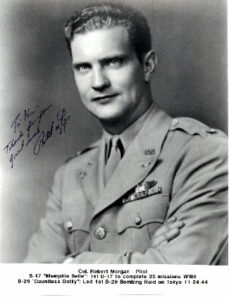
 Colonel Robert K. Morgan, pilot of the famed World War II bomber Memphis Belle, celebrated his 85th birthday in 2003 in Asheville, North Carolina, his hometown. Morgan is a charismatic individual and a personification of the thousands of crew members who fought in the air during that long ago war. His aircraft, Memphis Belle, was the first bomber to complete 25 missions in Europe when 80% of bomber crews did not complete 25 missions because they were shot down or otherwise lost. Morgan was not born to be a pilot although he was a good one, and he still flies. He was a fun-loving college student at the University of Pennsylvania in 1940 when he realized our country was headed for war and he wanted to get into the service. Morgan states, “I didn’t like to walk, and I couldn’t swim well so that left the Air Corps by default.”
Morgan entered active Air Corps service in February of 1941. His first training was at Camden, South Carolina where his instructor took him up in a PT-17 trainer plane for a series of snap rolls, spins and enough acrobatics that Morgan wondered whether he was in the right branch of service. Even so, Morgan soloed in less time than usual – six- and one-half hours. On one training mission, Morgan succumbed to the temptation to buzz the row of trainer aircraft lined up on the field. This resulted in a serious threat from his commanding officer to eliminate him from the flight-training program. This was the first of several devilish stunts he did.
At one of his next training stations, he was allowed to choose which he wanted, fighters or bombers. He surprised all his boyhood friends by choosing bombers. Driving his father’s car at high speeds through the mountains near Asheville, in their minds, qualified him as a fighter pilot. As Morgan states, “I chose bombers because I liked company in the air, and I would have a navigator to get me home.” Morgan graduated from basic flight training in early 1942 and was sent to McDill Field to train for multi engine aircraft. There were no four-engine bombers at McDill, only the twin engine Lockheed Hudson. His time was spent patrolling the Gulf of Mexico looking for submarines. One day on a boring patrol mission, Morgan noticed a party going on at St. Petersburg Beach. Going down for a close look, and again for an even closer look, was a mistake. The next day the commanding general called Morgan in for a conference and asked if he had been flying a Lockheed Hudson and had buzzed the cocktail party the general had attended. Morgan replied, “Yes sir!” and General Olds told Morgan he should eliminate him from flight training but since the government had $30,000 invested in him, he would not recommend that. Instead, General Olds said, “If I have anything to do with it, you will be the oldest second lieutenant in the Army Air Corps.” That almost happened!
Morgan was originally destined for Africa on a B-24 heavy bomber but orders were changed, and he stayed at McDill for training in B-17s. Morgan says the B-17 was the most beautiful airplane he had ever seen. On one of his training flights, he was over Asheville, North Carolina and while his instructions were not to land during the training flight, the thought of showing this beautiful airplane to some of his friends in Asheville was too much to resist. He landed on the short runway and burned out his brakes. A call to his squadron commander resulted in repairs being made but another black mark on the Morgan record. Two weeks later the squadron was flying to Walla Walla, Washington to continue training in B-17s. As punishment for the brake replacement caused by the unauthorized landing in Asheville two weeks earlier, Morgan had the “privilege” of riding an overcrowded troop train to Walla Walla. While in Walla Walla, he met the sister-in-law of the flight surgeon of the squadron, a beauty from Memphis Tennessee named Margaret Polk – the real Memphis Belle. A romance blossomed!
The squadron was assigned to Bangor, Maine to pick up a brand-new B-17 before going to Europe. All the crews were naming their planes and Morgan felt his crew should name their plane also. After much discussion, the bomber was named Memphis Belle by a slim margin. Two votes for Memphis Belle and one vote each for eight other names. Morgan called Esquire magazine in New York and talked to George Petty, the creator of the 1940’s Petty Girl drawings, to design the nose art for Memphis Belle. He agreed. An artist in the squadron painted it on the nose of the bomber. A red bathing suit on one side and a blue bathing suit on the other side, adorned the Memphis Belle.
In October 1942, Memphis Belle and crew went to Bassingbourn, England, a luxurious base of operations compared to most Air Corps bases. Morgan says everything was better except the food. On November 6, 1942, Morgan and crew went on their first bombing mission to Brest, France against Nazi submarine pens. The mission was accomplished without too many difficulties but the next mission against submarine pens at St. Nazaire, France was an entirely different matter. One plane from the squadron was lost and Memphis Belle came back with 50 or more bullet holes in the fuselage. At that point, the reality of the brutal air war came home to the crew of the Memphis Belle. During the 25 missions Memphis Belle flew, she lost eight engines that were shot out, a large piece of the right wing blown off and a six-foot piece of stabilizer destroyed along with many hundreds of bullet holes, all without the loss of any crewmember.
In the dark days of 1943, due to losses among air crews reaching as high as 80% of a squadron, a new rule was put in effect; any crew attaining 25 missions would go home, with their combat service completed. On Belle’s 20th mission a famous Hollywood director, William Wyler asked if he could come along and take movies for a training film. After filming the 25th mission, Wyler told Morgan the film was a documentary that was to be shown around the free world with Memphis Belle and her crew as the focal point. Morgan asked, “What if we hadn’t come back from the 25th mission?” Wyler replied, “We had a backup; Hell’s Angels.” This documentary called “Memphis Belle, the story of a B-17” is currently shown on the History Channel from time to time.
Upon the completion of 25 missions, Belle and her crew started out on their 26th mission, which was to help sell war bonds and thank the production workers all over the country for what they were doing to win the war and their help bringing the Memphis Belle crew and other military personnel home. A visit to Asheville was part of the tour and true to form; Morgan flew the Memphis Belle between City Hall and the County Court House upon leaving Asheville. One hundred seventy-three feet separate the two buildings. Old timers still talk about that.
Media coverage of the war bond tour was intense and the romance with the real Memphis belle, Margaret Polk, fell apart. However, Morgan was a close friend of Polk until her death in 1990. In her later years, Polk was a leader in the restoration efforts on the Memphis Belle.
While he could have had an easy job after his experience in Europe, Morgan went on to the Pacific to continue his military career with a B-29 Super Fortress squadron. His aircraft was named Dauntless Dottie. He completed another 26 missions and on November 24, 1944, was the leader of the first bombing mission on Tokyo, since Jimmy Doolittle’s famous raid in 1942. He also took part in the firebombing of Tokyo in early 1945 that burned 54 square miles to ashes. After Morgan left the Pacific, Dauntless Dottie crashed off the island of Kwajalein. Morgan is part of a current effort to find and rehabilitate the aircraft.
In 1990, William Wyler’s daughter, who is a movie producer, wanted to create a “Hollywood” movie on the World War II exploits of the Memphis Bell. She was going to name it the “Dixie Belle” but thought better of that and named it “The Memphis Belle.” It was a composite of every combat flight the Memphis Belle had made, and Morgan was not happy with it although it was entertaining and a box office success. Matthew Modine played the part of Morgan in the movie.
The B-17 Memphis Belle today is on triumphant display in the U S Airforce Museum in Dayton Ohio. Robert Morgan is very generous with his personal time, regularly speaking to high school history and ROTC classes and college classes. He attends air shows all over the world and continues to fly military and civilian aircraft. In 1997, he met the Queen Mother in England again, 54 years after she had congratulated him on the completion of 25 missions in the Memphis Belle.
Morgan has four children and resides in Asheville with his wife Linda, also a pilot, along with miscellaneous dogs and cats.
Interviewed 11/22/1999
B-17 statistics: Cost $314,000 in 1943, Wingspan 103’9”, Length 74’9”, Height 19’1”, Weight 65,000 pounds, Speed 160 mph @ 25,000 feet, Bomb Load 8,000 lbs., Fuel 2,520 gallons, Guns, 13 – 50 caliber machine guns, Crew 10