
Barbee, Boyce B.
- Service Branch: US Army Air Corps
- Rank or Rate: Sergeant
- Service Dates: 1942-1945
- Theater: Europe
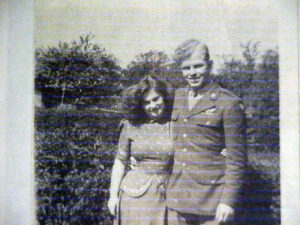 After Boyce Barbee completed his 25th combat mission in a B-24 Liberator bomber, his military career would take a most unusual turn. He became involved in a top secret “airline” that delivered men and information to and from the Soviet Union via Sweden. His aircraft also brought aircrews back to fight again after forced landing in Sweden due to lack of fuel or aircraft malfunction. If the unmarked and defenseless B-24 on which he was a crewmember had been shot down, the outside world would not be given any facts and if captured, he would have been shot as a spy because he carried no identification and was dressed in civilian clothes.
Barbee was born in Concord NC and graduated from Stoney Point high school, near Taylorsville. His father was a disabled WW I veteran who had been wounded and gassed. Through his father’s condition, Barbee became familiar with the aftermath of combat at an early age. After high school graduation, Barbee worked in a textile mill until drafted October 24, 1942. He was sent to Statesville for testing but did not leave Fort Bragg for indoctrination until November 11.
He did well on a test for “code work” and was assigned to the Army Air Force base in Atlantic City for basic training. Barbee went on to Scott Field IL for five months, studying Morse code and communication skills in preparation for his work as radioman on a bomber.
After radio school, he went to Harlingen, TX to air gunnery school. The training included shooting at target sleeves towed by a tow plane. He found out quickly that you had better not put a bullet hole in the towplane, or you would wash out immediately. Barbee passed with flying colors. Upon completion of the course in early 1943, he was promoted to sergeant and sent to Tucson AZ for assignment to a bomber crew as a radio operator. With Lt. Carnine as pilot, the crew flew day and night in preparation for combat – then on to Lincoln NB for assignment overseas.
At Lincoln NB, his crew was assigned as a replacement crew for those planes and crews lost in combat. Soon his crew was flown to North Africa, but still without their own plane. After a short time, his crew returned to England and joined the 392nd Bomb Group, flying some missions in other crew’s planes.
Lt. Carnine learned of a B-24 that had run out of fuel and landed in a nearby field. It was to be dismantled for parts because it was thought there was no room to take off from the field. Carnine said, “Let me see it!” Regulations required at least a pilot and radioman to be aboard any airborne B-24. Carnine and Barbee went to the field, had some minimum amount of fuel added to the tanks, all extraneous material removed, climbed in, ran up the engines to full power until the braked wheels slid on the ground. Carnine released brakes and took off, pulling up sharply to clear an apartment building at the end of the field, almost stalling, and then leveling off. Carnine had his B-24 – with just a little fuselage damage from the forced landing but with a shaken pilot and radioman on board.
The combat routine began – thirteen missions in thirty-seven days. In one instance, Captain Jimmy Stewart, the Hollywood actor, was the lead pilot of a bombing mission. On most missions, the bomb groups had to fight their way into, and out from, the target. It was too early in the war for long-range fighter escort to be available. It was bombers against fighters! Flak and German fighters were in abundance. The Germans also used a technique of dropping steel cables from fighter planes to drag through the bomber formations and this was effective in entangling and bringing down many of our aircraft. During Barbee’s tour of 25 combat missions in the worst air combat period of the war, over 700 crewmembers and about 70 aircraft were lost from his base alone.
Barbee’s station was his radioman desk in the bomber. On one high altitude mission, it was 50 degrees below zero in the plane. Barbee’s right electrically heated glove and his facemask shorted out as he was in process of decoding a message from Bomber Command. He lost consciousness and fell from his seat. The flight engineer noticed it and put another facemask on Barbee so he could breathe. It saved Barbee’s life and the lives of many of the crews as the message Barbee decoded instructed the Bomb Group to turn back immediately because jet stream wind changes would prevent them from making it back to base if they continued the mission.
Upon return from another mission, Barbee’s plane was very low on fuel. Just as Lt. Carnine noticed a fighter strip under construction as a possible landing spot, all engines quit! He landed with little room to spare. As the crew got out of their plane, a P-47 fighter, also low on fuel, landed. The fighter pilot said to Lt. Carnine, “I did not think I could land here but if a B-24 can land, I knew I could”.
Flight plans for bombing missions were designed to avoid flak where possible. However, as the Germans moved their antiaircraft guns on railcars from place to place, flak was difficult to avoid. On the “bomb run”, the bombers were sitting ducks for flak, and many planes were lost during this phase of a bombing mission.
One of Barbee’s duties was to see that all bombs had dropped, and the bomb bay was clear after the bomb run before closing the bomb bay doors. In one case, Barbee did not notice that one 500-pound bomb did not drop but was hanging precariously in the bomb bay. Barbee signaled the bombardier to close the bomb bay doors. After closing the doors, the bomb dropped. It went through the bomb bay door and fortunately did not hit any aircraft below Barbee’s plane. If the bomb had stayed in the bomb bay, it would certainly have exploded upon landing, with disastrous consequences.
A most unusual event happened on Barbee’s 25th and final bombing mission. Upon nearing the coast of France, just before crossing the English Channel, the tail gunner said, “There is a strange B-24 pulling up behind us. Their life vests are not like ours and it just does not look right.” Carnine told the tail, top turret, and ball turret gunner “Train your guns on the pilot of that plane and if there is one false move, blow that plane out of the sky”. As Barbee’s plane reached the English Channel, the B-24 turned back. It was Germans operating a captured B-24 with the intent of getting into our formation and shooting down our planes from the rear. This tactic of the Germans worked many times.
In March 1944, Barbee could not go home yet although he had completed his 25 missions. He was asked to report to his Commanding Officer who told him to pack up and leave the base in two hours for a top-secret assignment. He was given authority to obtain two sets of civilian clothes at Harrods Department Store in London. He had earlier received a letter from his mother asking what he had done as the FBI had been asking questions about him in his hometown. Barbee was then sent to Leuchers RAF base, Scotland where incidentally, he met his wife to be – Ann. His new commanding officer was Colonel Bernt Balchen, a world-famous arctic explorer who had accompanied Admiral Byrd on Arctic Expeditions and was the first pilot to land a plane in the Arctic.
A secret “airline”, under the command of Balchen and the auspices of the Office of Strategic Services, was being formed to carry men and information to and from Sweden in collaboration with the Russians. The airline, flying war weary, unmarked, unarmed, B-24s, only flew in bad weather so the Germans would not see them. The plane was configured to hold as many as 30 passengers lined up on the sidewalls of the aircraft. Barbee was issued a Russian visa, just in case he had need of it. Officially, the airline did not exist. Most of the people the airline carried were unknown to Barbee but there were some high-profile persons occasionally, including Count Bernadotte from Sweden. While in Stockholm, it was common to be seated near German or Japanese patrons in a restaurant or hotel – probably on secret missions themselves. Stockholm was an international hotbed of spies. Barbee also experienced his hotel room having been searched for by people unknown while out for dinner.
After the war ended in Europe, the airline was disbanded. Barbee was then involved in ferrying Navy crews to Germany to operate captured German naval vessels. The Potsdam conference with President Truman, Prime Minister Churchill, and Russian leader, Joseph Stalin, was about to take place and Barbee was notified to be available to accompany President Truman’s entourage if a flight to Moscow was necessary. Barbee was involved because he was the only radioman stationed in Europe with a Top-Secret clearance AND Russian visa, plus he was good at his job. The trip to Moscow did not take place.
Barbee married Ann and was transferred to the US for discharge, but Ann had to do a lot of paperwork to get here. Finally, she arrived in the US in March 1946 – one of thousands of “war brides”. When she arrived in New York by ship Boyce Barbee was there to meet her and jumped over the restraining fence to reach her as soon as he saw her come down the gangplank. This was a great reunion and the end to his WW II odyssey.
Barbee commented that his WW II experience showed him one person could make a difference even though part of a huge endeavor. He has particularly high respect for the British Royal Air Force pilots who were outnumbered and out manned yet won a great victory in the Battle of Britain in 1940. The memory of many friends lost in combat is a burden he still carries.
Boyce and Ann Barbee have one son, one daughter, and one grandson. He and Ann enjoy their family, time at the beach and still lead active lives.
Interviewed 6/4/1999