
Fleishman, Alvin T.
- Service Branch: US Navy
- Rank or Rate: Lt. Commander
- Service Dates: 1942-1946
- Theater: Pacific
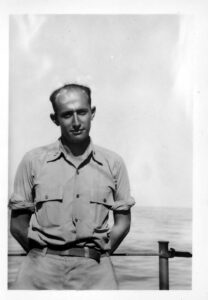 December 7th, 1941, Alvin Fleishman was visiting with a girlfriend who attended Madison College in Harrisonburg VA. They were listening to a concert on the radio when there was an interruption announcing the surprise attack on Pearl Harbor. Fleishman left immediately to get back to Washington and Lee University to check on the Navy commission he had applied for earlier. On his return, he drove through Richmond VA, and he recalls it was a “scary evening” because all the streetlights were out and there were sentries on the bridges around Richmond checking on the cars. He did not know it yet but there were much worse evenings in store for him in the South Pacific.
Fleishman’s father worked for the B. Fleishman Store in Anderson SC owned by his uncle. As a boy, Alvin Fleishman worked part time at the store. He was a very good student, graduating from Boy’s High School in Anderson as valedictorian in 1937. That was sufficient to obtain a scholarship to Washington and Lee University, Lexington VA where he took accounting and was involved in many extracurricular activities, including editor of the school newspaper. Fleishman also graduated as valedictorian of his class at Washington and Lee.
After graduating from W&L in 1941, Fleishman worked for a time in Richmond VA at Thalhimer Dept Stores. After the Pearl Harbor attack, he remarked, “Working at Thalhimer’s during Christmas season 1941 was full of both joy and despair.” On January 2, 1942, Fleishman went to Norfolk to check on the Navy commission for which he had applied. He received his commission March 1 and was called to active duty May 1, 1942.
Fleishman’s first duty station was Norfolk Navy Yard as an assistant supply officer because of his business training. He said, “If there was a dirty job to do I had to do it.” Frequently he oversaw the huge supply department on the midnight to 8 am watch. One night, an Ensign Lafarge from the cargo ship USS Titania came to him and said he desperately needed some supplies, as his ship was leaving port soon. Fleishman went out of his way to help Ensign Lafarge with his needs. This favor was paid back in late December 1942, when Fleishman was in desperate need of some supplies for USS Lardner and called on the cargo ship Titania for help. Ensign Lafarge returned the favor.
In mid-1942, Fleishman was assigned to Navy Supply Corps School at Harvard University to learn to be a professional navy supply officer. In September 1942, he received orders to report to the destroyer USS Lardner. It was “somewhere” in the South Pacific. Upon arrival at Pearl Harbor, Hawaii, he saw the most depressing, indelible sights. Fleishman remarked, “Ships were capsized, lying in the mud. The USS Arizona was underwater with 1177 dead men aboard. Many ships were badly damaged at their docks. Hickam Field was shot up and there were holes in just about everything. It was a confusing and distressing time.”
Fleishman boarded the battleship USS South Dakota and remained for two months en route to New Caledonia to report to USS Lardner. While on USS South Dakota, he was assigned the job of gun spotter. That required going up the highest mast of the ship with a pair of binoculars to report where shells landed. It was frightening and literally made Fleishman sick to climb up there. He recalls, “I saw the battleship fire broadsides with nine 16-inch guns going off at the same time, each firing a projectile weighing 2300 pounds. The sky turned orange for about 30 seconds, and the ship moved about 100 feet from the recoil.”
On December 2, 1942, Fleishman finally boarded USS Lardner at Espiritu Santo in the New Hebrides Islands. After boarding her, USS Lardner went to Guadalcanal and on up the chain of islands to New Georgia, Munda, Vela Lavella, and Kolombangara and finally, Bougainville. USS Lardner was in action near all the islands. The area between the islands was called “the slot” where major sea battles took place. The Japanese ships came down to attack almost every night. The volunteer Australian coast watchers stationed on the islands alerted our naval forces of what the Japanese were doing so we were prepared to meet them.
There were two cruisers, USS Minneapolis and USS Pensacola, that were badly damaged by Japanese action and USS Lardner was assigned to escort them back for repair. Japanese submarines attacked and USS Lardner got credit for sinking one of them. USS Lardner was also responsible for keeping planes from attacking landing craft while they landed men on the islands. There also were small Japanese boats like our patrol torpedo boats harassing our landing craft. USS Lardner had to keep them away so landings could be completed.
Fleishman said, “We went through hell in the first six months of 1943 but in July 1943, we were assigned to escort the aircraft carrier USS Enterprise to Bremerton WA for refit after battle damage.” There were five battle-scarred destroyers accompanying USS Enterprise as it went into San Francisco harbor. There were fireboats with water streaming from their hoses along with horns blowing, bands playing, and applause. The people were celebrating the return of our valiant warships. Fleishman says, “It gives me goose bumps today thinking about that huge celebration.”
USS Lardner went back to help secure the last of the islands in the chain, Bougainville, in November 1943. USS Lardner anchored in the idyllic setting of Empress Augusta Bay. It was a beautiful beach with white sand and blue water and 35,000 fanatical Japanese troops waiting to attack our forces. In the background was a volcano that glowed red at night – a perfect backdrop for the bloody battle ahead. The first and second Marine divisions landed with heavy casualties. Fleishman said, “It was nasty” but US forces eventually won. USS Lardner was in heavy action fighting off enemy planes while escorting amphibious crafts in for the landings.
The commander of USS Lardner’s destroyer division and one of the heroes of WW II was Commander Arleigh Burke, later to become Admiral and Chief of Naval Operations under President Eisenhower. He gained his nickname “31 knot Burke” while USS Lardner was under his command. He always had his destroyers going fast, attacking the enemy, just under the speed where they might burst their boilers.
Around Thanksgiving 1943, USS Lardner was assigned to rescue some Marines who were being slaughtered by the Japanese on Bougainville. Two ships stood off a way while USS Lardner went near shore to rescue the Marines. The Marines got to the ship in whatever manner they could. Most had been wounded and many died trying to get to USS Lardner. In all about 600 men were rescued, 300 aboard USS Lardner and 300 aboard another destroyer. Japanese boats were attacking, and it was a harrowing run back to safety. It was very frightening for wounded Marines who had just been rescued and thought they were about to be killed aboard USS Lardner.
In November, Fleishman received detachment orders to return to the US. It took a lot of effort to get his captain to sign them, as the captain did not want Fleishman to leave the ship. The captain said, “You are the best Supply Officer I ever had.” Finally, the captain signed the orders, giving Fleishman a handshake and a hug. After many months in the South Pacific under battle conditions, Fleishman finally arrived at home to see his excited parents. The Navy sent Fleishman on to Harvard Business School, as he was selected to be in the Naval Contract Termination Unit. That unit was created to pay government contractors and help them get back to civilian production as final war production needs were met. Fleishman did this as the war wound down and for four months after the war ended.
In 1946, Fleishman married Florence Gates, a WAVE (female navy person) whom he had met while in the Navy. She died in 1992. They had three daughters and a son, Dr. Henry A. Fleishman, a surgeon in Eden NC. Alvin Fleishman never officially retired but continued to work in the family business – Fleishman Department Stores until 1989 and then taught accounting and personnel management at Tri County Technical School, Pendleton SC until his health would not permit his continuing to teach. Alvin Fleishman loved the US Navy and continued after the war in the Navy Reserve for 26 years, attaining the rank of Lieutenant Commander.
Interviewed 2/1/2006