
Woodlieff, Jack Elwood
- Service Branch: US Army
- Rank or Rate: Sergeant
- Service Dates: 1942-1945
- Theater: Europe
 During a scene in the movie “Patton”, Lieutenant General George Patton, is shown in a tent paying last respects to the dead body of his former aide, Captain Richard Jenson. Not portrayed is another person in that tent, Sergeant Jack Elwood Woodlief of Leaksville NC.
Jack Woodlief did not know what to expect when he joined the US Army in January of 1942. He had heard news of the attack on Pearl Harbor over the radio at Chandler’s Drug Store in downtown Leakesville on December 7, 1941, and many of his friends had decided to sign up. On Monday, December 8, he thumbed his way to Danville VA to join the Army. For reasons he does not recall, the recruiter would not let him join and told him to come back later. Woodlief remembers walking about 10 miles on the way home to Leaksville before he was able to flag down a bus. He went back to Danville in early January and was allowed to join. A few days later he was in Camp Lee VA for uniforms and processing and on to Ft. Bragg NC for basic training and additional training in field artillery.
While at Ft. Bragg, Woodlief had a training sergeant who was very tough on the men. One day while Woodlief was on guard duty the sergeant walked past the guard post and Woodlief shouted “Halt! Advance and be recognized.” He then told the sergeant to show his identification and to back up 6 paces. After reviewing the identification, he threw it on the ground in front of the sergeant and said, “You are free to go.” The next day, the sergeant told Woodlief “You were rough on me yesterday and I compliment you for it. You did just right.”
Woodlief stayed for about 7 months at Ft. Bragg in field artillery but wanted to get into something else. He did not know what. About this time, Woodlief learned of the formation of the 47th Quartermaster Unit, Graves Registration in Fort Meade MD. He requested duty with that unit and was assigned to Ft Meade for training. This duty involves that of funeral director, embalmer, grave digger, hiker and detective all in one. It is work that is hard and unpleasant but must be done in wartime. After three months intensive training, in January of 1943 Woodlief was assigned to Oran, North Africa for duty, after the El Alamein victory by the British and the invasion of North Africa by the US Army in November 1942.
Woodlief’s first assignment in February was to go to the Kasserine Pass area where the German Afrika Korps had broken through and then were defeated a few weeks later by Allied forces. He was to search for bodies of US soldiers and bring them back for burial. Many bodies were recovered but while climbing the mountains surrounding the Pass, he came across a croquet mallet which he retained as an unusual souvenir for years.
In the early part of Woodlief’s time in North Africa there was no civilian labor available to do the backbreaking work of digging graves in the hard clay, so he and his unit had to do it themselves. Woodlief wore only a pair of shorts and a hat, and it was not long before his skin was burned almost black from the intense North African sun. Birds were dying from the heat. Later a labor pool was formed which relieved his unit from digging the graves. Mattress covers were used for burial bags. It was not unusual to see a North African Arab use a stolen mattress cover as a robe. Bodies were buried in temporary gravesites with wooden crosses and small metal markers that Woodlief made using metal embossing tools. Sometimes the grave sites were within 3 miles of the front lines but as time and battle action permitted, the cemeteries were beautified with some landscaping and a permanent cross or Star of David at each grave.
Woodlief’s responsibility was to identify the bodies of the dead soldiers through the dog tags worn. If these were missing, then dental impressions or fingerprints were used. If all else failed, then the records of the units were combed for missing soldiers and identification was made through birth marks, moles, hair color or anything that would help identify a corpse. Detective work of sorts was part of the job. It was not unusual for Woodlief to receive a body which was stark naked. The North Africans had no reservations about stealing clothes and dog tags from dead soldiers on the battlefield.
One day while working on a body, Woodlief noticed a bulge in the front pocket of the dead soldier. He put his hand in the pocket to pull out the object and accidentally pulled the pin on a hand grenade. Fortunately, the pants were so tight that the actuating lever was not released. Woodlief was able to pull the hand grenade out and throw it in a pit where it exploded harmlessly.
If dead German soldiers were found, the same care was given them relating to identification and other handling. However, frequently the Germans booby trapped their dead soldiers to kill men of the Graves Registration units, so this was a hazard of the work.
One day the body of Captain Richard Jenson, aide to General Patton, was brought in and there were no marks on his body. He had died of a broken neck. While on a courier mission, his jeep was attacked by a German bomber and Jenson leaped out of the jeep to the side of the road. A bomb landed near him and the concussion of the blast, and the movement of his helmet broke his neck. It was caused by the helmet being strapped under his chin. Patton had personally given the order that all helmets were to be strapped under the chin in good military fashion. The order was changed after Jenson’s death, so straps were worn to the back of the neck. This allowed the helmet to come off in event of concussion from a bomb or artillery explosion.
Woodlief was involved in preparing Captain Jenson’s body for viewing and was on duty when General Patton arrived in his command car at the viewing tent. Patton entered the tent while Woodlief stood at attention. Patton said, “At ease, soldier.” Patton took his helmet off and kneeled by Jenson’s body with his prayer book open and began praying for his dead aide with his hand on Jenson’s chest. Tears were streaming down General Patton’s face and he paused to cut a lock of hair from Jenson’s head and put it in his prayer book. It was a very emotional moment for Woodlief, and he will never forget it. General Patton rose and spoke to Woodlief saying “You are doing a good job, soldier” and left. Woodlief attended Captain Jenson’s funeral the next day and received a handshake and a compliment for his work from General Patton.
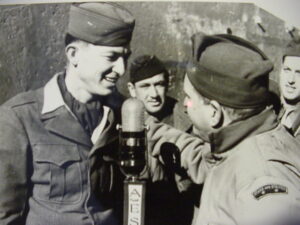
As the war progressed across North Africa Woodlief followed and went as far as Tunis before getting orders to go to Italy immediately after the US invasion at the Gulf of Salerno in Italy on September 9, 1943. As his unit progressed up into northern Italy, action was a little quieter, so Woodlief and his friends asked his Lieutenant if they could commandeer an empty little house in the mountains close to base for their living quarters rather than a tent. The request was approved and the group set up housekeeping for about two months in this mountain house. The house had a bomb hole in the roof which was repaired with a large sheet of canvas. The fireplace worked and everything was cozy. Near the house was a hostel where visiting celebrities stayed. Woodlief saw Walter Cronkite, Eric Severeid and Ernie Pyle who stayed at the hostel at one time or another. Phil Spitalny and his “All Girl Orchestra” also were there and gave a full performance for 12 soldiers including Woodlief
One day in northern Italy, a soldier came to the cemetery where Woodlief was working and asked to look around. Woodlief noticed he had stopped and was kneeling and sobbing at one grave marker. He had stumbled upon his brother’s grave marker and did not even know his brother was overseas in combat.
As the war wound down, word came that many soldiers in Europe would be going to the Pacific theater. However, upon returning by ship to New York, Woodlief found out he would be leaving the Army because he had enough points. He was discharged at Fort Bragg and arrived home in Leaksville at 3 PM in early September 1945 and greeted his family after being gone 32 months. One of the first things he did was take a walk up to the “Boulevard” to see old friends and get the feel of civilian life again.
Woodlief was married to Earline when he returned from service, they had no children and lived their entire life in Eden. He says his experience in WW II made him grow up very fast. He treasures his experience and the dear friends he made but would not “pay a dime” to repeat it.
Interviewed 6/23/1998