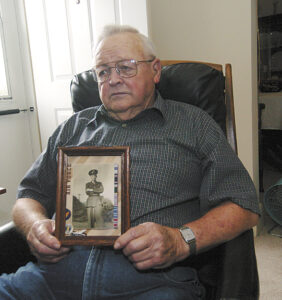
Tuttle, George Warren
- Service Branch: US Army Air Corps
- Rank or Rate: Sergeant
- Service Dates: 1942-1945
- Theater: S.A./Pacific
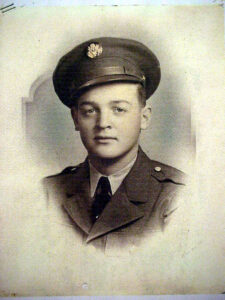 The B-24 heavy bomber was straining all its four powerful engines to make a desperate, almost vertical, climb out of a valley in New Guinea where another aircraft had crashed a day earlier. The wings brushed the treetops but there was enough momentum to take the plane safely to altitude for the trip back to base in Hollandia, New Guinea. In the valley were other stranded aircrew members checking out the lost civilization found by a reconnaissance crew a few days earlier. Warren Tuttle remembers that narrow escape from the valley as though it were yesterday. The complete story of the rescue of the stranded crew and the lost civilization was reported in November 1945 Reader’s Digest.
Tuttle was born in Madison NC and his family moved to a newly purchased farm in Reidsville in 1934. He graduated from Reidsville High School in 1940 and worked on the family farm until he was drafted. He did not know much about the war but on December 7th, 1941, the day Pearl Harbor was attacked, some Army troops were marching through Reidsville on the way back from maneuvers and he and his friends told the troops about the attack. Tuttle knew he would be drafted eventually so continued to work on the farm. When he was drafted, he did not expect to visit thirty of the United States and fourteen foreign countries before his release from the Army.
When the draft board letter arrived in September 1942, he promptly went to Fort Bragg for his physical and tests and was assigned to aircraft engine mechanic school in Gulfport, MS. The Air Corps was so desperate for aircraft mechanics that it dispensed with normal basic training for Tuttle and his fellow trainees. After additional training on engines at Wright Patterson Air Base in Ohio he was sent to Laredo TX to a Photo Mapping Squadron. Tuttle’s job was to help map Mexico and Central America over several months using the Lockheed Vega twin engine aircraft. By this time Tuttle had been promoted to instrument specialist, which involved repair and replacement of aircraft instruments.
During a temporary tour of duty in Florida, his Commanding Officer requested two volunteers to go to Brazil for mapping duty. Tuttle agreed to go at 9:30 a.m. and was on a plane by 11 a.m. to Sao Paolo, Brazil. Tuttle’s unit was responsible for mapping Brazil but Tuttle’s time in Sao Paolo was primarily spent in refueling aircraft from 55-gallon drums and repairing aircraft instruments. The Brazilian Air Force was responsible for anti-submarine patrol off South America where many German submarines lurked. No good maps were available, and several aircraft crashed into unmarked mountains. While mapping, four planes flew side by side about one half mile apart at 20,000 feet. Literally miles of photographic film were used mapping Brazil.
While Tuttle was in Sao Paolo, he wore his Army uniform as he had not had time to obtain any civilian clothes. Sao Paolo was a hot bed of German spies. The US Army radio men were successful in locating about seventy German short wave transmitters reporting information to German intelligence. One night while walking back to his hotel in Sao Paolo, a dark limousine seemed to be following him. He stopped under a streetlight and looked at the car. One of the passengers got out and asked him if he was a US soldier. Tuttle said “Yes” and the man invited him to join them at a private bar for some refreshments. It turned out that the men who entertained Tuttle that evening were high profile businessmen including the President of Bell Telephone of South America, the President of a large Department store in Sao Paolo and the editor of the Sao Paolo newspaper. It was an enjoyable evening for Tuttle. About Christmas of 1943, Tuttle was transferred to Venezuela and started to fly regular mapping missions for several months. After his Venezuela tour of duty, he received a 20 day leave enroute to Riverside CA where his group was assigned B 24 Liberator heavy bombers to be used as mapping aircraft in the Far East. Tuttle took gunnery training in the four months he waited while pilots were being trained to fly the Liberator bombers. Tuttle’s pilot did not allow Tuttle to graduate from gunnery school for fear a newly trained and certified gunner would be taken from his crew to Europe, where gunners were needed desperately.
After this training Tuttle’s unit was transferred to Leyte in the Philippines and later, New Guinea. While in the Philippines, Tuttle took mapping flights to islands that were invasion targets for our forces, some as long as 17 hours in the air over enemy territory, thus the gunnery training. However, Tuttle never had occasion to fire on an enemy aircraft. In the Philippines Tuttle was wounded in an unusual way. A building was being torn down, and Tuttle happened to be observing it. There were many mice in the building. A man threw a knife at a mouse but missed and the knife imbedded itself on the side of Tuttle’s foot. The knife was pulled out and his foot sewn up by a doctor without benefit of any anesthetic. Fortunately, it was not a serious wound. No purple heart award was made.
While in the South Pacific, Tuttle and his fellow aircrew men listened to Tokyo Rose who played good American music as well as spewing out propaganda to attempt to destroy morale among the troops. When Tuttle’s group was transferred to New Guinea, Tokyo Rose announced it on the radio and welcomed his group to New Guinea. Her intelligence sources were very good!
It was in New Guinea that the lost civilization called Shangri-La was discovered in a remote valley. Tuttle’s aircraft was sent to find the plane that had crashed while on a reconnaissance mission over the valley. Later, Philippine workers were dropped into the valley to build a short runway. A glider was flown into the valley to land on the runway and rigging was set up to allow a C 47 transport to snatch it with the personnel who were still alive on board, out of the valley behind the C 47.
When on flying duty, Tuttle always had a certain fear while over enemy held territory. While he never shot at an enemy plane, his plane was shot many times from the ground.
One fond memory Tuttle has is of the wonderful food that his unit enjoyed. Since his unit was totally separate from the bases where they operated, the unit had its own cooks and obtained its own food from Australia. Only the best food would do and that is what he and his fellow crew members enjoyed. Tuttle was on one trip of the “Fat Cat” run to get food when a violent storm came up tossing the plane around like a rag doll. The pilot told the crew to prepare to bail out over what was either the ocean or New Guinea. Just before bailing out, which likely would have meant certain death, the storm stopped as suddenly as it began. The trip continued uneventfully from that point back to the New Guinea base.
On more than one occasion, a Japanese soldier still at large would wear a US uniform from a dead soldier and use it to sneak into the mess hall at the New Guinea base and eat from the Army chow line. Some were caught and captured in the mess hall.
On August 14th, on Leyte, while Tuttle watched a movie, shouts arose, and guns began to go off. It was the VJ day announcement. Victory over Japan! One of the men ran across a road to tell his buddy. He was hit by an Army vehicle and killed instantly.
Things happened fast after that. Tuttle was transferred to Seoul, Korea for duty and later made crew chief of the “Click and Shutter” a B-24 Photo Recon plane. He never served as crew chief though as immediately after being made crew chief, he received orders to return to the United States. When his transport ship arrived in Seattle, it was greeted by thousands of well-wishers.
After a train ride of eight days to Ft. Bragg, Tuttle was discharged on Christmas Eve, 1945. He obtained a ride to Greensboro on that bitterly cold day and then hitchhiked to Reidsville. His parents did not know he was on his way home. He stopped at Belk’s Department store where his brother worked, and his brother took him home for the great reunion with his parents after more than three years of seeing much of the world and being in harm’s way. Tuttle says he would not take anything for his experiences and the friends he made during his time in WW II.
Most of Tuttle’s career after World War II was with the NC Highway Department. Warren Tuttle and his wife Frances were married on December 25, 1946, and have lived their entire married life on the Reid School Road family property purchased in 1934 by Tuttle’s father. The Tuttle’s have one married daughter and one granddaughter. Interviewed 7/9/1999