
Stanfield, William Alvis
- Service Branch: US Army
- Rank or Rate: PFC/later Major
- Service Dates: 1943-1945
- Theater: Europe
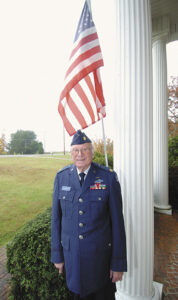 In 1994, on the Fiftieth anniversary of D Day, Alvis Stanfield was at the US Cemetery in France, overlooking the invasion beaches of Normandy. Private First Class Stanfield had been at the invasion beaches shortly after D Day in July 1944 as a 19-year-old boy but was returning as President of the Fifth Infantry Division Society. Stanfield had the high honor of placing a wreath in memory of 5th Infantry Division soldiers buried there.
Stanfield had not yet graduated from Reidsville High School when he received his draft notice. After activation into the service, he reported to Camp Jackson SC for his uniforms and further assignment to the 423 Infantry Regiment, 106th Infantry Division. He took basic training with his newly assigned unit and did much KP (Kitchen Police, i.e. – cleaning up, peeling potatoes etc.) and mail clerk duties. Stanfield did not like the initial disorganization and uncertainty of being part of a new Regiment, so he requested transfer to combat duty. After he volunteered for combat, he was treated with much more respect by his commanding officer.
Stanfield was assigned to Fort Meade MD in preparation for overseas assignment but was with a particularly rowdy group of men, many of whom found a way to leave Ft Meade at night, without permission, to carouse in nearby cities. The only way the commanding officer would control the men was to take away their clothes, except for underwear, after duty hours. There was no unauthorized carousing in town after that.
After shots and some further indoctrination, Stanfield and his groups were loaded on the converted ocean liner, Empress of Australia, for the voyage to Liverpool, England and on to Litchfield, England by truck. Litchfield civilians had been told to evacuate their homes to allow lodging for about 10,000 US soldiers.
In September 1943, he was assigned to Warren Point in County Down, Ireland with the Fifth Infantry Division. Virtually all of Ireland was a military base building up to the invasion of Normandy. He trained in the mountains of Ireland and had much time off to enjoy the country. He was billeted in town so he learned to know the townspeople, many of whom are friends to this day. One person he met was Patrick Carr, a ten-year-old boy who became the mascot of his Company. In 1961, Stanfield sponsored the then 27-year-old Carr, to come to the US to live and become a naturalized citizen. He has remained friends with Carr to this day.
On July 3, 1944, Stanfield left Warren Point and sailed to Normandy coming ashore on Utah Beach to relieve the 16th Infantry Regiment of the First Infantry Division, which had advanced 15 miles into France in 33 days. That first night he walked on guard duty near the beach with great trepidation. The next day, Stanfield’s unit relieved the 16th Infantry Regiment, and it was clear the men had been under tremendous combat stress. There were no smiles or greetings; just a zombie like stare from the men being relieved. Stanfield never realized a group of men could smell so bad after a few weeks in combat without the basic niceties of life. He was about to understand this.
The Fifth Division would be fighting in the vast, dreaded, hedgerow country. You could not see anything beyond the road you were on. Roads were lined on both sides with high mounds of soil that prevented one from seeing anything on the other side. When it rained, the roads became quagmires. Stanfield’s unit waited in a hedgerow three days for the flanks to catch up with the main thrust of the Regiment. A German tank was no more than 50 yards away and fired regularly toward Stanfield’s unit with an almost immediate explosion on the hedgerow behind him. He did not get much rest there before he had to advance into combat that was even more treacherous.
On July 15, 1944, thirty-nine days after D Day, Stanfield’s unit was only 18 miles from the beach. On July 26, orders came down for the Fifth Division to attack Douville. As his unit approached Douville, Stanfield took binoculars and a trench knife from the body of a dead US officer. Later, Stanfield’s squad leader borrowed the binoculars. Shrapnel from German 88 mm artillery hit the binoculars as they hung around his squad leader’s neck and prevented shrapnel from entering his body. The squad leader credits Stanfield with saving his life.
After a particularly exhausting 11-hour march toward the next objective of St. Lo, Stanfield passed a group of British soldiers, one of whom remarked” Don’t take it too hard mate, it can’t last forever you know.”
The Allies made a breakthrough at St. Lo and at this time, the Fifth Division was assigned as the nucleus of General Patton’s newly formed Third Army. On one occasion, General Patton made a speech to the men and some nurses attended. The nurse’s faces became redder, as the air became bluer with Patton’s salty speech.
Stanfield describes St. Lo as “blown apart” from massive bombing by the US Army Air Corps and the fire of artillery units. Only chimneys and foundations were to be seen in this city of about 10,000 people. The Germans were in retreat and Patton’s Third Army was in pursuit. Patton was moving so fast the troops were surviving on K Rations and it was a challenge to keep gasoline available for vehicles.
Angers was the next, and largest, city to be liberated after D-Day. German resistance was very stiff around Angers. One night Stanfield and 11 other men were told to protect a bridge 8 feet wide over a small river. The Germans were firing their 88 mm artillery all night long trying to blow up the bridge but no attack by German soldiers was made that night. The entire evening was spent trying to avoid being hit by German artillery.
At Chartres, the Fifth Infantry was given the job of liberating the city. While the battle of Chartres was fierce, the world-famous cathedral was untouched by the war that swirled around it. One afternoon near Etampes, France, Stanfield, and his unit were pinned down in a field behind a long mound of potatoes about one foot high. The mound was the only thing between Stanfield and a German 88 firing on his unit from 1,000 yards away. They were stuck. At one point, his friend lost the ammo clip to his rifle. The friend got up on his knees to search for it and a German bullet took one finger off and put a bloody crease in his forehead. The squad leader went to him to give first aid oblivious to the enemy fire. They were pinned down until night when they escaped to the woods around their position. The Germans withdrew with heavy casualties and Chartres was liberated. The young French girls did not seem to mind kissing and hugging the smelly, bedraggled soldiers who liberated them.
Stanfield and his unit were transported by truck most of the way to Reims, France but also had to march a significant distance. The stress of marching and battle was severe. The men did not have time or availability to take a shower or shave. They were wearing olive drab wool uniforms, which were very hot but had to be worn, as the fatigue uniform caused a US soldier to look too much like a German soldier. To this point, Stanfield felt that he had spent as much time behind enemy lines as he had in front of the lines. After Reims was liberated, church services were held for the troops on Sunday.
General Patton turned toward Metz and Germans were firing on the Fifth Division killing Stanfield’s company commander. One night, the new Company Commander asked Stanfield to go on a one-man patrol to find the position of another company. The password changed at midnight, so Stanfield was not eager to go. If he did not get back before midnight, he would not know the password and could be shot by a sentry. Passwords came down every day from HQ and were based on well-known terms or phrases in the US, such as “Apple”, as a password, and “Orchard”, as the response. Stanfield understood many sentries have itchy trigger fingers. At night, telephone poles look like people, stray cows become enemy soldiers and Americans can “become” Germans.
At dusk, the Germans attacked, pushing cows ahead of them to absorb rifle and artillery fire. At this point Stanfield’s platoon was down to five men from the 45 that had been originally assigned. The other 40 men were either wounded or dead. As relief came in to allow the five men to go to the rear, an artillery round came in and killed two more men. Stanfield’s platoon was now down to three men out of the original 45. When the platoon moved back up to the main line of resistance, there were so many replacements, Stanfield felt as though he was a stranger in his own platoon. In most cases, he did not learn their names before they were killed. Stanfield said, “If a man lived 24 hours in combat, he was a veteran”.
The German artillery was constant and on one occasion as Stanfield puts it, “I got in the way of some shrapnel.” A shell exploded in the air and hit him. The platoon was now down to two men of the original 45. After Stanfield was wounded, he was given first aid and evacuated to a hospital away from the battle lines. Stanfield was eventually sent back to the US on the Queen Elizabeth liner along with his ragged uniform and worn-out combat boots. He arrived at Holland General Hospital on Staten Island and was later sent to Wakeman General Hospital in Indiana. Stanfield was under medical care for one year two months and 8 days, being discharged from the hospital and military service on December 6, 1945.
After release from the Army, Stanfield attended King’s Business College. He worked for American Tobacco for a time and then spent 31 years with Sears Roebuck managing the Greensboro distribution center. Stanfield continued in the Army reserves attaining the rank of Major. He has also served as President of the Society of the Fifth Division, a 1200-member organization.
As Stanfield puts it, “I went in the service as a boy and came out a hardened veteran”. Stanfield and his wife Vera are very active and have traveled the world over. The purpose of many of the trips has been to maintain contact with friends made in Ireland and France during World War II. Oh yes, the Irish Company mascot, Patrick Carr, now retired, comes from Chicago to Reidsville to visit from time to time.
Interviewed 8/6/1999