
Harris, Robert A.
- Service Branch: US Navy
- Rank or Rate: Lt. Commander
- Service Dates: 1942-1946
- Theater: Pacific
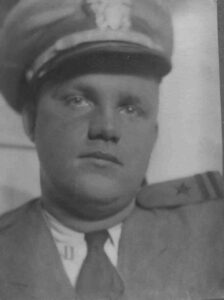 In His Own Words:
Comment on first antisubmarine patrol off Key West: If we found a submarine, we were ordered to ram and sink it. This action would cause our ship to sink too.
On minesweeper duty: Typically, no ship goes in front of a minesweeper. We were very expendable.
On duty aboard a minesweeper: We were brown as berries. We didn’t wear shirts or ties. It was hard to tell an officer from an enlisted man.
On leading Marines to their landings at Iwo Jima: Our orders were to get them onto the beach at any cost.
On losses during the landing at Iwo Jima: Twelve landing craft following us were blown out of the water. All killed.
On food: I made sure my crew ate as well or better than any aircraft carrier or battleship crew. I was well overspent on food provisions but was never criticized for it! It kept the crew happy.
On the Atomic bomb: It saved my life. We didn’t have to invade Japan, with the projected loss or wounding of a million men in the invasion, not to mention the loss of Japanese lives.
The battle for Iwo Jima which began in February 1945 was one of the bloodiest fights in the South Pacific. Bob Harris was there on a minesweeper three days before the invasion, sweeping mines from the waters surrounding the island. During, and for ten days after the invasion, his ship acted as a guide ship for the Marines who were going into the beaches on landing craft.
This was a far distance from his birthplace in Arcola, NC on August 9, 1918. Harris attended schools in Warrenton and went on to what was then Campbell Junior college and then to the University of North Carolina at Chapel Hill for an accounting degree which was awarded to him in 1939. After a stint with US Steel in Birmingham, Alabama as a trainee, he volunteered for Officer Candidate School in the Navy rather than be drafted. Harris chose the Navy over the Army because he did not like to “hike” that much. After induction, he took a troop train to Notre Dame University where he began his training in basic military courses. Then, on to Columbia University in New York City for intensive training in gunnery, seamanship and shipboard engineering. Although Harris was an accounting major in college he came out with top grades in his class in engineering.
After graduation, he was transferred to St. Petersburg, Florida to set up a ship identification program for the Navy. From there he was transferred to Key West, Florida to the USS Mystic, patrolling the waters between Key West and Cuba looking for submarines. If a submarine were discovered, their orders were to ram and sink it, which would sink the USS Mystic as well.
While in Key West, Harris took a course on anti-submarine warfare and one of his friends and classmates was the well-known pianist, Eddie Duchin. He also spent time on old WWI submarines learning submarine tactics to help understand the evasive maneuvers of submarines.
In early 1943 he went to Beaumont, Texas to help commission a minesweeper, USS Pioneer. This ship was 230 feet long with a beam of 32 feet and a crew of 100 men. As with any ship being commissioned there was a long list of items to be accomplished to make it ready for duty.
After commissioning in mid-1943, the Pioneer was assigned to convoy duty in the Atlantic. The submarine menace was still strong at that time, and convoys would travel at night with lights out. This made the trip across the Atlantic precarious due to the possibility of collision with other ships during the night. The Pioneer was on the outer perimeter as interference for the main body of 100 or more ships making the crossing with men and material to fight the war. On the first trip across, the convoy had to turn and go well below the equator to avoid submarines. The convoy’s best defense was to outrun the submarines if they were sighted. Harris points out that minesweepers are responsible for finding and destroying mines, whether contact, magnetic, electric or acoustic. Finding contact mines was done by using paravanes attached to a long cable going out from one side of the minesweeper which would cut the mines loose from the cables holding them in place. Machine gun fire exploded them when they came to the surface.
In many cases, a minesweeper would go at maximum speed and the bow wake would push contact mines out of the way so gunners could explode them. The minesweeper also had an electric hammer making a loud banging noise which set off acoustic mines. A diesel electric generator on the minesweeper created a high voltage current in the water to set off electric and magnetic mines.
The ship Harris later commanded was wooden so it had a very low magnetic field which was not enough to set off magnetic mines. Magnetic mines were typically not used in shallower waters where the ship Harris later commanded would sweep mines.
After more training in mine warfare and anti-submarine tactics, Harris was transferred to Orange, Texas where the ship he was to command was being built. It was 136 feet long with a 25-foot beam and a crew of 32 men, including four officers. It had a 3-inch gun, several 30 caliber machine guns and a supply of 12 depth charges as well as paravanes for minesweeping. It had twin diesel engines and an identical diesel for generating electric impulses to set off electric and acoustic mines.
Harris took command in spring of 1944 and immediately went to sweep Boston harbor as well as around the Cape Cod area. About that time there was a huge storm on the East coast and a minesweeper on the way to the Pacific sunk off Cape Hatteras. Harris’ minesweeper was sent to replace it, leaving Boston in the fall of 1944. He went through the Panama Canal and on to Honolulu with a convoy. In December, he sailed with the largest convoy he had ever seen to Iwo Jima. The orders were sealed so no one knew where they were going until miles out to sea. On the way, the ship stopped at Eniwetok and Saipan to get fully outfitted.
Frequently the crew would listen to propagandist Tokyo Rose who was well informed as to ship movements. The crew enjoyed her music although she seemed to know too much for comfort.
The ship left Saipan and arrived at Iwo Jima on D Day minus three. There were about 600 ships in the water off Iwo Jima including USS North Carolina, other battleships and aircraft carriers. Harris’ job was to sweep mines in front of the landing beaches as well as around the island. Later, Harris’ ship was responsible, along with other small ships, to guide landing craft to the beach. His orders where to proceed and lead the landing craft to the beach “at all costs”.
Fortunately, Harris’ ship was not hit by enemy fire as the Japanese stopped firing so as not to reveal their positions and allow big guns of the USS North Carolina and other ships to destroy them. On one run to shore however 12 landing craft behind Harris were blown out of the water with all hands killed.
Harris could see the big shells from the USS North Carolina pass overhead with their deadly “swoosh” sound and explode on Mount Suribachi. The noise was deafening.
There were many kamikaze planes crashing into the Naval vessels, but they were after the big ships not Harris’ minesweeper. The biggest danger was crossfire. When the large ships fired at the kamikazes, they lowered the guns to sea level and took no notice of other ships that might be in the line of fire. Fortunately, Harris’ ship was not hit. After Iwo Jima, Harris’ ship went to the Philippines, Guam and Saipan in preparation for the invasion of Japan and awaiting further assignment. About then, victory was declared over Japan and Harris went to the Sasebo, Japan harbor to sweep mines so vessels could safely get into the harbor. While tied up to the pier in the Sasebo, Japan harbor during a hurricane, the lines holding Harris’ ship to the pier broke. Another ship with an admiral aboard contacted Harris’ ship with the message ” stay clear, we are having problems,” Harris replied, “what do you think we are having?” No further response was heard from the admiral.
Harris would have been released from active duty in August of 1945, but it took his relief almost three months to catch up to Harris’ ship due to a hectic sailing itinerary after hostilities ceased.
Harris was released from active duty on 12/1/1945 and after turning down US Steel’s reemployment offer, moved to Eden and had a very productive career with Fieldcrest Mills as well as being involved in major civic activities, retiring as Executive Vice President of Fieldcrest in 1977.
Interviewed 4/29/1998