
Burton, Jesse
- Service Branch: US Army Air Corps
- Rank or Rate: Staff Sergeant
- Service Dates: 1942-1945
- Theater: Europe
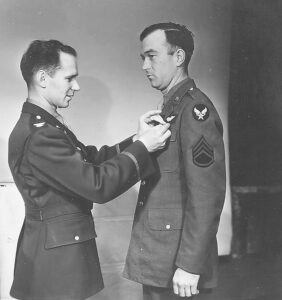 June 6, 1944. It was D-Day! The Allies were attacking “Fortress Europe” with 3,000 landing craft, 3,000 naval ships for bombardment and miscellaneous support, and thousands of aircraft to suppress German resistance to the landings. Early in the morning on D-Day, transports pulled gliders carrying paratroopers who had specific missions in advance of the regular assault troops. Jesse Burton, a waist gunner on a B-24 Liberator bomber, was with the 44th bomb group which was assigned the mission of dropping bombs on a key target 15 minutes before US troops were to land on Utah and Omaha beaches. Burton was part of the largest invasion in history.
War was the farthest thing from Burton’s mind while attending one room Mount Hermon School in Rockingham County. Burton’s mother was his teacher. He continued to Wentworth Consolidated School, graduating from High School in 1932. Burton’s first love was baseball; playing first base on his high school team.
He decided to attend King’s Business College in Greensboro while also working at a tobacco crop in Rockingham County. In 1936, he went to work for National Biscuit Company in Greensboro but after a short time came home to Rockingham County to work for Carolina Woolen Mills, which later became Fieldcrest Mills. This was his first real job since “following mules” on the farm.
Burton heard about the sneak attack on Pearl Harbor December 7, 1941, while taking his newly drafted brother to Danville on the way to Fort Eustis VA. He knew it meant trouble for our country and possibly for him. Burton kept up with war news and continued working at Fieldcrest until October 14, 1942, when he was drafted.
He was sent to Fort Bragg and who should greet him on arrival but Floyd Osborne, mayor of Leaksville, who had been drafted earlier. Burton went through the usual routine of getting his uniform and taking shots but due to his records being lost, he had to take all shots again. After a week he was sent to Fresno CA to a former Japanese Internment Camp for further limited training and tests. His test results showed he was suited for duty as a gunner/armorer on aircraft. His physical examination revealed that he was 6 feet 1 inch tall and the limit for aircraft gunners was 6 feet. Since there was a great need for gunners, the examining doctor took 1 inch off Burton’s recorded height so he “qualified” as a gunner.
Gunnery school at Tyndall Field, FL was Burton’s next stop. Using marked projectiles in 50 caliber machine guns, he fired at target sleeves trailing behind tow planes and was graded on how accurate he was. There was no free time during the several weeks of training except for one evening in town for a movie. Even so, Burton enjoyed the training.
After a brief time in Tucson AZ, he went on to El Paso TX as part of the process of assembling and training crews for the four engine B-24 Liberator bombers. There were navigation problems, mock bombing runs, and formation flying to get the crews ready for combat.
The 40 crew members assembled in Arizona went to Camp Kilmer NJ for embarkation on Queen Mary to Liverpool, England. The food was terrible, and the voyage was rough. Burton survived for eight days on hard biscuits and fried liver.
The night Burton arrived; the Germans bombed the cathedral at Coventry. British Prime Minister Churchill knew of the attack beforehand because the German code had been broken. Churchill could not take defensive measures because the secret of the code breaking would have been compromised.
The 44th Bomb Group’s permanent station became Shipdham, England.
After heavy action in North Africa in 1943, the Group did not fly any combat missions until early 1944. Upon arrival, Burton’s crew was assigned a war weary B-24, known as “Lemon Drop” that had survived the infamous and costly raid on the Rumanian Ploesti oil fields. On some missions in early 1944, “Lemon Drop” had to abort due to mechanical problems.
Burton did not think about dying on a mission but rather about doing the job he was assigned. He felt he could do nothing about the situation he was in so had to perform well if he wanted to survive. The whole crew had similar feelings and even in those bleak circumstances considered themselves brothers in arms. Oddly, the stress of battle and combat did not affect any of the men unduly until they approached the 35-mission level, at which point they would be relieved of air combat duty. That is when the men felt they might just make it to the “magic number” of missions. Before that, they felt the odds of making 35 successful missions were remote.
The B-24 was the most sought-after bomber of World War II as it could fly higher, faster, and farther, with a heavier bomb load, than the B-17 Flying Fortress. It just was not as pretty. Its ungainly appearance earned its nickname “Pregnant Cow”. B-24 crews called the B-17 a “Hand Grenade Carrier”. To this day, the crews of the Flying Fortresses and Liberators carry on their friendly, competitive banter.
Burton did not know from day to day when he would be called to take part in a bombing mission. Such information was kept from the men until the last minute. If the crews did not know mission plans, it was unlikely the enemy would find out by listening to “loose lips”. On mission days, the crews usually awakened about 5 am. There was limited time to do what they had to do, including eating a light breakfast and attending briefings about the route to target, weather, and the number of enemy fighters likely to be encountered on the way as well as the level of flak expected. Most crew members ate very light breakfasts to reduce the possibility of upset stomachs during the long flights. The next step was getting dressed in electrically heated flight suits, heavy socks, gloves, and flying boots. Also included in their pack was information on escape routes if shot down, steel helmet, earphones, 45 caliber pistol, parachute and K rations. The crew then boarded a truck to carry them out to the plane. After an inspection of the plane, they were ready for takeoff. Burton’s 50 caliber machine guns on the bomber were already armed and ready. A well-loved chaplain always came by for prayer with the men
Typically, 24 aircraft in his squadron took off, one after the other. The planes formed up with others at about 15,000 feet and later split off, heading for their respective targets. Sometimes the German 88s did not fire on the planes as they approached their targets. Anti-aircraft artillery was expected and if it did not come, that also worked on the crew’s minds. The best time for enemy planes to attack was during the bomb run as the bombers were flying straight to the target. When over the target, the enemy fighters stopped attacking and the flak became heavy. The German gunners knew the altitude and direction of the planes, so bombers were sitting ducks during the bomb run. In one case Burton was called to another location on the plane and while he was away from his position a piece of flak came through the skin of the bomber right where he had been stationed next to his gun; a narrow escape indeed!
After the release of bombs, the pilot turned the plane quickly and headed for home. Then fighters usually started attacking again. Later in the war, long range US fighter aircraft were able to escort our bombers, so the enemy had our fighters to deal with, saving many crewmembers lives. Burton’s longest mission was to Berlin – a ten-hour mission. The flak was the heaviest he had ever seen, coming from what he later learned were 844 anti-aircraft guns dispersed around Berlin.
When returning safely over the English Channel, after the strain and excitement of a mission, Burton would sometimes fall asleep on a lumpy bed of spent 50 caliber machine gun casings. If a bomber had a wounded crewmember on board, a flare was fired from the plane to indicate it needed priority in landing as well as needing the “meat wagon” to pick up and care for the wounded crewmember. Then came a 45-minute debriefing on anything of importance during the mission, a shot of whisky to help calm the nerves, a nap and then a visit to the mess hall for some “chow”.
After 35 missions and being relieved from further combat, the food got noticeably worse. The best food was saved to feed the combat crews. Burton remembers a lot of Spam being served to him after his 35th mission.
The most memorable flight Burton made in Europe was the bomb run in support of the June 6, D-Day invasion. He was awakened on June 5 at 10 pm and told “this is for real; the invasion is on”. Every member of the invasion force was given a letter from General Eisenhower, the Supreme Allied commander telling them of his confidence in each person and asking the blessings of Almighty God on the great undertaking about to begin.
The excitement and morale was so high there were people volunteering to fly on D-Day. Burton’s plane was to fly over Colleville, France and drop bombs in support of the landing. Each bomber was marked with two thick black stripes surrounding the fuselage to distinguish them from any of our planes the Germans may have captured and in turn, might try to enter our formations to shoot down our planes.
After the bombs were dropped, the planes had to turn east to avoid flying over our men and perhaps getting shot down by friendly, but confused, forces. Burton’s bomb run was successful, and all bombs were dropped 15 minutes before the landings. Burton’s next D-Day bombing mission was at 5:15 pm over Vire, France dropping 12 – 500# fragmentation bombs to disrupt communication lines. There were no enemy planes in sight on either mission.
In total, Burton spent 219 combat hours on B-24s and a similar amount of time in training flights. After 35 missions in combat Burton volunteered as a gunnery instructor in Laredo Texas but there were more instructors than students, so he was sent to Greenville MS to do office work until he was discharged. The news of victory in Europe and later, over Japan, thrilled him. He was proud to have served his country and thankful he did not meet the fate of so many of his friends who died in combat. He returned to Eden and his work in Production Scheduling at Fieldcrest Mills. He also continued as an active member of Bethlehem United Methodist Church, the church he originally joined in 1927.
Burton married his sweetheart Frances August 11, 1945. They had no children. Frances died February 25, 1999, after almost 54 years of marriage. She had been a teacher for many years in Eden schools. Since 1951, Burton has been very active as a volunteer, particularly with youth at the YMCA and as a member of the board of directors of the Y’s Men’s Club. He also served as a Y’s Men Regional Director. He continues to help when he is able. Jesse Burton never gives up!
Interviewed 3/16/2000