
Bumgarner, Dr. John Reed
- Service Branch: US Army
- Rank or Rate: Major - MD US Medical Corps
- Service Dates: 1941-1945
- Theater: Pacific
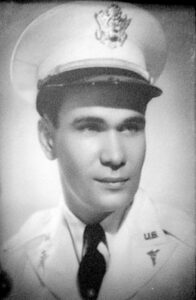 It was ironic that on December 7, 1941, the day Dr. John Bumgarner completed his one-year active-duty obligation in the Army Medical Corps reserve, the Japanese attacked Pearl Harbor, Hawaii and caused the United States to enter WW II. These events brought changes in his life that no one should have to experience.
Bumgarner’s father was a Methodist minister so Bumgarner “grew up” in many different North Carolina communities, the last, being Miller’s Creek, NC. After graduation from Wilkes High School in 1928, he attended Lincoln Memorial University in Harrogate TN. He desired to attend medical school, so he transferred to NC State to get required pre-med courses. Bumgarner had little money, so he worked for a few years as a chemist at a hosiery mill to earn tuition to allow him to attend the Medical College of Virginia. During his senior year at medical school a Colonel in the Army Medical Corps convinced Bumgarner along with others to join the Medical Corps reserve, promising that it was extremely unlikely they would ever be called to active duty.
During medical residency at a hospital in Chattanooga TN, Bumgarner noticed many reserve officers were being called to active duty, so he decided to leave his residency and return to North Wilkesboro to practice with a doctor friend until being called for active duty. All his official mail was being sent to Miller’s Creek NC, and while home for a visit, he noticed a letter from the Army ordering him to active duty on December 7, 1940, for one year. It was December 9 when he saw the letter, so he was already late. He traveled to Ft. Knox KY, reported to an irate officer and after Bumgarner explained why he was four days late no punishment was given.
Bumgarner was transferred to Ft. Custer MI after a short time and was greeted by six feet of snow. The Colonel assembled the physicians one day and said he needed an unmarried reserve officer with the rank of first lieutenant to go to the Philippines. Bumgarner was the only one who qualified on all three counts. Realizing he was being described, Bumgarner “volunteered.”
He went to San Francisco by train and boarded a transport for the long journey to the Philippines. When he arrived, an officer from Sternberg General Hospital told him not to get too comfortable in his quarters in the old Luneta hotel in Manila. He said prophetically “The Japanese will be here in about six months”. Bumgarner spent ten idyllic, routine months in Manila treating mostly malaria, dengue fever, and dysentery cases. It helped prepare him for what he would face in less than a year. On December 7, 1941, he had orders to go back to Norfolk VA to be released from active duty. The bombing of Pearl Harbor, Hawaii changed that instantly.
The Japanese invaded the Philippines on December 8, (December 7, Honolulu time) and marched toward Manila. In late December, Bumgarner and the medical staff were ordered to General Hospital #1 on Bataan as Manila was under attack and they all would be killed if they stayed there. On December 25, 1941, the Christmas meal the medical group had was the last full meal they would enjoy for years.
General Hospital # 1 was set up in an old barracks building. Bumgarner stayed a short time and then went to General Hospital # 2 which had been set up in the jungle with no cover except for a few tents for the operating room and some equipment. Bumgarner’s ward in General Hospital # 2 was designed for 200 people with a maximum of about 1,000 for the hospital. Everything was under reasonable control for a while but with pit privies, flies and mosquitoes, many staff people developed dysentery and malaria. The soldiers fighting the Japanese were in terrible condition with little food or medicine. Some of the medical staff were as sick as those being treated. Sanitation was poor and growing worse by the day as the patient load expanded with sick and wounded.
At night, one could see the guns flashing in the distance and all knew in only a short time the area would be overrun by the Japanese. On April 9, Japanese troops entered the hospital and told all persons they would be killed if any of their orders were resisted. At that time, there were 7,000 patients in General Hospital # 2, the largest number in Army history in a single hospital setting. It was impossible to treat patients adequately. Only a kind word and encouragement could be given to the very sick patients. The Japanese took everything of value including all food and medicine. The Japanese brought in floor scrapings from a rice processing plant for hospital food. It was full of filth and dirt, but it was the only food available. It was boiled and eaten.
The Japanese then sent Bumgarner and the medical staff to Cabanatuan, Philippines to set up a hospital for all prisoners of war. He would stay there for what seemed an eternity. The patients from Camp O’Donnell, the destination of the Bataan Death March, were like thin, pale ghosts. About 13,000 patients came through the hospital and of that number almost 4,000 had died by December 1, 1942. It was not unusual for seventy patients to die in a single night. As those almost too weak to walk carried the bodies for burial, the living watched in respect and called it the “parade of the dead”. The staff almost became immune to the daily carnage, as was so common. Burying the dead was backbreaking work for those strong and well enough to dig the necessary large gravesites. The Japanese did not like to go near the hospital for fear of catching a disease, but they insisted on an accurate daily accounting of all prisoners. In January 1944, Bumgarner received the first mail he had received for years. One of the letters contained a bill for tailoring a suit of clothes while in Manila. The others were letters from home, which lifted his spirits temporarily.
In February, he was ordered to go to Japan to establish hospitals for prisoners of war. The medical personnel were put in the hold of an old rusty transport with rats as their shipmates for a one-and-a-half-month voyage to Japan. Conditions in the hold were horrible. Rice and tea were lowered into the hold once a day for sustenance. Amazingly, no one died on the voyage to Japan although an American submarine attacked one ship in the convoy.
Bumgarner arrived on the island of Honshu and was taken by train and barge to Camp Kamiso where he was the only physician, but without medicine, for some 150 British, Dutch and Irish prisoners who worked in a cement factory. Anyone who had lived in captivity as long as these men, were survivors in every sense of the word. While they were tough, resilient and determined to live, poor treatment, beatings, and being sick were part of everyday life in Camp Kamiso.
In early 1945, it was becoming clear that the fortunes of the Japanese war effort were ebbing, and this was shown by the treatment the prisoners were getting from guards. Infractions that would normally be cause for a beating or being shot became a lecture or some milder punishment. In April, Bumgarner observed the first of the B-29 raids and heard bombing. This was an uplifting event and gave some renewed hope to the prisoners. In June 1945, a supply of medicine came through to Camp Kamiso and finally Bumgarner could give some positive medical treatment to the prisoners.
In July of 1945, Bumgarner and others were suddenly transferred to Camp Bibai, Japan, which was a camp for 450 prisoners who worked in the coalmines. When leaving for Camp Bibai the Japanese colonel in charge saluted Bumgarner, which was a great shock. Normally Bumgarner would be prodded with a bayonet in the back. The diet was awful at Camp Bibai and medicine was in very short supply. Bumgarner knew with the ten-hour workdays, sickness, exhaustion, poor sanitation, and lack of food, men would not last long in that environment.
Bumgarner was in sickbay when the atomic bombs were dropped on Hiroshima and Nagasaki. After Japan surrendered, two Japanese officers came in, saluted him, and informed him of the surrender. Then they lectured him on the brutality and inhumane actions of the United States in dropping the bombs. The next day every Japanese soldier was gone. Before they left, however, one soldier who had been particularly brutal came around asking the prisoners to hit him as some sort of pay back for his inhumane treatment of them. The prisoners just laughed at him.
Bumgarner was transferred by airplane and ship to Letterman General Hospital in San Francisco for treatment and observation. He was diagnosed with pulmonary tuberculosis as well as many other diseases. After lengthy series of hospitalizations, he was finally released in July 1949, returning to the medical profession to specialize in cardiology. He came to Greensboro in 1955 and practiced for 30 years at Moses Cone Hospital, becoming Chief of Cardiology.
Dr. Bumgarner has written four books, including one on the health of the Presidents of the United States from a physician’s point of view as well as his book regarding his WW II experiences called “Parade of the Dead”. He and his wife Evelyn are now deceased. He lived to be the last surviving physician of all physicians on Bataan.
Interviewed 11/28/2000