
Baumgardner, Sterling
- Service Branch: US Army Air Corps
- Rank or Rate: Captain
- Service Dates: 1941-1961
- Theater: Europe
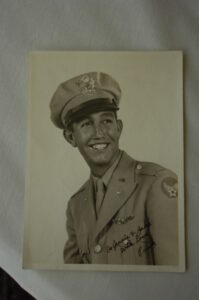 As a young man, Sterling Baumgardner sang in a southern gospel quartet with his brothers. During his senior year at Greenville TX high school, he and his brothers were enticed to move to Siloam Springs, Arkansas to perform on a radio program – all living expenses paid. He did not make much money but finished high school there and enjoyed the experience. Upon graduating in 1939, he moved to Lawrenceburg IN to attend music school. However, his older brother left the quartet, causing Baumgardner to lose interest in pursuing a music career. He returned to Greenville to work in his father’s grocery store.
It was required that men Baumgardner’s age register for the draft. After registering, he quickly was drafted into military service on February 16, 1941. He was assigned to a National Guard unit from Greenville and sent to Camp Bowie, Brownwood TX for heavy weapons training. Baumgardner was destined to be a machine gunner at that point.
In the summer of 1941, his unit went on maneuvers in Louisiana. Baumgardner weighed 125 pounds. At the end of the two-month maneuvers, he weighed 150 pounds. Most men lost weight. His training at Camp Bowie continued and while home on leave December 7, 1941, after a singing performance, his brother shared the news he heard that Pearl Harbor had been attacked. Baumgardner was recalled to Camp Bowie and felt he would never see his home again. On Tuesday, December 9, he received orders to leave by troop train to the west coast. He arrived at Fort Lewis, Washington and his unit was immediately assigned to help guard the West Coast from an expected attack by Japan. He drove a truck carrying machine guns, up and down the coast as far as San Francisco. He stayed overnight in Civilian Conservation Corps buildings and at County fairgrounds. Baumgardner was on this type of guard duty until January 1942 when he applied to the Air Corps for flight training. He had aspired to be a pilot for as long as he could remember. His application was accepted, and he passed the physical but did not pass the written test. In June 1942, he took the test again and passed the written test but did not pass the physical. He failed because he told the interviewer of an accident he had had years before which caused him to be unconscious for five days: automatic disqualification.
In January 1943, Baumgardner was transferred to Hialeah, Florida for guard duty on the East Coast like his West Coast duty. He again applied for flight training and this time he passed both the physical and written test. The interviewers did not ask about accidents. In August 1943, he was assigned to Peabody College in Nashville TN for one semester of training and passed the aptitude tests for pilot, navigator and bombardier. He learned that there was to be a cut back in pilot training and those on pilot track would go into the infantry. Baumgardner elected to go into navigation and felt confident he would continue in the Air Corps. He continued on to Pre-Flight training in Montgomery AL but only completed half the course. The need for navigators was so great that all students with a 90 or above average were immediately sent to advanced navigation school in Coral Gables FL. He graduated in Florida and received his Navigator wings July 4, 1944.
The crew was formed and assigned to Rapid City SD. It was thrilling to be assigned to further training on a B-17 Flying Fortress. Baumgardner was very comfortable in his navigator work and was highly regarded in his unit.
In a B-17, the navigator sits at a desk directly below the pilot, next to the bombardier. It is vital that the navigator has the precise time shown on his watch to do navigation work in coordination with navigators on other aircraft. Being just a few seconds off could mean a mid-air collision. Baumgardner carried a 45-caliber pistol, wore an electrically heated flying suit, boots, gloves as well as oxygen mask and steel helmet in addition to regular clothing. While at high altitude in the unheated plane, he was tethered to an electrical cord and oxygen tube for survival at 45 degrees below zero centigrade. He was also the “recorder” for significant events aboard the aircraft. For example, the navigator records when engines were started, when roll out for takeoff begins, unusual observations while in flight and when bombs are dropped. He is also responsible for firing a nose gun under combat conditions.
His crew went to Lincoln NB to pick up a new B-17 and immediately headed for the east coast and then on to Scotland. The crew left the B-17 in Scotland and traveled to Podington, England as their permanent base assignment. There were so many temporary airbases in England it was easy to mistakenly land at the wrong base. His crew was assigned another plane and Baumgardner flew his first mission on November 9, 1944, to Metz, Germany. The typical mission was assigned the night before on the bulletin board. Wakeup call was at two or three a.m. depending on the length of the mission with breakfast following. The briefing was in a large room with a map behind a curtain. The curtain would be drawn back and the crews would be told the target for that day, the route, expected opposition, weather, bomb load and reason for the mission. Pilots, navigators and enlisted crew members would then break out to individual sessions relating to their specialties.
After a quick trip in a jeep to the aircraft and a review of checklists, the plane was ready for takeoff. Usually, 36 aircraft were in a group, taking off at 30-second intervals. They joined up with aircraft from other bases to form the “bomber train” to the target. This was a highly orchestrated production, and a timing mistake could spell disaster in the air.
Baumgardner’s 92nd Bomb Group was the first to drop the “Disney Bomb” (as in Walt Disney), a bomb we would call “high tech” today. His aircraft carried two of the 4,500-pound bombs. They were dropped from high altitude and designed to penetrate 20 to 30 feet of concrete, primarily on submarine pens. Upon falling to 5,000 feet, an attached rocket motor fired and increased the velocity to 2,400 feet per second. When they hit, concrete would erupt in all directions.
After dropping bombs, the Bomb Group would fly back in formation, land, and then report for debriefing. In poor visibility, the aircraft would fly back to base very low, under the weather. Baumgardner recollects one time when his pilot said half-jokingly over the intercom, “Convoy, 12 o’clock high”. The plane was so low it had to climb to miss the masts of the ships in the convoy.
After landing, a shot of whisky was provided in the debriefing room for crewmembers to calm their nerves. Those who did not drink would usually give their ration of liquor to those who did. Baumgardner’s job required him to keep good records of everything that merited reporting to the debriefing personnel. For example, any planes shot down, enemy troop activity and high concentrations of anti-aircraft fire.
Flying through heavy flak on the bomb run is a memory, which even today, gives Baumgardner flashbacks to the danger he faced in those days. He remembers the “bam” sound that flak made when it penetrated the fuselage. He also remembers the day a group of bombers, out of position overhead, almost dropped their full load of bombs on his bomb group. Quick action on his pilot’s part to get out of the way saved many lives that day. On another occasion, a shell hit a steel structural member in the nose of his B-17 and caused the flak to be directed away from the plane. A hit two or three feet away on the fuselage would have destroyed Baumgardner’s B-17. He saw many of his friends go down. He watched for their parachutes and prayed for their safety as they fell.
Baumgardner’s last flight was March 24, 1945; his 31st mission – he was going home! He wrote three letters that day, one to his mother and dad and letters to two friends. Unfortunately, one of his dear friends had already died during the invasion of Iwo Jima. Baumgardner expected to be assigned to a B-29 bomber in the Far East to fly bombing missions against the Japanese. He was assigned as train commander on a troop train to California. He learned that victory was declared in Europe while on the train. There was a major celebration that night. When Baumgardner arrived in Santa Ana, California, he started to have nightmares about his bombing missions. They subsided but came back many, many years later on a vacation trip to Germany.
Baumgardner was sent back to Love field in Dallas for further training to be a navigator on long distance transport flights. On the way, he learned about the victory over Japan. Baumgardner wanted to stay in the service and become a pilot but some administrative problems prevented that. If he stayed in as an officer he would have had to sign up for a longer term of service, Baumgardner elected to revert to enlisted status and stay in only 20 years rather than committing to a longer term of service. He was given the rank of Senior Master Sergeant with a rating of “enlisted navigator.” When in an aircraft, he did the same job he had done in combat in Europe. His ground job eventually involved machine accounting systems in the early years of those systems.
Baumgardner says he made some poor investment decisions long ago and decided to learn more about investing and he became quite good at it. When he retired in 1961, he went into the investment business full time, eventually moving to Reidsville, Ann’s hometown. He presently has investment clients around the world, served from his Reidsville home.
Baumgardner has four daughters, seven grandchildren and two great grandchildren that he and Ann enjoy. His children live across the country and traveling to see them is one of Baumgardner’s pleasures.
Baumgardner’s World War II experience made him a more disciplined person who appreciates life and the great sacrifices made by young men and women who go to war.