
Barham, Joseph L.
- Service Branch: US Army Air Corps
- Rank or Rate: Sergeant
- Service Dates: 1941-1945
- Theater: US/Egypt
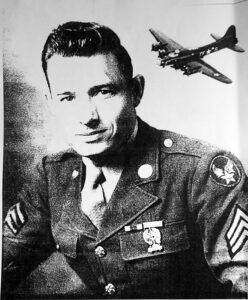 There was an important man aboard the aircraft parked on an outlying portion of the Cairo, Egypt air base where Joe Barham was stationed. His identity was a secret but later revealed as Franklin D. Roosevelt, the President of the United States. President Roosevelt was on his way to attend the Teheran conference, an historic meeting with Winston Churchill and Joseph Stalin to chart the course of the war. Joe Barham got close enough to take a picture of the aircraft that brought Roosevelt to the meeting of the “Big Three” allied powers.
Barham was born in Spray NC and grew up during the Depression. He attended Leaksville High School but had to drop out at age 15 to go to work. He worked at Marshall Field & Co. in the Blanket Finishing Mill until he was drafted into military service in August 1941. Barham was not enthusiastic about the Army and because of his interest in airplanes, he and four friends volunteered for the Army Air Corps. After joining, he was sent to Camp Lee VA on a very crowded troop train – then on to Jefferson Barracks MO three days later. This is where he received rigorous basic training with close order drill, kitchen police duty (KP), physical training, marching, training films, frequent inspections and harassment from his drill sergeant. One evening while in basic training, Barham was ordered to guard a pile of coal. A skunk happened to come along, and it wet him thoroughly. The odor was terrible and could not be removed so his clothes were burned and a new set issued promptly.
After eight weeks of basic training, Barham was assigned to Cochran Field near Macon GA for eight weeks of training as an aircraft mechanic. Barham wanted to learn to fly and requested flight training. As pilots were in short supply, he was given the opportunity. The instructor took him up in a BT-13 trainer and after a few aerobatics, was successful in making Barham sick to his stomach. This experience ended Barham’s interest in becoming a pilot. His aircraft mechanic ability was very good and after graduation from mechanical school, Barham was promoted to corporal and made crew chief on a BT-13 trainer at Cochran Field.
On December 7, 1941, while Barham was at Cochran Field, the Japanese made the sneak attack on Pearl Harbor Naval Base in Hawaii. Everyone on Cochran Field wanted to contact his or her families. Because there were few pay phones on the base, lines of men and women stretched for ¼ mile. It took hours for Barham to reach a pay phone to call his family. The news of the attack disturbed him as it would anyone, but Barham knew he had a job to do and he would do it.
After 14 months at Cochran Field, he was transferred to Warner Robbins Air base as a fuel truck driver. There was an auxiliary field at Waycross GA and Barham had to drive from Warner Robbins to Waycross regularly. On one evening trip, he was crossing a bridge and a city bus started across the bridge after Barham was on the bridge. There was no room for both vehicles and the sparks flew as the two scrapped each other and the tanker was in danger of leaking and exploding. An accompanying safety truck foamed down the bus and tanker and, along with the noise and commotion, scared the wits out of the bus passengers. That was the only problem Barham ever had while driving a tanker truck.
In September of 1943, Barham was transferred to Link Trainer School. A Link Trainer was a device used to train pilots safely under simulated instrument flying conditions. Oddly enough, it was invented by a pipe organ maker who used his knowledge of pumps and bellows to create this aviation-training device. After Barham was trained, he was put in charge of one of the Link trainers. He enjoyed putting pilots through the paces under simulated adverse flying conditions. However, this did not satisfy Barham for long and he wanted to get back doing flight line mechanical work – keeping the planes flying – as he originally had been trained to do. It was in 1943 that he married his girlfriend, Pauline.
In late 1943, he saw a bulletin asking volunteers to go to Seymour Johnson Air Base in North Carolina for work as flight line mechanics. This was close to home and his new wife, so Barham volunteered. He was transferred and upon arrival at Seymour Johnson was promptly put in the kitchen as a cook. Barham had trouble understanding that assignment. After complaining, he was assigned to the flight line, where he wanted to be.
One day while another mechanic was warming up the engine on a P-40 Warhawk, the propeller came off and careened across the field. It tore through a hanger wall, missing about 20 men on the way and continued tearing through the other side of the hanger before coming to rest. The noise was so great that others heard the propeller hit the hanger and thought the air base was under attack. On another occasion, Barham was warming up a P-47 Thunderbolt fighter plane. It was hard to start and caught on fire. Barham knew he had little chance of getting out of the plane alive. He kept grinding the starter hoping to get the engine started and blow the fire out. Fortunately, the engine started, and the fire was blown out by the rush of wind from the turning propeller -a narrow escape indeed!
In the fall of 1944, Barham learned there was a squadron being formed flying C-46 transport planes over the “hump” (Himalayan Mountains) in Burma, carrying supplies to China. The squadron would be based in Egypt and fly to Karachi, India, on to Burma and to China. It was a long supply line, but it worked. Within several days, he was in New York ready to sail to Egypt in a 36-ship convoy. Guns, boats, airplanes and supplies were lashed to the decks of the transport. Upon arrival at Port Said, Egypt, the material and planes were transferred to John Payne Field near Cairo. John Payne was the name of a pilot who led the first attack of a bomber group from Africa against the Italian fleet. He was later killed in action. Barham remembers the orders of his commanding officer when his unit arrived. He said,” Don’t eat the food, don’t drink the water and don’t touch the women”. If any one of our troops made a pass at a Muslim woman, he would be marked for death. The food and water were full of organisms causing amoebic dysentery. That could kill you too!
At John Payne Field, Barham had a permanent Quonset hut to live in, but the temperature rarely got below 125 degrees during the day and frequently dropped to freezing at night. Life in Egypt was very trying with the weather and poor working conditions. There were movies in the evening and occasionally a USO celebrity show would come through. Barham remembers Jack Benny, Clark Gable and Tennessee Ernie Ford as some of the entertainers.
Sandstorms were frequent and blinding. Sometimes you could only see a few feet ahead and sand was everywhere – in your clothes, hair and living space. Fortunately, the cooks kept it out of the food. During a sandstorm, uncomfortable gas masks were worn to be able to breathe. Barham’s time was spent repairing battle-damaged aircraft. Barham was also the squadron barber after finding he had a knack for that. The British had an air base near John Payne Field and Barham was impressed with the fact that British troops always stopped work for a spot of tea at certain times in the day no matter what was happening.
When Roosevelt visited Cairo, he made King Farouk of Egypt a gift of a C-47 transport for his personal use. Barham was assigned as a mechanic on that plane, and he came in frequent incidental contact with King Farouk, who knew Barham by name. King Farouk wanted his mechanics to ride in the plane with him when he went on a trip. These trips were mostly to Alexandria or Luxor, Egypt to visit government officials. While on King Farouk’s aircrew, Barham had the opportunity to visit many of the sights in Egypt and surrounding countries, including Palestine (this was before Israel was created in 1948). Barham was probably one of the first US citizens to go rabbit hunting in Palestine. He saw the Sphinx, King Tut’s artifacts and climbed the Egyptian pyramids. He visited the Valley of the Kings and saw tomb artifacts of the ancient Kings of Egypt. He enjoyed a wonderful learning experience as one of King Farouk’s aircrew men.
On May 8, 1945, the war in Europe was over and of course, this was cause for joyful celebration. There was only warm beer on the base so CO2 from the fire extinguishers was used to cool 00000 enough “points”, in a few months Barham was on his way home. His ship took him to Norfolk, and he caught a train to Fort Bragg for discharge September 13, 1945. His wife Pauline and a 12-month-old daughter he had not seen yet were eagerly awaiting him at home.
Barham returned to work at Marshall Field and Company, but poor economic conditions caused a layoff, and he found work at A&P Tea Co in the produce department. He worked for 22 years for A&P and after his retirement in 1975, worked at Fieldcrest Mills in the Security Department for 25 years, retiring in 2000.
He is convinced that America is the greatest country on earth and is pleased he had an opportunity to help protect it. World War II took a sheltered young person who had never been anywhere to speak of and sent him halfway around the world, molding him into a man in the process.
Barham has two sons and one daughter. He and his wife also enjoy their six grandchildren and two great grandchildren.
Interviewed 2/24/2002