
Barbee, Ann Collins
- Service Branch: Royal Air Force
- Rank or Rate: Lead Aircraft Woman
- Service Dates: 1942-1945
- Theater: Scotland
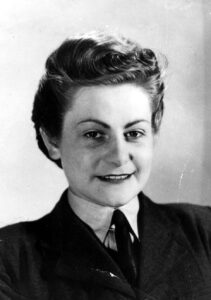 The air raid sirens began wailing at 11 pm. The German Luftwaffe bombers arrived on their nightly schedule while young Ann Mooney was running home from a dance. She saw neighbors running to air raid shelters in heavy coats with nightclothes underneath. She knew her mother would be upset because she was not home yet but that did not bother Ann much. Attending a dance was more important than a few German bombers and she did not like air raid shelters. War was not very real to her, yet!
Ann Barbee was born in Dundee north of Edinburgh, Scotland. Her family is part of the Fraser clan. Before being drafted by the Royal Air Force, Ann had never been more than fifty miles from her home. Loving parents sheltered her life. Her mother even spared her some of the normal chores such as doing dishes after the family meal. Her two older brothers did most of the chores.
She attended St. Mary’s catholic school in Dundee, graduating from high school at age sixteen. There were few jobs available for young girls but her skill at sewing led her to a five-year apprenticeship in tailoring. It was enjoyable work to her and she was paid $1.50 per week while being trained. Her pay increased as she learned and her expenses where minimal since she was living at home.
Barbee remembers well the Sunday, September 3, 1939, speech when she heard Prime Minister Neville Chamberlain speak on the radio to announce the sad news that England was at war with Germany. She remembers her mother crying in fear that her two sons would have to go off to war. Nightly blackouts started immediately in Dundee and all the British Isles to avoid giving the Germans easy bombing targets.
Barbee’s two brothers did go to war but the family never thought that daughter Ann would have to go too. Barbee continued her work at the tailor shop and in 1940, the company she worked for began making covers for gas masks from a heavy fabric. Citizens on the British Isles had to always carry a gas mask with them.
Bombings were intense in England after the war started, especially in London. Bombing started in Scotland in 1941 as Barbee recalls. She remembers that bombing was relatively light but typically started at 11 pm. It was particularly worrisome during summer because Scotland is so far north, there was enough light at midnight to allow German bombers to see their targets.
Life did go on for a young girl full of energy and Barbee loved to dance. She would attend dances beginning at 8 pm in a local hall but made sure she was on her way home when they ended at 11 pm or earlier. She would hear the air raid sirens going off and see neighbors running to the air raid shelters. There were aircraft flying overhead and in one case, a German plane machine-gunned a neighbor’s house for no apparent reason. Not everyone went to an air raid shelter. Most shelters were above ground and primarily made of concrete blocks. People sat on hard benches until all clear sounded. Some shelters collapsed from bombs landing nearby and temporarily trapped the people inside. It could be dangerous inside, or outside, an air raid shelter.
There was little damage around Dundee because no vital industry was there. Barbee remembers seeing the “Pathe-Gazette” newsreels at the movies and the terrible devastation in Germany due to Allied bombing campaigns. She thought to herself “this could never happen in Dundee”.
Rationing started about this time. Everyone received a ration book; even babies. Meat was in short supply and butcher shops were only open one or two days a week. Sugar was used in ammunition so that was very scarce. Worst of all, tea was in short supply. Used tea bags were the norm in most households. One egg per person was allowed every six weeks. Gasoline supply was not a problem as it was in the United States because few people had automobiles in Dundee. Most people rode bicycles, walked, or took the bus.
It soon became obvious that all the young men in town were gone to the service. Most of them went early to the African campaign against General Erwin Rommel and his tanks. There were primarily women and older folks around town. One day, Barbee got the shock of her life when she received a draft notice. Her employer told the draft board that he needed her in defense work and Barbee was deferred three times. The fourth time, the request was denied because military personnel needs were so critical that Barbee had to go. In September 1942, Barbee was given no choice and drafted into the Royal Air Force. She could have been drafted into the Army, Navy, or the “Land Army” which was essentially work on a farm. In any case, Barbee was devastated. She thought Britain had lost the war if she were needed in the military!
Her basic training at a station near Andover, Scotland was a rude awakening to wartime training. After her physical, she went down a line of corpsmen who gave her countless shots in both arms. She was given uniforms in the traditional RAF blue color and a hard straw pillow along with her blankets and sheets. She ran – she did pushups – and marched – and marched. Barbee evolved into excellent physical condition but could not believe she was in the service.
Her aptitude test indicated she would have talent as an armorer or a flight mechanic. She received some advice indicating she should opt for the armorer job as a flight mechanic would have to be available all hours of the day or night repairing aircraft and she would not have a life. Barbee got the armorer job and was transferred to Tealing Air Base only eight miles from her home in Dundee. She was able to commute to work by bicycle.
Tealing was a training base for Spitfire fighter pilots. Barbee’s job was to clean the machine guns after the pilots returned from their training flights. This involved taking guns from the planes, taking them apart and using emery cloth to clean off any rust; then using an anti-freeze solution to clean every bit of residue from the guns so they sparkled when she finished. Barbee did not do dishes at home but here she was with her hands in anti-freeze and using emery cloth on machine guns. In her words, “It was a mess.” In the morning, she remounted the guns in the Spitfires and fired a burst to be sure they were firing properly. Fortunately, her physical strength gained in basic training allowed her to handle heavy guns without too much strain. After a year, Barbee was transferred to Leuchers Air Base in Scotland.
Leuchers was Barbee’s taste of the real war. This was also near Dundee, but she had to live on the base because of the demands of her work. Instead of training flights, Leuchers was a bomber base supporting the Wellington and Lancaster four engine bombers. She was loading machine guns for gunners who fired from waist positions and turrets on the bombers. Each day she received orders designed for the mission of the day. Depending on the mission, its target, and likely opposition she loaded appropriate belts of ammunition. If there was a long mission, there would be less ammunition to make room for more fuel. Typically, Barbee would load the ammunition belt with standard shells, and then every fifth would be a tracer so the gunner could see the projectile path. If appropriate, incendiary shells would be loaded in the belt.
There were Australian, Polish, French, New Zealanders, and Czech crews at Leuchers so it was a broadening experience to get to know people of so many different nationalities. Her work was just as dirty and demanding, only there was a new element; it was personal. She knew the guns being cleaned and armed were going to be used against the enemy in the air war. As the bombers took off on a mission, Barbee knew who was on the planes and knew they were flying into harm’s way. When the planes were due back, people on the base would gather watching to count the planes as they returned. Frequently, planes did not come back, and this was very distressful for Barbee.
After several months as an armorer at Leuchers, an opening came up in the tailor shop on base for which she qualified. She took a crash course in military tailoring and began work. At that time, Boyce Barbee, her future husband, was flying out of Leuchers on top-secret missions.
One day, Boyce Barbee came into the shop for some tailoring work. They began seeing each other regularly and “love bloomed”. Boyce Barbee was going to be sent back to the states and time was short to get married. Normally, the “Banns of marriage” had to be published by law. This was a three-week period where anyone could object to a marriage for cause. Due to the circumstances, a license was issued quickly. Boyce and Ann were married but Boyce was going back to the states! As the war wound down Ann Barbee was anxious to get out and begin her new life as Boyce Barbee’s wife.
Barbee was released from the Royal Air force in October 1945. When she boarded the vessel for America, it was to be a nine-day trip with 900 other British war brides and about 300 children. Ann Barbee was the first down the gangplank in New York. Boyce Barbee was there and jumped over the restraining gate to take his bride in his arms for a welcoming embrace. The rest is history.
In 1994, the Barbee’s made a visit to Leuchers Air Base. When the commanding officer heard their background of service on the base, they were treated like royalty and given a grand tour of the base seeing some of the old buildings that held many memories for them.
The Barbee’s have lived and been retired in Rockingham County for many years but also enjoy time at Oak Island, NC. Barbee is retired from the teaching profession and has raised purebred dogs as a hobby. On her time in the service, Barbee remarks, “My time in the service changed my whole life because I married an American and became a citizen of the United States. I have tried diligently to be a model citizen and good example, particularly to young people that I taught”.
The marriage of Boyce and Ann Barbee produced a son, a daughter, and one grandchild. Ann and Boyce continue to lead active lives.
Interviewed 7/6/1998